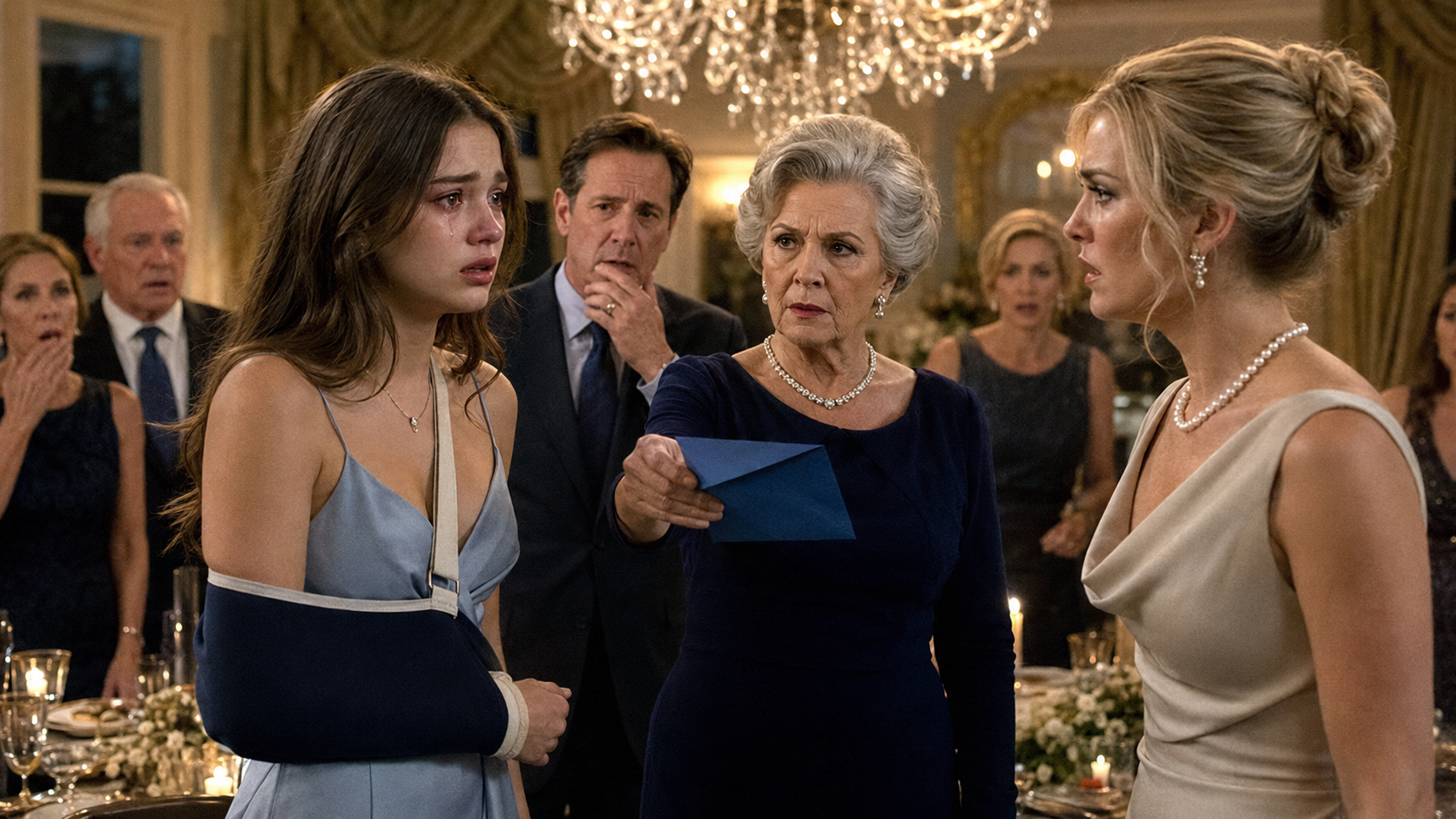
My Father’s Bride Thought She Could Erase My Mother — Then Grandma Opened the Blue Envelope and Stopped the Wedding Cold

The first time I saw my father’s fiancée wearing my mother’s pearls, I thought grief had finally made me hallucinate.

They were not ordinary pearls.

My mother, Marian Bell, had worn them only twice in my lifetime — once at my parents’ twentieth anniversary dinner, and once in the hospital chapel three days before she died, when she asked the nurse to help her sit up because she wanted to look “like herself” for one last family photo.

The pearls had been hers before she was a wife, before she was a mother, before cancer folded her body into something small and breakable. Her own mother had given them to her when she turned eighteen, along with a note that said, Never wear anything that makes you feel smaller than you are.

After the funeral, the pearls disappeared.

My father said they were probably packed away somewhere.

My grandmother said nothing.

I believed him because back then I still wanted to.

Then, eleven months later, at my father’s engagement dinner, his fiancée walked into our dining room wearing them around her throat like a trophy.

Her name was Serena Vale.

She was thirty-eight, polished, blonde, and always dressed as if a camera might appear from behind a curtain. She smiled with her lips but never her eyes. She called me “sweet girl” in front of guests and “dramatic” when we were alone.

She had been my mother’s friend.

Not best friend. Not family. Just one of those women who brought casseroles during chemo, hugged too long at the funeral, and somehow never left.

By Christmas she was helping my father decorate the house.

By February she was staying for breakfast.

By May she had moved into my mother’s bedroom.

And by June, she was standing beneath the chandelier my mother picked out, wearing my mother’s pearls, preparing to announce a wedding date.

I sat at the far end of the dining table with my right arm in a sling and my ankle wrapped tight under my chair. A car accident two weeks earlier had left me bruised, stitched, and slow. Serena had still made me help with the dinner.

“Lila knows the house better than anyone,” she had said that morning, handing me a list while I stood on crutches in the hallway. “She can manage the seating cards.”

My father, Nathan Bell, had looked up from his phone.

He had seen the sling. Seen the crutches. Seen my face.

Then he had looked back down.

That was the moment I understood something ugly.

He was not missing what was happening.

He was allowing it.

The house was full of people by seven o’clock. Serena’s friends from the country club. My father’s business partners. A pastor with kind eyes and a nervous smile. Neighbors who had cried beside us at my mother’s memorial and were now sipping champagne under her roof as if eleven months was a respectful amount of time to replace a dead woman.

Grandma Ruth arrived last.

She did not come in through the front door like everyone else.

She came through the kitchen, the way she always had when my mother was alive, carrying a small blue envelope and an old leather handbag.

At seventy-six, my grandmother was tiny enough to disappear in a crowd, but she had the kind of quiet that made people lower their voices. She wore a navy dress, flat shoes, and the silver brooch my mother had given her the first year she made real money as a nurse.

When she entered the dining room, Serena was laughing too loudly beside my father.

Then Grandma saw the pearls.

The room did not change.

But Grandma did.

Her face went still in a way I had only seen once before — at the funeral, when my father tried to speak about loyalty and love while Serena cried harder than I did in the second row.

Grandma’s eyes moved from the pearls to my father.

Then to me.

I looked away.

Not because I was ashamed.

Because if she looked at me too kindly, I would break open in front of everyone.

Serena noticed her first.

“Ruth,” she said brightly, touching the pearls as if she wanted them noticed. “I’m so glad you came.”

Grandma did not smile.

“I wasn’t invited.”

The room quieted by half a degree.

Serena’s smile tightened.

“Oh, that must have been a mistake.”

“No,” Grandma said. “It wasn’t.”

My father stepped in quickly. “Mom, please. Not tonight.”

Grandma looked at him for a long moment.

“Not tonight,” she repeated softly. “That has been your favorite sentence for almost a year.”

A few guests exchanged glances.

Serena gave a small laugh, the delicate kind meant to make another person look rude.

“We’re all emotional,” she said. “This is a big step for the family.”

I wanted to ask what family she meant.

Instead, I stared at the seating chart I had made with my left hand, because my right arm still hurt too badly to hold a pen. Serena had crossed out my mother’s sister from the guest list that afternoon.

“She makes everything gloomy,” Serena had whispered.

My mother’s sister.

At my mother’s table.

In my mother’s house.

Grandma Ruth walked toward me first.

She touched my shoulder gently.

“Are you in pain?”

I nodded once.

My father finally looked at me.

“Lila said she was fine.”

I laughed before I could stop myself.

It came out sharp and small.

Serena’s eyes flicked toward me.

“Sweetheart, you insisted on helping.”

I lifted my head.

“No. You said if I really wanted this family to heal, I’d stop acting like a guest in my own home.”

The room became quiet enough that I could hear ice melting in someone’s glass.

My father’s jaw tightened.

“Lila.”

There it was.

The warning voice.

The same voice he used when I was eight and spilled juice on legal papers. The same voice he used when I was fifteen and came home late. The same voice he had used after Mom died whenever I cried too loudly, asked too many questions, or said Serena’s name with too much truth in it.

But I was nineteen now.

My mother was dead.

And my father’s warning voice no longer scared me as much as his silence did.

Serena stepped forward.

“I think this is grief talking.”

Grandma Ruth turned to her.

“No, Serena. Grief is honest. This is what happens when everyone else has been lying.”

My father moved quickly then, coming around the table with his palms open.

“Mom, enough. We are not doing this here.”

Grandma’s hand went into her handbag.

“I agree.”

For one strange second, relief crossed my father’s face.

Then Grandma took out the blue envelope.

“We should have done it months ago.”

Serena stopped touching the pearls.

My father’s eyes dropped to the envelope.

Something changed in his face.

Not confusion.

Recognition.

Fear.

Grandma held the envelope against her chest.

“Marian gave this to me eight days before she died.”

The air left the room.

My fingers curled around the edge of the table.

My mother’s name had become something people handled carefully, like antique glass. Serena avoided it unless she wanted sympathy. My father only said it when he needed to sound wounded. But Grandma said it like my mother was still standing somewhere nearby, listening.

Serena swallowed.

“Ruth, Marian was very sick near the end.”

“She was dying,” Grandma said. “She was not blind.”

My father’s voice dropped.

“Don’t.”

Grandma looked at him.

“You should have thought about that before you gave another woman your wife’s pearls.”

The pastor lowered his eyes.

A woman near the fireplace whispered, “Oh my God.”

Serena’s hand flew to her necklace.

“These were a gift.”

“No,” Grandma said. “They were stolen.”

My father snapped, “That is a disgusting accusation.”

Grandma opened the envelope.

Her fingers did not tremble.

Mine did.

Inside was a folded letter on pale blue paper.

My mother’s paper.

She had used that stationery for thank-you notes, birthday letters, grocery lists when she felt fancy. The sight of it hit me harder than I expected. Suddenly I was ten years old again, watching her write my name on a lunch bag with a purple pen. Suddenly I was seventeen, sitting beside her hospital bed while she wrote slowly because her hands had begun to shake.

Grandma unfolded the letter.

“My darling Lila,” she read.

My lungs forgot how to work.

Across the room, my father shut his eyes.

Serena stared at the pearls in her own hand as if they had turned hot.

Grandma continued.

“If this letter is being read aloud, it means the thing I feared has happened. It means your father has tried to move forward so quickly that people have mistaken his speed for healing. It means Serena is still standing close enough to my life to pretend she was invited into it.”

Serena made a broken sound.

“That’s cruel.”

Grandma did not look up.

“I have known for months that something was wrong. I knew when your father stopped coming home on time. I knew when Serena began answering questions before I asked them. I knew when she touched my things like she was practicing.”

The guests were frozen.

Not polite frozen.

Trapped frozen.

My father gripped the back of a chair.

“She was paranoid. The medication—”

Grandma lowered the letter.

“She wrote this before the stronger medication started.”

He said nothing.

That silence said more than any confession.

Grandma looked back at the page.

“Lila, I am sorry. Not because I am leaving you. I fought to stay. I am sorry because I saw what they were doing, and I still hoped love would shame them into stopping.”

Something inside me cracked.

I had spent eleven months wondering if I was cruel for hating Serena.

Wondering if grief had made me unfair.

Wondering if my father was just lonely.

Wondering if I was the problem because I could not clap for the woman who had moved into my mother’s life before the sheets were cold.

But my mother had seen it too.

She had seen everything.

Grandma read on.

“If Serena is wearing my pearls, remove them. They were never meant for her. They belong to my daughter. They belong to the woman who will remember me honestly, not conveniently.”

Serena stepped back.

“No.”

Grandma lifted her eyes.

“Take them off.”

My father moved beside Serena.

“Mom, you have no right.”

Grandma reached into her handbag again and pulled out a small velvet pouch.

“I have every right.”

She opened it.

Inside was a receipt.

Then another.

Then a photograph.

She held the photograph up for the room to see.

It showed Serena in my mother’s bedroom, standing in front of the mirror, wearing the pearls and one of my mother’s silk robes.

The date stamped in the corner was three weeks after the funeral.

The room gasped.

Serena’s face emptied.

“That was private.”

My voice came before I planned it.

“In my mother’s bedroom?”

Everyone turned.

My father’s eyes flashed.

For once, I did not stop.

“You wore her robe?”

Serena blinked quickly, forcing tears.

“I was grieving too.”

I stared at her.

“You grieved by dressing up as her?”

A man near the doorway muttered something under his breath.

Serena’s tears sharpened into anger.

“You have no idea what it was like. Your father was alone. This house was drowning. Someone had to help him survive.”

I looked at my father.

“And Mom? Did you help her survive too?”

His face went pale.

“Lila, you’re upset.”

“No,” I said. “I’m finally not.”

Grandma’s mouth tightened with pride so small only I could see it.

Then she turned the page.

“There is more.”

Serena shook her head.

“No. This is enough.”

Grandma’s voice cut through the room.

“You don’t get to decide what is enough in Marian’s house.”

My father finally lost control.

“This is my house.”

Grandma looked at him with something colder than anger.

“No, Nathan. It isn’t.”

For a moment, nobody moved.

Even I did not understand.

My father gave a short laugh.

“What are you talking about?”

Grandma reached into the blue envelope and removed a second document. Thicker paper. Legal print. A notary seal at the bottom.

My father recognized the paper before I did.

His face changed.

Serena saw his face and grabbed his arm.

“Nathan?”

Grandma read calmly.

“Six weeks before her death, Marian amended the Bell Family Trust. The house, including all contents purchased or inherited by Marian Bell before and during the marriage, transfers to Lila Bell upon her twentieth birthday.”

My ears rang.

My twentieth birthday was in four months.

My father shook his head.

“No. That’s impossible.”

Grandma continued.

“Until that date, Nathan Bell may remain in the residence only as guardian and caretaker, provided the home remains Lila Bell’s primary residence and provided no unrelated adult partner or spouse claims residence, control, or ownership of the property.”

Serena’s hand dropped from the pearls.

The words landed one at a time.

No unrelated adult partner.

No spouse.

No control.

No ownership.

My father whispered, “She wouldn’t do that to me.”

Grandma looked at him.

“She did it for her daughter.”

I pressed my hand to my mouth.

All those months I had thought my mother left me.

But she had been protecting me from a bed she knew she would never leave.

Serena turned to my father, her voice low and vicious now.

“You told me this house was yours.”

He did not answer.

“You told me we could live here.”

Still nothing.

“You told me after the wedding—”

Grandma’s eyes narrowed.

“After the wedding what?”

Serena closed her mouth.

Too late.

Grandma unfolded another page.

“She also left instructions,” she said.

My father’s voice cracked.

“Mom.”

Grandma ignored him.

“Any attempt by Nathan Bell to transfer, sell, refinance, remodel, dispose of personal family property, or use the home as marital property will terminate his right to remain in the residence immediately.”

Serena stared at the walls.

The dining room walls my mother had painted sage green because she said white rooms made people lie.

The chandelier my mother found at an estate sale.

The old piano by the window.

The china cabinet.

The framed photos Serena had slowly removed and replaced with flower arrangements.

None of it was hers.

None of it was my father’s to give.

Grandma put the document down.

“And because Serena has been living here since May, Nathan is already in violation.”

My father shouted then.

Not loudly enough to scare Grandma.

But loudly enough to show everyone who he became when shame stopped working.

“She was helping me!”

Grandma’s face hardened.

“She was measuring curtains.”

Serena’s cheeks flushed.

My father looked around the room as if searching for someone to rescue him.

No one moved.

His business partner stared at the floor.

The pastor closed his Bible.

Serena’s friends looked at their shoes.

People always enjoy a scandal until they realize they are standing inside one.

Then Grandma took out the final paper.

“This is from Marian’s attorney.”

My father sat down.

He did not choose to sit.

His legs simply stopped holding him.

Grandma read, “Upon confirmation of unauthorized residence by Serena Vale, formal notice will be issued requiring her removal from the property within fourteen days. Any family heirlooms, jewelry, documents, clothing, or personal items belonging to Marian Bell must be returned immediately.”

Serena’s hand went to the pearls again.

Grandma extended her palm.

“Now.”

Serena looked at my father.

He stared at the table.

That was the first time she saw what I had learned months ago.

My father loved comfort more than courage.

Serena unclasped the pearls with shaking hands.

For a second, I thought she might throw them.

But too many people were watching.

She placed them in Grandma’s hand.

Grandma walked to me.

Slowly.

Carefully.

As if carrying something sacred.

Then she lowered the pearls into my lap.

“They were always yours,” she said.

I touched them with my good hand.

They were still warm from Serena’s skin, and that almost made me sick.

But beneath that warmth was something else.

Weight.

History.

My mother.

Serena’s voice broke behind us.

“You’re all acting like I’m some monster. I loved him. I loved this family.”

I turned.

For the first time all night, I looked at her without fear.

“No. You loved the empty space my mother left.”

She flinched.

Good.

I kept going.

“You loved her bedroom. Her jewelry. Her husband. Her table. Her house. You loved how easy it would be to step into a life already built.”

My father stood.

“Lila, stop.”

I looked at him.

“You first.”

The words surprised him.

They surprised me too.

But once they were out, I could feel my mother in them.

Not soft.

Not sweet.

Strong.

“You stopped being my father the day you let her treat me like an inconvenience in my own home.”

His face crumpled.

“Don’t say that.”

“You let her throw away Mom’s clothes.”

“I didn’t know—”

“You knew.”

He swallowed.

“You let her take Mom’s room.”

“I was lonely.”

“So was I.”

That silenced him.

Not because it healed anything.

Because he had no excuse for it.

I pointed to my sling.

“You let me sit here tonight writing place cards with a fractured wrist because she wanted everything perfect.”

Serena whispered, “I didn’t know it was fractured.”

I looked at her.

“You drove me to the appointment.”

Her mouth opened.

Closed.

Somewhere near the fireplace, a woman picked up her purse.

Then another.

The dinner began falling apart quietly. Chairs scraped. Glasses were set down. No one wanted dessert. No one wanted champagne. No one wanted to be photographed at the celebration anymore.

The pastor approached Grandma.

“I’m sorry,” he said softly.

Grandma nodded once.

“You should be. But not as sorry as they are going to be.”

Serena turned on him.

“Don’t leave.”

But he already had.

One by one, people walked out through the foyer beneath my mother’s framed family photographs.

By the time the last car door closed outside, the house felt larger than it had in months.

Serena stood near the table, still dressed like a bride at a party that had turned into a trial.

My father rubbed both hands over his face.

Grandma gathered the papers and placed them back into the blue envelope.

“You need to pack,” she told Serena.

Serena laughed once.

A hard, ugly sound.

“You can’t just throw me out.”

Grandma looked at my father.

“No. But he can ask you to leave tonight, or Marian’s attorney can begin formal action tomorrow morning.”

Serena stared at him.

“Nathan?”

He looked at her then.

I could see him calculating.

Love.

Money.

House.

Reputation.

Future.

He chose exactly what I expected him to choose.

“Maybe you should stay at the hotel for a few days,” he said.

Serena’s face changed so completely that for one second I almost felt sorry for her.

Almost.

“You coward,” she whispered.

He said nothing.

She ripped the engagement ring off her finger and threw it at him.

It bounced against the table, rolled once, and stopped beside the seating chart I had made.

Then she looked at me.

All the sweetness was gone now.

“You think you won.”

I lifted the pearls from my lap.

“No,” I said. “I think my mother did.”

Serena left without her coat.

The front door slammed so hard the window beside it rattled.

For a long time, no one spoke.

My father bent down and picked up the ring.

He looked older than he had that morning.

Not sad.

Exposed.

“Lila,” he said quietly.

I did not answer.

He stepped toward me.

Grandma moved between us.

It was such a small movement.

But my father stopped.

That hurt him.

I was glad.

Then I hated myself for being glad.

Then I decided I could be glad for one night.

“You should go upstairs,” Grandma told him.

He looked at her like a child.

“Mom.”

“No,” she said. “You do not get to be the son tonight. You do not get comfort from the mother of the woman you betrayed.”

His face twisted.

“I made mistakes.”

Grandma’s voice was calm.

“No. You made choices and called them mistakes when they became expensive.”

He looked at me.

“I loved your mother.”

I held the pearls tighter.

“Maybe. But you didn’t honor her.”

That was the last thing I said to him that night.

He went upstairs alone.

Grandma helped me stand.

My ankle screamed when I put weight on it, but I did not cry this time. She brought my crutches, held my elbow, and guided me into the living room.

The room looked strange.

Serena had removed the old family quilt from the couch weeks ago and replaced it with white pillows no one was allowed to touch. She had hidden my mother’s books in storage baskets. She had put away the photo of Mom laughing with flour on her cheek from the year we tried to bake bread and failed spectacularly.

Grandma noticed too.

Without saying a word, she walked to the storage cabinet and opened it.

Inside were my mother’s books.

Her gardening journal.

A framed photo from my eighth-grade graduation.

A ceramic bowl I had made in school, ugly and lopsided, with Mom painted across the side in purple.

Grandma took out the bowl and placed it on the coffee table.

Then the photo.

Then the books.

One by one, she returned my mother to the room.

I sat on the couch, holding the pearls, watching the house breathe again.

Finally, Grandma sat beside me.

“I should have read it sooner,” she said.

I shook my head.

“You were waiting for him to do the right thing.”

She looked at the doorway where my father had disappeared.

“Yes.”

“Mom was too.”

Grandma’s eyes filled.

“She loved him.”

“I know.”

“That was the tragedy.”

I leaned into her shoulder like I was little again.

For the first time in almost a year, the house did not feel haunted by what was missing.

It felt guarded by what remained.

The next morning, Serena sent twelve messages.

Then twenty.

Then an email.

Then a long post online about betrayal, grief, and being “punished for loving a broken family.”

Grandma printed it out, marked three false statements in red pen, and sent it to Marian’s attorney.

The post disappeared by noon.

By the end of the week, movers came for Serena’s things.

There were fewer boxes than I expected.

That was because most of what she had used was never hers.

My mother’s robes stayed.

My mother’s books stayed.

My mother’s china stayed.

The pearls stayed with me.

My father stayed too, but not in the way he had before. He moved into the guest room. He stopped using the master bedroom after Grandma told him Marian’s attorney had documented everything.

For weeks, he tried to talk.

I was not ready.

Maybe someday I would be.

Maybe not.

Forgiveness, I learned, is not a bill other people get to hand you because they are tired of owing.

On my twentieth birthday, the house legally became mine.

Grandma brought a cake from the bakery my mother loved. My aunt came. Two neighbors came. The pastor sent flowers and a handwritten apology. My father stood awkwardly in the kitchen, looking like a guest in the home he once tried to give away.

When it was time to blow out the candles, Grandma placed the blue envelope beside me.

“There’s one more thing,” she said.

My father looked up.

So did I.

Grandma smiled gently.

“This part was only for Lila.”

My hands shook as I opened it.

Inside was a smaller note.

My mother’s handwriting again.

Not legal.

Not angry.

Just hers.

My brave girl,

If you are reading this, then you made it through the hardest part. I am sorry I could not stand beside you in the room where the truth came out. But I need you to know something: protecting you was the last great work of my life. Not because you are weak. Because you were mine.

Do not let bitterness build a second grave inside you. Let people earn their way back slowly, if they can. Let others leave forever, if they must. But never confuse keeping peace with keeping quiet.

This house is not a prize. It is a place to become yourself.

Fill it with people who say your name kindly.

Wear the pearls when you need to remember that you come from women who survived more than anyone saw.

And when someone tries to replace me, do not fight for my place.

No one can take it.

I read the last line three times.

Then I cried.

Not the quiet kind of crying I had learned to do in bathrooms and stairwells.

Real crying.

The kind that bent me forward.

Grandma held me.

My aunt cried too.

Even my father turned away and covered his mouth.

But this time, no one told me to stop.

No one said I was ruining the mood.

No one called it grief talking.

They let me cry in my mother’s house, under my mother’s roof, with my mother’s pearls in my hand.

And when I finally stood, I walked to the living room mirror.

My ankle had healed by then.

My arm had too.

The scars were still there, faint but visible.

I fastened the pearls around my own neck.

For a second, I saw her.

Not as a ghost.

Not as a memory.

As a woman who had known exactly what love was worth, and exactly what betrayal cost.

My father came to the doorway.

He did not step inside.

“Lila,” he said quietly. “You look like her.”

I touched the pearls.

“No,” I said.

Then I smiled, because for the first time it did not hurt to say it.

“I look like me.”

My Father’s Bride Thought She Could Erase My Mother — Then Grandma Opened the Blue Envelope and Stopped the Wedding Cold
I gave an elderly man a lift on a deserted winter road — and later found out who he really was.