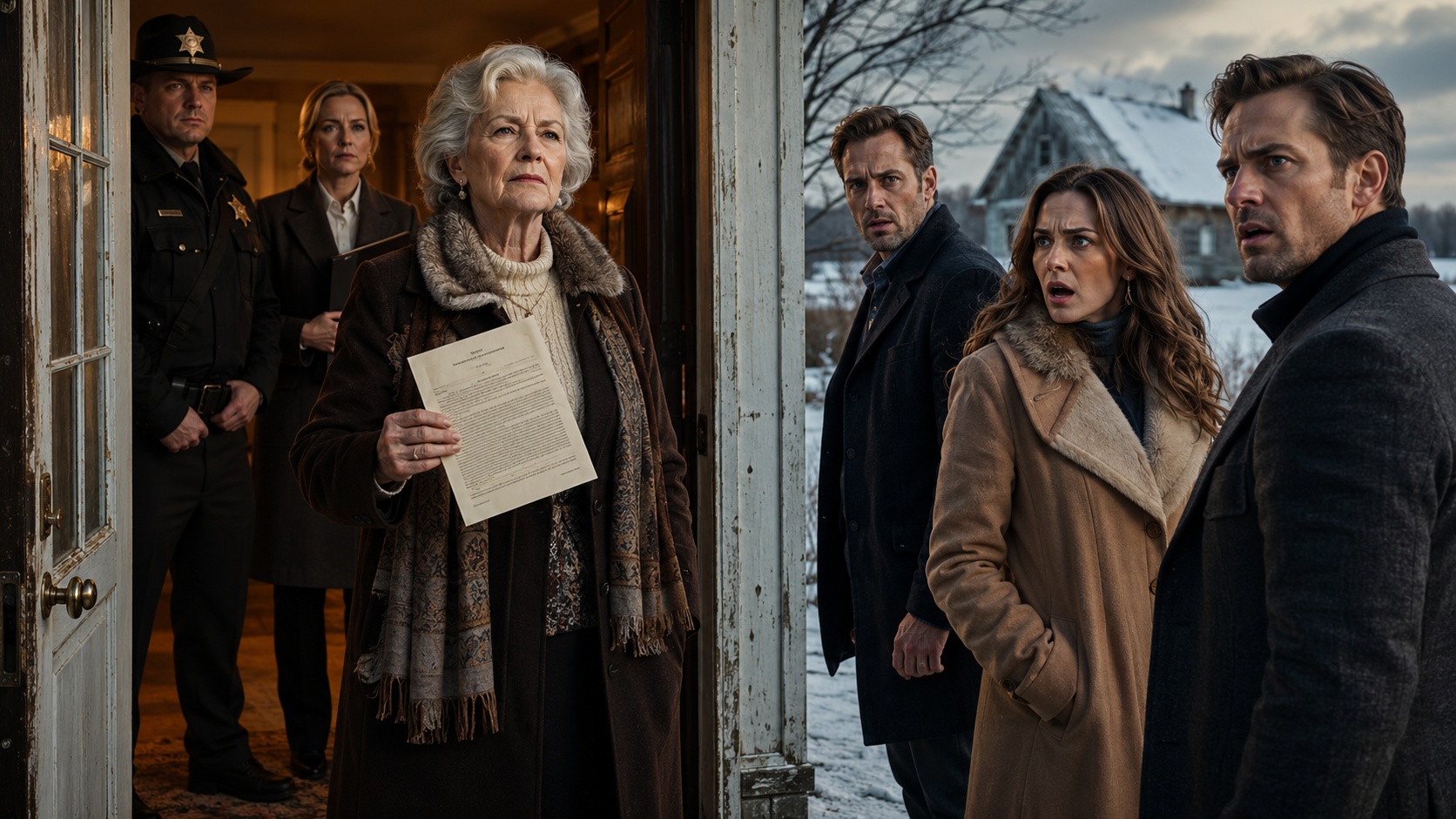
The first mistake her children made was assuming silence meant weakness.
For almost two years, Eleanor Graves had listened.
She had listened when her oldest son, Derek, explained that the land was “too much responsibility” for a woman her age.
She had listened when her daughter, Natalie, called the farm “dead money,” as if the soil beneath their childhood feet had not paid for their braces, their college books, their first cars, and the funeral flowers they had placed on their father’s grave.
She had listened when her youngest, Owen, said, “Mom, we’re only trying to protect you,” in that careful, soft voice people used when they were already reaching for something that did not belong to them.
And each time, Eleanor had nodded.
Not because she agreed.
Because she was learning.
A woman who has spent seventy-one years surviving winter storms, hospital bills, bad harvests, grief, and the slow cruelty of being forgotten by the people she raised does not always announce when she has changed.
Sometimes she just grows very quiet.
And while everyone mistakes that quiet for surrender, she starts collecting proof.
That morning, the snow came down in clean white sheets over Briar Hill Road, softening the fences and burying the tire tracks that led to the old farmhouse. The maple trees behind the barn stood bare and black against the pale sky. The pond was frozen at the edges. The porch swing, the one Eleanor’s husband had built by hand the summer before his diagnosis, moved slightly in the wind.
Inside, the house smelled of woodsmoke, coffee, and lemon polish.
Eleanor had cleaned everything before they came.
Not because she cared what they thought.
Because her husband had always said, “If trouble is coming through your front door, meet it standing in a clean house.”
So she had swept the hallway, polished the dining table, lit the fireplace, and placed three chairs across from her own.
Then she had made coffee for herself only.
At 10:03 a.m., the first black SUV turned into the driveway.
Derek.
Of course Derek came first.
He had always liked arriving before everyone else so he could decide what the room was supposed to feel like.
He parked too close to the porch, stepped out in a charcoal wool coat, and adjusted his leather gloves before looking at the house. He did not look at the barn. Did not look at the fields. Did not look toward the old oak where his father had once hung a rope swing for him.
Derek only looked at the windows.
Like a man checking whether the valuables were still inside.
At 10:06, Natalie arrived in her white Mercedes, tires slipping slightly on the icy gravel. She stepped out with sunglasses on despite the gray sky, her phone pressed against her ear, her face tight with annoyance.
At 10:09, Owen pulled in last.
He sat in his truck for almost a full minute before opening the door.
Eleanor watched from behind the lace curtain.
Her youngest looked pale.
That almost hurt her.
Almost.
Then she remembered the email.
The one where Owen had written, Maybe if we tell her Dad wanted this, she’ll stop fighting.
And whatever tenderness had started to rise in her chest went cold again.
Three children walked toward the porch.
Three adults who had once fit in her arms.
Three people who had forgotten she was their mother until they needed her signature.
Derek knocked once and opened the door without waiting.
“Mom?” he called, stepping into the hallway.
That was another thing Eleanor had noticed.
People who believed they owned you never waited to be invited in.
Natalie came behind him, shaking snow off her boots onto the rug Eleanor had braided herself twenty-five years ago.
“Honestly, this driveway is dangerous,” Natalie muttered. “You can’t keep living like this.”
Owen closed the door gently.
He at least still remembered how.
Eleanor stood in the doorway to the sitting room wearing a navy dress, her silver hair pinned neatly at the back of her head. She had put on her pearl earrings that morning. Not for beauty. For armor.
Derek stopped when he saw her.
For half a second, his face changed.
Not with love.
With surprise.
He had expected a tired old woman in a sweater, maybe confused, maybe emotional, maybe easy to push.
He had not expected his mother to look ready.
“Mom,” he said slowly. “Why are you dressed like that?”
Eleanor smiled.
“Because I’m receiving guests.”
Natalie gave a sharp laugh. “Guests? We’re your children.”
“Yes,” Eleanor said. “That is what makes this so sad.”
The hallway went quiet.
Owen looked at the floor.
Derek’s jaw tightened. “We came to help you. You disappeared for four days, you stopped answering calls, and you refused to meet with Mr. Harlan from the development office.”
“Mr. Harlan,” Eleanor repeated. “The man offering one and a half million dollars for land he has never planted, walked, repaired, buried a dog on, or paid taxes on.”
Natalie removed her sunglasses.
“Mom, please don’t start with the poetry.”
“It isn’t poetry,” Eleanor said. “It’s ownership.”
Derek sighed, already tired of a conversation he had not yet won.
“We are not doing this in the hallway.”
“No,” Eleanor said. “We’re doing it in the sitting room.”
She stepped aside.
Derek moved first, as always.
Natalie followed, irritated.
Owen came last.
And then all three of them stopped.
Sheriff Jonah Price stood beside the fireplace.
Attorney Vivian Crowe sat at the dining table with a leather folder in front of her.
And near the bookshelf, quietly adjusting a small recording camera, was a licensed court videographer named Paige Miller.
Derek’s face changed so quickly Eleanor almost admired it.
Command became caution.
Anger became calculation.
Natalie froze with one hand still wrapped around the strap of her purse.
Owen whispered, “Mom… what is this?”
Eleanor walked to her chair.
Her husband’s chair, really.
The worn brown leather one beside the fireplace. For years after Henry died, she had avoided sitting in it because it felt like stealing his place.
That morning, she sat in it because she finally understood.
He had left that place for her.
Not as a shrine.
As a reminder.
The head of the house was not whoever spoke the loudest.
It was whoever protected it.
Derek pointed at the camera. “Turn that off.”
“No,” Eleanor said.
“Mother, I’m serious.”
“So am I.”
Natalie looked at the sheriff. “Is this necessary?”
Sheriff Price’s face gave away nothing.
“That depends on what you came here to do.”
“We came to talk to our mother,” Derek snapped.
Attorney Crowe opened her folder.
“Then you won’t mind witnesses.”
Derek looked at her with open contempt. “And you are?”
“Vivian Crowe. Elder law attorney. Estate counsel for Mrs. Graves.”
Natalie’s eyes narrowed. “Since when does my mother need an elder law attorney?”
Eleanor folded her hands in her lap.
“Since my children started acting like I needed protection from everyone except them.”
A small sound escaped Owen.
Derek turned on him. “Don’t.”
One word.
One warning.
Eleanor heard it.
So did the sheriff.
So did the camera.
Derek inhaled, then forced his expression into something softer.
“Mom. This has clearly gotten out of hand. We were worried. You haven’t been yourself.”
There it was.
The sentence they had rehearsed.
You haven’t been yourself.
Such a convenient phrase.
It could mean anything.
You are tired.
You are grieving.
You are old.
You are difficult.
You are not obeying.
Eleanor looked at the three of them and remembered smaller versions of their faces.
Derek at seven, furious because his kite had torn.
Natalie at nine, demanding to wear church shoes into the muddy field.
Owen at five, curled against Eleanor’s side during a thunderstorm, asking if the sky was angry.
She had loved them through fevers, failures, tantrums, heartbreaks, and debts.
She had loved them when love cost sleep, money, youth, and patience.
And somehow, after all that, they had mistaken being loved for being owed.
“You’re right,” Eleanor said. “I have not been myself.”
Natalie’s shoulders relaxed a little, thinking she had found an opening.
Eleanor continued.
“For the last few years, I was lonelier than I admitted. Softer than I should have been. More willing to excuse cruelty if it came wrapped in the word family.”
Derek’s eyes hardened again.
“But I am myself today.”
No one spoke.
The fire cracked sharply in the hearth.
Attorney Crowe removed the first document from the folder and placed it on the table.
Derek glanced at it, then away.
Too fast.
Eleanor noticed.
She had become very good at noticing.
“This meeting is being recorded,” Attorney Crowe said, “because Mrs. Graves has been pressured repeatedly to sign a transfer agreement involving her property on Briar Hill Road, including the farmhouse, barn, and forty-three acres of surrounding land.”
Natalie sat down without being invited.
“That property is a burden. We’ve explained this.”
“You’ve explained what it is worth,” Eleanor said. “Not what it means.”
Derek remained standing. He liked height. It helped him feel right.
“Mom, this is exactly the problem. You’re thinking emotionally. This land is valued at one point five million dollars. You cannot maintain it alone. The taxes are rising. The developer’s offer expires soon.”
“No,” Attorney Crowe said calmly. “The offer does not expire soon. That was false.”
Derek turned his head slowly.
“What?”
Attorney Crowe slid a printed email across the table.
“HarborStone Development confirmed in writing that the offer has no deadline. Your statement to Mrs. Graves that she had forty-eight hours to sign was inaccurate.”
Natalie’s mouth tightened. “Maybe Derek misunderstood.”
Eleanor looked at her daughter.
“You used the word emergency.”
Natalie lifted her chin.
“Because it felt like one. You were being stubborn.”
“Stubborn,” Eleanor repeated.
She let the word sit there.
There was a time it would have hurt her. Mothers are trained to fear becoming burdens, trained to shrink every need down to something polite. Stubborn was what people called older women when they did not move quickly enough out of the way.
But that morning, the word landed on the floor and died there.
Eleanor turned to Owen.
“And you said your father would be ashamed of me.”
Owen closed his eyes.
Derek said, “We are not here to rehash every emotional comment.”
“No,” Eleanor said. “We’re here because you tried to steal my land.”
The room went still.
Natalie stood. “That is disgusting.”
Sheriff Price shifted one step away from the fireplace.
Not toward Natalie.
Just enough to remind everyone he was there.
Natalie noticed and sat down again.
Derek laughed once.
It sounded thin.
“Steal? Mom, listen to yourself. We’re your children. This land will come to us eventually. All we did was try to help you make a smart decision before taxes and medical expenses eat everything.”
Eleanor reached into a small wooden box on the side table.
Henry had made that box in 1988.
Walnut, hand-sanded, with a brass latch that had darkened with age.
For years, it held receipts, old photographs, folded letters, and the tiny hospital bracelets from each child’s birth.
Now it held evidence.
She removed the first paper.
“Fourteen thousand dollars,” she said.
Derek frowned. “What is that?”
“The amount I gave you for Elise’s surgery.”
His expression flickered.
Natalie looked at him.
Owen opened his eyes.
Eleanor placed the bank record on the coffee table.
“Elise never had surgery. I called her.”
Derek’s face went flat.
“She had a private medical situation. You had no right—”
“She said she didn’t know what I was talking about,” Eleanor said. “She also said she thought you had borrowed money from me for your office renovation.”
Natalie’s eyes moved from Derek to the paper.
Derek did not look at her.
Eleanor placed another document down.
“Twenty-two thousand dollars. Natalie’s emergency mortgage payment.”
Natalie’s cheeks flushed instantly.
“That was a very complicated time in my life.”
“It was also a lie.”
Natalie’s mouth opened.
Eleanor kept going.
“You told me the bank was days away from taking your home. There was no foreclosure notice. No missed mortgage payment. But there was a payment to a luxury travel company three days later.”
Natalie stood again.
“You investigated me?”
Eleanor looked at her daughter for a long, painful second.
“No. You involved me.”
That stopped her.
Because it was true.
Every lie had been dragged to Eleanor’s kitchen table, wrapped in tears, guilt, urgency, and the kind of pressure only children know how to place on a mother.
Eleanor turned to Owen.
He already looked ashamed.
That almost made it worse.
Because shame without action is just another form of selfishness.
“Thirty-seven thousand dollars,” she said softly. “For your business tax problem.”
Owen swallowed.
“I was going to pay you back.”
“When?”
He said nothing.
Eleanor placed the page on the table.
“You told me you were about to lose everything. But the tax notice was from three years earlier and had already been settled. The money went to a boat.”
Owen looked like a man folding inward.
“It wasn’t like that.”
“No,” Eleanor said. “It was exactly like that.”
Derek slapped his hand against the back of a chair.
“Enough. You dragged us here to shame us? Fine. We’ve all borrowed money. Families help each other. That doesn’t change the fact that you are sitting on land you can’t manage and refusing to make a rational decision.”
Attorney Crowe spoke before Eleanor could.
“Borrowing money under false pretenses may be relevant. But it is not the central issue.”
She removed another document.
This one had a notary stamp.
Owen saw it first.
His face turned gray.
Natalie whispered, “Derek…”
Derek stared at the paper.
Eleanor watched him understand that the room had been built before he arrived.
Every chair.
Every witness.
Every page.
All of it waiting for him.
Attorney Crowe placed the document in the center of the table.
“This is the transfer authorization submitted to North County Title Services nine days ago. It authorizes the sale of Mrs. Graves’s property and lists Derek Graves as financial representative.”
Sheriff Price looked at Derek.
Derek did not blink.
Eleanor’s voice remained calm.
“That is my signature at the bottom.”
Natalie whispered, “Mom—”
“But I did not sign it.”
The words fell quietly.
They did not need volume.
The fireplace popped.
Outside, the wind pressed snow against the window glass.
Derek looked at Attorney Crowe.
“This is a misunderstanding.”
Attorney Crowe nodded once.
“Good. Then you can explain why the signature was submitted electronically from your office IP address.”
Derek’s face lost color.
Natalie turned toward him fully now.
“Derek?”
He ignored her.
Attorney Crowe continued.
“And why the notary listed on the document has provided a sworn statement that she never witnessed Mrs. Graves sign anything.”
Owen covered his mouth with one hand.
Derek took a step back.
Eleanor had seen him afraid only a few times in his life.
Once when he was twelve and fell through the ice near the pond.
Once when his father collapsed in the barn.
Once at the funeral, when he realized grief could not be delegated.
This fear was different.
This was not fear of loss.
It was fear of consequence.
Derek looked at the sheriff.
“Are you accusing me of something?”
Sheriff Price’s voice was even.
“I’m listening.”
That was worse than an accusation.
It gave Derek space to ruin himself.
Natalie pointed at the document.
“I didn’t know about that.”
Eleanor looked at her.
“No?”
Natalie’s eyes widened. “No.”
Eleanor reached into the box again.
Natalie sat down slowly.
The next page was an email printout.
Eleanor did not read it immediately.
She let Natalie recognize the shape of her own words.
Then she spoke.
“Two weeks ago, you wrote to Derek: If Mom refuses, we may need to establish diminished capacity. Owen can handle the emotional part.”
Owen looked at Natalie as if she had struck him.
“You said I could handle the emotional part?”
Natalie’s face flushed. “That was taken out of context.”
Eleanor gave a small, tired smile.
“Everything cruel is taken out of context once someone reads it aloud.”
Attorney Crowe placed another paper beside it.
“This is a draft petition for guardianship prepared but not filed. It claims Mrs. Graves is confused, financially irresponsible, and vulnerable to outside influence.”
Eleanor leaned back in Henry’s chair.
“Outside influence,” she said. “That means anyone who told me I had the right to say no.”
Derek’s eyes moved rapidly now, searching for the weakest person in the room.
He chose Owen.
“Owen, tell her. Tell her we never meant to hurt her.”
Owen stared at him.
For the first time that morning, he did not obey.
Derek’s voice sharpened.
“Owen.”
Owen looked at his mother.
Eleanor could see the boy he had been, trapped inside the man who had learned to hide behind everyone else’s decisions.
“I’m sorry,” Owen whispered.
Derek exhaled with relief, thinking apology was the beginning of escape.
Then Owen said, “I knew parts of it.”
Natalie closed her eyes.
Derek turned slowly.
“What did you just say?”
Owen’s voice shook, but he kept going.
“I knew Derek was pushing too hard. I knew the deadline wasn’t real. I knew the capacity thing was wrong.”
Eleanor’s chest hurt.
Not because she was surprised.
Because hearing the truth still hurts, even when you have prepared for it.
“Why?” she asked.
Owen looked down.
“Because I owed him money.”
Derek snapped, “Shut up.”
Sheriff Price took one quiet step forward.
Derek stopped.
Owen wiped his face with both hands.
“I owed him money, and he said if the land sold, everything would be fixed. He said Mom would be fine. He said she’d get a condo near town, and we’d all visit more.”
Eleanor laughed softly.
It was not a happy sound.
“You would visit more after selling the only place where you could have visited me for free?”
No one answered.
Because some truths leave no room for defense.
Natalie tried again, but her voice had lost its sharpness.
“Mom, this is ugly, but it can still stay private.”
There it was.
The family’s favorite religion.
Privacy.
Keep the pain private.
Keep the lies private.
Keep the loneliness private.
Protect the family name, which usually meant protect the people who had harmed the family.
Eleanor looked toward the window.
Beyond the glass, the white fields stretched all the way to the tree line. In spring, wildflowers would come up near the fence. In summer, the grass would turn gold and high. In autumn, the maples would burn red behind the barn.
Henry had died in the upstairs bedroom, facing those fields.
Not because the hospital couldn’t keep him longer.
Because he wanted to see home at the end.
Derek wanted to call that land dead money.
Natalie wanted to call it a burden.
Owen wanted to call it a solution.
But Eleanor knew what it was.
It was witness.
It had watched her become a wife, mother, widow, and finally, herself again.
“No,” she said. “It will not stay private.”
Derek’s face tightened.
“You don’t want to do that.”
“I know exactly what I want.”
“No, you don’t. You’re angry.”
“Yes.”
He blinked.
Eleanor stood slowly.
At seventy-one, standing too fast made her hip ache. She stood anyway.
“I am angry because I earned the right to be angry. I am angry because every one of you learned how to sound loving while reaching into my pockets. I am angry because you used your father’s name like a crowbar. I am angry because you mistook my loneliness for stupidity.”
Owen began to cry silently.
Natalie stared at the table.
Derek’s face hardened again because guilt had never been a language he spoke fluently.
“You’re going to destroy your children over paperwork?”
Eleanor looked at the forged signature.
“No. You nearly destroyed your mother over land.”
That sentence did what no accusation had done.
It made Natalie flinch.
Attorney Crowe reached into her folder.
“There is still one remaining matter.”
Derek watched her hand.
He was no longer pretending not to be afraid.
Eleanor lifted a cream-colored envelope from the wooden box.
It was not thick.
It was not dramatic.
Just one envelope.
One document.
Four notarized pages.
A blue ribbon seal.
And the date from three days earlier.
Derek stared at it.
“What is that?”
Eleanor held it for a moment before answering.
She wanted to remember this second.
Not because she enjoyed their fear.
She did not.
That was the terrible part. Even now, part of her still wanted to save them from the consequences of being themselves.
But another part of her, the part Henry had loved most, knew that mercy without boundaries becomes permission.
She placed the document on the table.
“This is the deed restriction and irrevocable land trust agreement for Briar Hill Farm.”
Natalie frowned.
“What does that mean?”
Attorney Crowe answered.
“It means Mrs. Graves has transferred the land into a protected trust. It cannot be sold to HarborStone Development. It cannot be used as collateral for your debts. It cannot be transferred by power of attorney. It cannot be inherited by any beneficiary named in the prior will.”
The words moved through the room like a slow blade.
Derek stared at his mother.
“You did what?”
Eleanor’s voice did not tremble.
“I protected my home.”
Natalie’s face went white.
“You can’t just remove us from everything.”
“I did not remove you from everything,” Eleanor said.
Derek let out a bitter laugh.
“Oh? That’s generous.”
Eleanor looked at him.
“I removed you from anything that required trust.”
That silenced him.
Attorney Crowe continued.
“Upon Mrs. Graves’s death, the farmhouse will become the residence of the Briar Hill Senior Advocacy Foundation. The land will support housing, legal aid, and emergency relocation for elderly people facing financial abuse.”
Owen looked up.
“Foundation?”
Eleanor nodded.
“In your father’s name.”
Derek’s expression changed from fear to rage.
“Dad would never agree to this.”
For the first time that morning, Eleanor’s eyes flashed.
“You do not get to borrow your father’s voice to defend what you did.”
Derek stepped back as if she had slapped him.
She took one step toward him.
“Your father spent forty years building this place. He fixed fences with cracked hands. He drove tractors before sunrise. He came home so tired some nights that he fell asleep at the kitchen table. And do you know what he said to me the last winter he was alive?”
Derek said nothing.
Eleanor’s voice softened, but that made it stronger.
“He said, ‘Promise me you won’t let them turn this place into money before you are done living in it.’”
Natalie looked away.
Owen sobbed once.
Derek’s mouth tightened.
“You’re lying.”
Eleanor smiled sadly.
“I used to wish you were better at it.”
Attorney Crowe placed one more paper beside the trust agreement.
“This is also notice that Mrs. Graves has revoked all previous powers of attorney and medical authorizations naming any of you. She has executed new documents naming an independent fiduciary.”
Natalie gripped the edge of the table.
“An outsider?”
Eleanor looked at her daughter.
“A professional.”
“That’s cold.”
“No,” Eleanor said. “Cold is discussing how to prove your mother incompetent while asking what her land is worth.”
Natalie’s lips trembled.
For the first time, she looked less polished.
Less certain.
Almost young.
And because Eleanor was still a mother, part of her wanted to cross the room and hold her.
But then she remembered Natalie stepping over her loneliness year after year, calling only when there was a crisis, turning every holiday into a negotiation, every favor into an obligation.
Eleanor stayed where she was.
Derek pointed toward the document.
“I’ll contest it.”
Attorney Crowe did not blink.
“You can try.”
“I’ll say she was pressured.”
Sheriff Price looked at him.
“By whom?”
Derek’s jaw worked.
Attorney Crowe said, “The trust was executed after two independent capacity evaluations, one from a physician and one from a licensed geriatric psychologist. Both confirm Mrs. Graves is fully competent. The signing was witnessed, recorded, notarized, and filed.”
Derek’s face darkened.
“You planned all of this.”
Eleanor nodded.
“Yes.”
The honesty seemed to offend him more than the act.
“How long?”
“Long enough.”
Natalie whispered, “You let us come here knowing this was already done?”
Eleanor turned to her.
“You let me sit alone for five Christmases knowing I was waiting for you.”
That broke the air.
Even Derek had nothing for that.
Eleanor’s voice lowered.
“I waited with food going cold on the table. I waited with gifts wrapped for grandchildren who were told I was too tired for visitors. I waited after surgery when my neighbor cleaned my stitches because all three of you were busy. I waited every time one of you said, ‘We’ll come next weekend.’”
She looked at each of them.
“And then I stopped waiting.”
Owen bent forward, elbows on his knees, crying now like a boy.
“I’m sorry, Mom.”
This time, Eleanor believed he meant it.
But meaning it was not enough.
“I know,” she said.
He looked up hopefully.
“That does not erase it.”
His face collapsed.
Derek shook his head in disgust.
“This is unbelievable. You’re choosing strangers over your family.”
“No,” Eleanor said. “I’m choosing people who know what family has done to them.”
Natalie’s eyes filled despite herself.
“What about us?”
Eleanor looked at her daughter, and the years moved between them.
The first fever.
The first dance recital.
The slammed teenage doors.
The wedding dress fitting where Natalie had cried because Eleanor said she looked beautiful.
All of it real.
All of it still true.
That was the cruelest thing about betrayal.
It did not erase love.
It forced love to stand beside evidence.
“I hope you become better people,” Eleanor said.
Derek laughed coldly.
“That’s it?”
“No,” Sheriff Price said.
Everyone turned to him.
He held up a packet.
“Mrs. Graves has requested formal review of the forged transfer authorization, attempted financial exploitation, and related communications. I’ll need each of you to remain available for statements.”
Natalie looked terrified now.
“Are we being arrested?”
“Not at this moment,” the sheriff said.
Derek pointed at Eleanor.
“You would do that? To your own children?”
Eleanor took a slow breath.
For one second, she saw him at six again.
Jelly on his chin.
A bandage on his knee.
Asking if monsters were real.
She wished she could tell that boy no.
But the man standing in front of her already knew the answer.
“I am not doing this to my children,” she said. “I am doing this because of what my children did.”
Derek’s eyes shone, but not with grief.
With fury.
“You’ll regret this.”
Eleanor nodded once.
“I have regretted many things.”
She looked toward Henry’s empty chair, then back at her son.
“But not today.”
Derek grabbed his coat from the back of the chair.
Natalie rose unsteadily.
Owen remained seated, as if his legs had forgotten their purpose.
Derek turned at the doorway.
“You think this makes you strong?”
Eleanor met his eyes.
“No. Strength was raising you after your father worked double shifts. Strength was forgiving you when you forgot my birthday three years in a row. Strength was pretending I didn’t hear the disappointment in your voice every time I said no.”
She lifted the trust document from the table.
“This is not strength, Derek. This is the receipt.”
He left first.
The front door opened hard enough to shake snow from the porch roof.
Natalie followed, but stopped beside Eleanor.
For a moment, neither of them spoke.
Then Natalie whispered, “Were you really that lonely?”
Eleanor looked at her.
That question hurt more than the forged signature.
Because Natalie was asking after the damage had finally become visible.
“Yes,” Eleanor said.
Natalie covered her mouth.
“I didn’t know.”
Eleanor’s eyes softened.
“No. You didn’t ask.”
Natalie began to cry, but Eleanor did not move to comfort her.
Not because she enjoyed it.
Because some tears are not requests.
Some tears are consequences.
Natalie walked out after Derek.
Only Owen remained.
The sheriff stepped into the hallway to give them space, but not far. Attorney Crowe closed her folder quietly. Paige stopped the recording.
Owen sat in the chair across from his mother, shoulders shaking.
“I don’t know how I became this person,” he said.
Eleanor believed that too.
People rarely become cruel all at once.
They explain one small selfish thing.
Then another.
Then another.
One day they look up and call betrayal practical.
“You became this person,” she said gently, “because no one made you stop sooner.”
He cried harder.
“I can fix it.”
“Maybe.”
He looked up.
“Will you let me?”
Eleanor studied him.
Her youngest.
Her softest child.
Her most easily led child.
Also a grown man who had chosen comfort over conscience.
“I will not give you money,” she said.
He nodded quickly. “I don’t want money.”
“I will not change the trust.”
“I know.”
“I will not protect you from the legal consequences of what you helped do.”
His face twisted.
But he nodded.
Eleanor leaned back.
“If you want to fix something, start with the truth. Not with me. With yourself.”
Owen wiped his face with his sleeve like he had when he was little.
“I’m sorry, Mom.”
“I know.”
“Do you hate me?”
That was the first question that sounded like her son.
Eleanor closed her eyes briefly.
When she opened them, they were wet.
“No,” she said. “That would be easier.”
He broke then.
Not dramatically.
Quietly.
Completely.
And Eleanor, after everything, placed one hand over his.
Not forgiveness.
Not permission.
Just proof that love could still exist without surrendering the house.
Outside, Derek’s SUV roared down the driveway.
Natalie’s car followed more slowly.
Owen stayed for another hour.
He signed a statement.
He answered questions.
He left without asking for anything.
That alone felt like a beginning.
By late afternoon, the snow had stopped.
Sheriff Price left with copies of the documents. Attorney Crowe packed her folder and paused near the door.
“You did well today,” she said.
Eleanor gave a small smile.
“I don’t feel well.”
“No,” Vivian said. “I suppose justice rarely feels clean while it’s happening.”
After everyone left, Eleanor stood alone in the sitting room.
The house was quiet again.
But it was a different quiet.
For years, silence had sat around her like neglect.
Now it felt like space.
She walked to the window and watched the fields turn blue in the evening light.
The land was still hers to live on.
No developer could flatten the barn.
No child could trade the pond for debt relief.
No forged signature could carry Henry’s work into someone else’s profit.
A week later, Derek hired an attorney.
Two weeks later, North County opened a formal investigation.
Three weeks later, Natalie sent a letter.
Not a text.
A letter.
It arrived in a cream envelope with Eleanor’s name written carefully on the front.
Inside, Natalie admitted what she had done, what she had known, what she had ignored. She did not ask for money. She did not ask to be added back into the will. She wrote only one sentence that Eleanor read three times.
I thought being your daughter meant I could always come back, but I forgot that coming back is not the same as never leaving.
Eleanor folded the letter and placed it in Henry’s walnut box.
Not with the evidence.
With the old photographs.
A month later, Owen began volunteering at the senior center in town.
Eleanor did not praise him for it.
She also did not mock him.
She let good actions remain actions, not performances.
Derek did not call.
That hurt.
Then it hurt less.
Then, one morning in April, Eleanor walked the fence line with a thermos of coffee and realized she had gone almost an entire hour without thinking of him.
The guilt came immediately.
Then relief.
Then grief.
Then peace.
Healing, she discovered, was not one feeling.
It was a room full of feelings learning to stop fighting.
By spring, the Briar Hill Senior Advocacy Foundation had its first case.
A seventy-eight-year-old woman named Ruth came to the farmhouse with a plastic grocery bag full of bank statements and trembling hands. Her nephew had been taking her pension checks. Her church friend had driven her out to Briar Hill because she heard “a lady there knows what to do.”
Eleanor made coffee.
Vivian reviewed the papers.
Owen, who happened to be repairing a porch step that day, stayed outside until Ruth left because he understood the sight of him might make her uncomfortable.
That was the first thing Eleanor noticed.
He was learning when not to enter the room.
Progress, sometimes, was simply not making yourself the center of someone else’s pain.
That evening, after Ruth had gone and the porch step was fixed, Eleanor stood beside Owen in the yard.
The sunset turned the fields amber.
Owen wiped sawdust from his hands.
“Dad would’ve liked this,” he said quietly.
Eleanor looked at him.
For once, the mention of Henry did not feel like theft.
“Yes,” she said. “He would have.”
Owen nodded.
Then he said, “I’m still sorry.”
“I know.”
“I’ll probably be sorry for a long time.”
“You should be.”
He accepted that.
And because he accepted it, Eleanor finally gave him something softer.
“Come for supper next Sunday.”
Owen froze.
“Really?”
“One supper,” she said. “No promises after that.”
He smiled through tears.
“One supper is enough.”
Eleanor looked across the land.
“No,” she said. “It isn’t. But it’s a start.”
The farmhouse windows glowed behind them.
The barn stood steady in the distance.
The old oak waited for leaves.
And beneath their feet, the land remained exactly where Henry had left it.
Not sold.
Not stolen.
Not surrendered.
Protected.
Like Eleanor.
Like every woman who finally learns that a locked door is not bitterness.
Sometimes it is the first honest boundary love has ever had.

