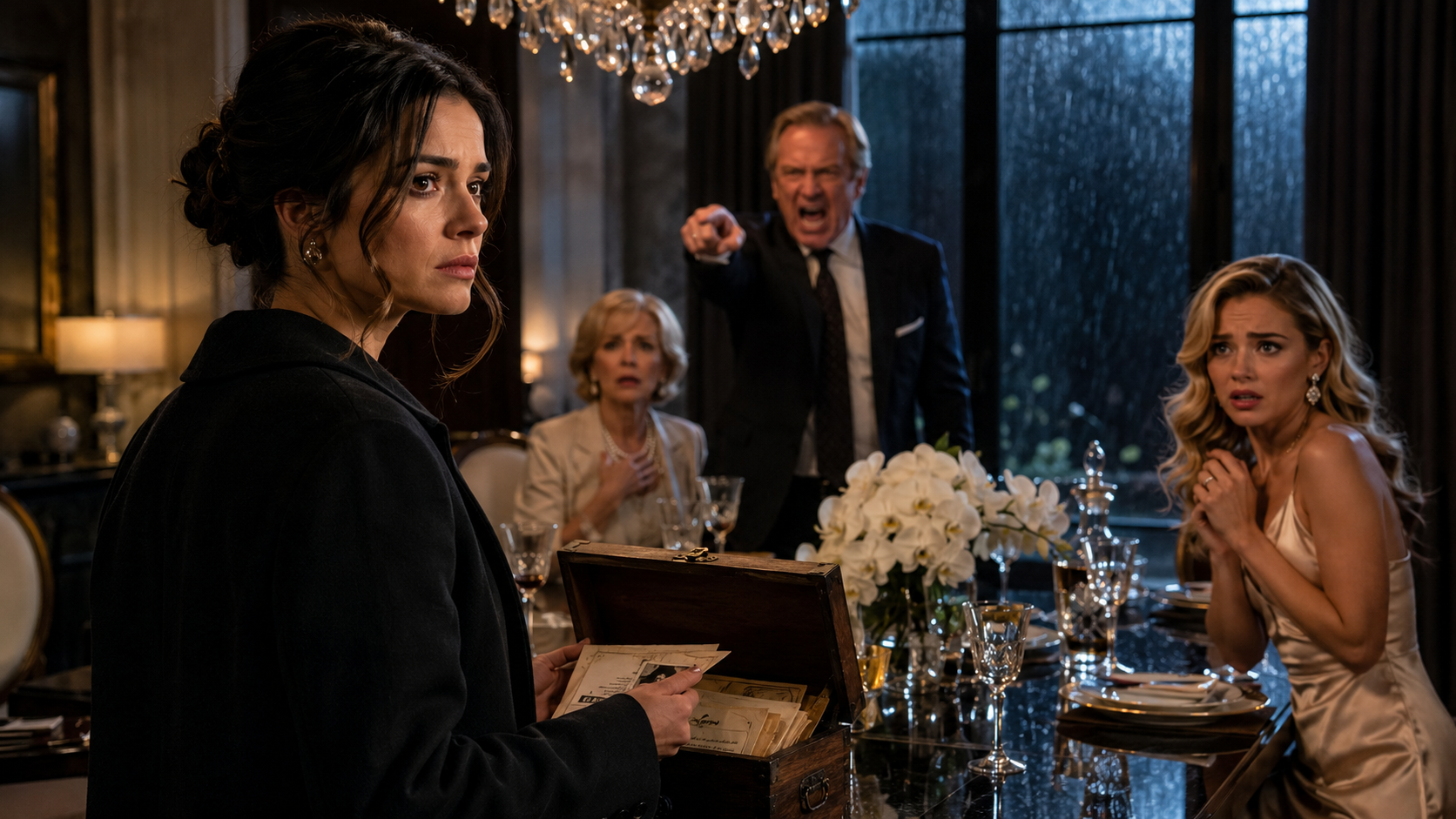
She Opened the Cedar Box at Her Sister’s Celebration — and the Family Finally Heard the Truth

No one at the table expected Mara Ellis to come back.

Not really.

They had invited her, of course. Her mother had sent the message with all the correct words, all the polite little phrases that made cruelty sound like etiquette.

We hope you can put the past aside for one afternoon.

Clara would love to have the whole family together.

Your grandmother would have wanted peace.

That last sentence was the only reason Mara came.

Not because it was true.

Because it was the kind of lie her family had been using for years, and for the first time in her life, Mara had decided she was done letting lies sit comfortably in rooms where she had once been made to stand.

The celebration was being held at the Ashbourne Club, the kind of private dining room where the chandeliers were low, the napkins were folded like flowers, and the waiters moved silently enough to make rich people feel powerful. Outside, late autumn rain streaked the tall windows, turning the city into a blur of headlights and gray stone.

Inside, everything glittered.

Crystal glasses.

Gold-rimmed plates.

White orchids.

Clara’s diamond bracelet flashing every time she lifted her champagne flute.

Mara paused at the entrance for half a second, one hand around the handle of the old cedar box she carried at her side.

It had belonged to her grandmother.

The wood was scratched near one corner, darkened with age, and still faintly smelled of lavender and paper. Mara had spent the last three nights going through everything inside it. Letters. Receipts. Copies of checks. Legal notes. Bank statements. One small cassette tape in a cracked plastic case. Enough truth to burn a family mythology to the ground.

Her cousin Owen saw her first.

His smile froze.

Then Aunt Patricia turned.

Then Uncle Neil.

Then her mother, Irene, who pressed one pale hand against her pearls as if Mara had entered wearing blood instead of a black coat.

And finally Clara.

Beautiful Clara.

Beloved Clara.

The daughter who never had to raise her voice because the room always leaned toward her anyway.

She sat at the center of the long table beside her husband, Julian, glowing in a cream silk dress, her hair swept back, her smile polished for photographs. This was supposed to be her day. The family had gathered to celebrate her new position as executive director of the Whitmore Foundation, a role their father had apparently “recommended” her for after “years of dedication.”

Mara almost laughed when she read that in the invitation.

Years of dedication.

That was what they called being carried across every bridge someone else had built.

Clara’s eyes moved from Mara’s face to the cedar box.

For one brief second, her expression changed.

Not much.

Not enough for anyone else to notice.

But Mara noticed.

Clara had always been good at looking innocent.

She had never been good at looking surprised.

“Mara,” her mother said softly, rising too quickly. “You came.”

“I was invited.”

“Yes, of course.” Irene’s smile trembled. “We weren’t sure you would feel comfortable.”

The old version of Mara would have apologized.

For arriving.

For making people nervous.

For existing in a way that forced them to remember what they had done.

That woman had died slowly over the past year, sentence by sentence, document by document, until all that remained was someone quieter, colder, and far less willing to bleed for other people’s comfort.

“I’m comfortable,” Mara said.

Her father, Malcolm Ellis, stood near the head of the table with one hand on the back of his chair. He was still tall, still broad-shouldered, still wearing the face that had frightened her as a child without ever needing to raise a hand.

“Mara,” he said.

Just her name.

A warning disguised as a greeting.

She met his eyes.

“Dad.”

A hush moved through the table.

Not silence exactly.

More like everyone suddenly remembering the last time Mara had been in the same room with them.

Thanksgiving.

The argument.

Clara crying beautifully into a linen napkin.

Malcolm telling Mara she was unstable.

Irene whispering, Please don’t do this here.

And Mara leaving before dessert while seventeen relatives watched her walk out as if she had ruined the family instead of finally reacting to being ruined by it.

Clara stood slowly.

“There you are,” she said, voice warm enough to fool anyone who hadn’t grown up beside it. “I was starting to think you were going to punish us by staying away.”

A few relatives laughed politely.

Mara did not.

Clara’s smile tightened.

Julian, Clara’s husband, looked between them and shifted in his chair. He was a handsome man with the soft confusion of someone who had married into a story and never questioned who had written it.

Mara placed the cedar box on the empty side table near the wall.

The sound was small.

Still, everyone heard it.

Her father’s eyes dropped to the box.

“What is that?”

Mara removed her coat and laid it neatly over the back of a chair.

“Something Grandma Ruth left for me.”

Her mother’s face lost color.

Clara’s hand closed around the stem of her champagne glass.

Malcolm’s jaw tightened.

The room understood something before anyone said it.

Whatever was inside that box had not been invited.

“Mara,” Irene said carefully, “today is not the day for difficult conversations.”

“That’s interesting,” Mara replied. “Because difficult conversations always seemed perfectly acceptable when I was the subject and not the speaker.”

Aunt Patricia looked down at her salad plate.

Uncle Neil cleared his throat.

Clara gave a soft little sigh.

“There it is,” she said. “I wondered how long it would take.”

Mara turned toward her.

“How long what would take?”

Clara tilted her head with practiced sadness.

“The performance.”

A few people shifted uncomfortably.

It was a perfect Clara sentence. Gentle enough to sound concerned. Sharp enough to wound. Vague enough that anyone could pretend she hadn’t meant harm.

Mara had spent thirty-four years being cut by those kinds of sentences.

Tonight, for the first time, she did not bleed.

“I’m not here to perform,” Mara said.

“Then why bring a box?” Clara asked.

Mara smiled faintly.

“Because people in this family have a strange relationship with memory. I thought objects might help.”

Malcolm stepped forward.

“You will not turn your sister’s celebration into another scene.”

Another scene.

That was what they called it when Mara told the truth in the wrong tone.

She looked at him calmly.

“I’m not turning it into anything. I’m finishing something that started before I was old enough to understand it.”

Her mother whispered, “Please.”

Mara almost looked away.

Almost.

Irene had mastered that voice.

The wounded voice.

The frightened voice.

The voice that made Mara feel cruel for noticing her own pain.

But Grandma Ruth’s letter sat inside the cedar box, folded in a blue envelope, and Mara had read it so many times the words no longer felt like ink. They felt like a hand on her back.

Your mother knows more than she admits. That may hurt you most. I am sorry.

Mara opened the box.

The old brass hinges gave a quiet creak.

Clara sat down.

No one told her to.

She simply did, as if her knees had lost interest in holding her.

Mara took out the first folder.

It was not dramatic.

That was almost the cruelest thing about it.

The truth did not come wrapped in thunder.

It came on thin paper, with dates, signatures, bank logos, and careful handwriting from dead people who had finally become braver than the living.

“This,” Mara said, holding up a copy of a letter, “is from Westlake University. Dated March 14, twelve years ago.”

Malcolm’s expression did not change.

But his fingers tightened on the chair.

Mara continued.

“It confirms my acceptance into the graduate design program.”

Cousin Owen looked up sharply.

“You got into Westlake?”

Mara glanced at him.

“Yes.”

“I thought you didn’t apply.”

“That’s what I was told too.”

The first crack opened at the table.

Small.

Audible.

Clara’s eyes moved toward Malcolm.

Mara laid the letter on the table.

“Grandma offered to pay the tuition. All of it. Not a loan. Not conditional. Not something I would need to earn by being grateful enough. She wrote directly to Dad because she wanted to make sure the paperwork was handled quickly.”

Her father’s voice came low.

“Mara.”

She took out the second page.

“This is his response.”

Irene closed her eyes.

That was when Mara knew.

Some part of her had still hoped.

Pathetic, maybe.

Human, definitely.

She had still hoped her mother had been ignorant. Weak, perhaps. Frightened, perhaps. But not fully aware.

Yet Irene’s face was not confused.

It was ashamed.

Mara read the letter aloud.

“Ruth, I appreciate your generosity, but Mara is not suited for that kind of pressure. Clara has the discipline and social instincts to make use of real opportunity. Mara needs stability, not ambition.”

The room became very still.

Rain tapped lightly against the windows.

Somewhere outside the private dining room, a waiter laughed in the hallway, and the sound felt obscene.

Mara placed the page beside the acceptance letter.

“For twelve years,” she said, “I believed I had lost that program because our family couldn’t afford it.”

Uncle Neil frowned.

“But your father told us you decided not to go.”

Mara looked at him.

“Yes. He told everyone different versions. To some of you, I was afraid to leave home. To others, I was too depressed. To others, I had missed the deadline. I heard all of them eventually.”

Clara set down her glass.

“Mara, this is ancient history.”

Mara turned.

“No. Ancient history is dead. This has been living in every room I entered.”

Clara’s mouth pressed into a thin line.

Mara reached into the box again and removed three bank copies clipped together.

“These are checks from Grandma Ruth. One for my tuition deposit. One for housing. One for supplies. All written to me. All endorsed and deposited into an account I did not control.”

Malcolm’s face darkened.

“That account was a family account.”

Mara nodded slowly.

“That’s what I thought you might say.”

She removed another document.

“So I asked the bank for archived records. It took months. Do you know what those records show?”

No one answered.

Mara looked directly at Clara.

“They show that two weeks after Grandma’s first check cleared, a payment in almost the exact same amount went to Clara’s study-abroad program in Florence.”

Clara’s chair scraped softly against the carpet.

“That is not fair.”

Mara laughed once.

It surprised even her.

Not because anything was funny.

Because the sentence was so perfectly absurd it broke something loose inside her.

“Not fair?”

Clara’s cheeks flushed.

“I didn’t know where the money came from.”

“No,” Mara said. “But you never asked.”

“That is not the same thing.”

“It is when you keep accepting gifts from a hand you refuse to look at.”

Julian turned to Clara.

“Is that true?”

Clara’s eyes flashed at him.

“Don’t start.”

That was new.

Mara saw several relatives notice it too.

Clara had always performed sweetness for audiences. But panic was not sweet. Panic was quick, sharp, and honest.

Malcolm slammed one hand lightly on the table.

“Enough. I will not sit here while you twist old financial decisions into some fantasy of persecution.”

Mara lifted another folder.

“We haven’t reached fantasy yet.”

Her father stared at the folder.

For the first time that evening, his confidence flickered.

Mara saw it.

So did Clara.

So did Irene, who whispered, “Mara, please, there are things you don’t understand.”

Mara faced her mother.

“Then explain them.”

Irene opened her mouth.

Closed it.

Her silence filled the room more completely than any confession could have.

Mara nodded once.

“That’s what I thought.”

She took out a photograph next.

An old one.

Faded around the edges.

Mara at nineteen, standing beside Grandma Ruth on the porch of the lake cottage. Mara was laughing in the picture, head tilted back, hair loose in the wind. She barely recognized that girl. Not because she had changed physically, but because that girl still believed love could be earned by being easy to overlook.

Grandma Ruth had written on the back:

My brave girl, before they taught her to apologize for breathing.

Mara held it for a moment, then placed it on the table.

Her aunt Patricia made a soft sound.

“I remember that summer,” Patricia said. “Ruth was so proud of you. You won that design award.”

Mara looked at her.

“Yes.”

Patricia’s brow furrowed.

“But Malcolm said Clara helped you with the submission.”

Clara looked away.

Mara smiled, but there was no happiness in it.

“Of course he did.”

She opened a small envelope and removed a printed email chain.

“This is from the award committee. Grandma saved it because she was the one who picked me up when I received the certificate. Not Clara. Not Dad. Not Mom.”

Irene began crying quietly.

Mara did not stop.

“I want everyone here to understand something. I am not bringing this up because I need applause for things I did as a teenager. I’m bringing it up because every time I achieved something, the story changed before it reached this family. If I succeeded, Clara helped. If I failed, I was fragile. If Grandma loved me, she was interfering. If I objected, I was jealous.”

Clara stood again.

This time she did not pretend calm.

“You are jealous.”

The words landed hard.

There it was.

The center of the thing.

The label they had pinned to Mara so many times it had started to feel like her name.

Mara looked at her sister.

“No. I was lonely.”

Clara blinked.

Mara continued, voice low.

“I was lonely while sitting at tables full of relatives. I was lonely in family photos where I was standing two feet away from everyone else. I was lonely when Mom corrected my tone but never your cruelty. I was lonely when Dad called your confidence leadership and my sadness weakness. That is not jealousy, Clara. That is what happens when a child grows up beside a favorite and everyone tells her the hunger she feels is envy.”

For a moment, Clara looked almost wounded.

Almost.

Then her face hardened.

“You always do this,” she said. “You make everything sound poetic so people forget how exhausting you are.”

Mara nodded.

“There she is.”

Clara’s nostrils flared.

“What is that supposed to mean?”

“It means you can only stay graceful when nobody challenges the script.”

Julian pushed back from the table.

“Clara, maybe you should let her finish.”

Clara turned on him.

“You don’t know this family.”

“No,” he said quietly. “But I’m starting to.”

That landed harder than anything Mara had said.

Clara sat down again, but this time not elegantly.

Mara reached into the cedar box and took out the blue envelope.

Her hands changed when she touched it.

Not shaking exactly.

But softer.

The room seemed to sense it. Even Malcolm stopped moving.

“This,” Mara said, “is a letter Grandma wrote six months before she died. Her attorney gave it to me after probate began. I did not know about it until three weeks ago.”

Irene whispered, “Oh God.”

Mara looked at her.

“Yes. I think that is an appropriate reaction.”

She opened the envelope.

The paper inside was thick and cream-colored. Grandma Ruth’s handwriting slanted slightly upward, as if even at the end, her words were trying to rise.

Mara began to read.

“My dearest Mara,

If this letter has reached you, then I am no longer there to correct the stories that have been told about you. I waited too long. I softened too many truths. I allowed myself to believe that if I loved you quietly enough, it would make up for the noise of everyone else’s neglect.

It did not.

So I am leaving you more than money.

I am leaving you records.

I am leaving you names, dates, copies, and proof, because people who benefit from your silence will often call your memory bitterness.”

Mara’s voice caught.

She stopped.

No one moved.

Then she continued.

“You were never the difficult child. You were the inconvenient witness. You noticed unfairness too early. You asked honest questions in a family that preferred beautiful answers. Your father mistook control for wisdom. Your mother mistook peace for goodness. Your sister mistook attention for love.

And I, shamefully, mistook sympathy for action.

For that, I ask your forgiveness.”

Irene was openly sobbing now.

Malcolm stared at the far wall.

Clara’s face had gone pale and blank.

Mara folded the first page down and looked around the room.

“Grandma left more.”

Malcolm’s head snapped toward her.

“Mara, stop.”

She almost smiled.

Not because she enjoyed this.

Because for once, he had said the quiet part with fear in his voice.

“No.”

One word.

Small.

Plain.

A word she had been trained out of using.

It felt strange in her mouth.

It felt like a key.

Malcolm took a step forward.

Noah moved before Mara even looked at him.

He had been standing near the wall since she arrived, silent in a navy suit, one hand resting on the back of an empty chair. To most of the family, he probably looked like a friend. Maybe a boyfriend. Maybe moral support.

He was, in fact, the forensic accountant who had spent the last month helping Mara trace twelve years of hidden transactions.

“No closer,” Noah said.

His voice was calm.

Malcolm stared at him.

“Who the hell are you?”

“Noah Bell,” he said. “I’m here at Mara’s request.”

Clara gave a bitter laugh.

“You brought backup?”

Mara looked at her.

“No. I brought a witness.”

Noah opened his briefcase and removed a slim laptop.

Several people at the table shifted as if the temperature had dropped.

Mara turned back to the letter.

“Grandma left me the lake cottage,” she said.

The room erupted.

Not loudly at first.

More like air breaking.

Aunt Patricia gasped.

Uncle Neil muttered something under his breath.

Irene pressed both hands over her mouth.

Clara stood so quickly her chair almost tipped.

“No.”

Mara looked at her.

“Yes.”

“That cottage belongs to the family.”

“No,” Mara said. “It belonged to Grandma.”

Malcolm’s face had gone red.

“We have held holidays there for thirty years.”

“And for thirty years,” Mara replied, “I washed dishes in that kitchen while Clara opened gifts in the living room and everyone joked I was ‘helpful.’ For thirty years, I slept on sofas so Clara and her guests could have bedrooms. For thirty years, Grandma watched it happen and hated herself for not stopping it sooner.”

Clara pointed at the box.

“You’re using a dead woman to punish us.”

Mara’s voice dropped.

“No. A dead woman finally told the truth because the living refused.”

Noah connected his laptop to the wall screen.

The Ashbourne Club used the screen for charity presentations, anniversary slideshows, and corporate announcements. Tonight, it displayed a scanned copy of Grandma Ruth’s trust amendment.

Mara did not need to explain much.

The words were plain.

The cottage went to Mara.

The private trust went to Mara.

The authority over all related family access went to Mara.

Clara read the screen like it was written in a language she hated but understood perfectly.

“That can’t be legal.”

Noah answered.

“It is.”

Malcolm turned on him.

“You are not this family’s attorney.”

“No,” Noah said. “Which is fortunate, because this family appears to have a complicated relationship with disclosure.”

Aunt Patricia inhaled sharply.

Mara almost told Noah to stop.

Then she remembered every time someone had not stopped Clara.

So she said nothing.

Malcolm faced Mara again.

“What do you want?”

The question was smaller than she expected.

For years, she had imagined this confrontation. In her mind, her father would shout. Clara would cry. Her mother would collapse into apologies. The family would finally see everything clearly.

But reality was not clean.

Her father looked angry and old.

Her sister looked cornered, not sorry.

Her mother looked broken, but Mara no longer trusted brokenness as proof of love.

And the relatives looked uncomfortable in the specific way people look when they realize they have benefited from not asking enough questions.

“What do I want?” Mara repeated.

She glanced down at the cedar box.

Then at Grandma Ruth’s letter.

Then at Clara.

“I want the lies corrected.”

Clara laughed.

“There it is. You want a public apology.”

“No,” Mara said. “I want public correction. Apologies are optional. Truth is not.”

Malcolm’s voice hardened.

“You cannot force people to rewrite the past.”

“No,” Mara said. “But I can stop funding the version that erased me.”

She took out the final folder.

“This contains copies of the letters Clara sent Grandma during the last two years of her life.”

Clara’s entire face changed.

Not a lot.

Enough.

Julian saw it.

Mara saw him see it.

“Don’t,” Clara whispered.

For the first time all evening, her voice held no polish.

Mara looked at her sister for a long moment.

Somewhere inside her, a younger Mara still wanted Clara to be better than this. Still wanted the older sister who once braided her hair before school, who once killed a spider in their bedroom and made Mara laugh until she forgot to be scared.

But memory was dangerous when used as a blindfold.

Clara had not been only cruel.

That was what made it complicated.

She had also been funny, protective when it cost her nothing, generous when being generous made her look good, affectionate when no one was watching too closely.

But she had also known.

Maybe not everything.

But enough.

Mara opened the folder.

“Grandma, I am worried about Mara,” she read. “She has become increasingly resentful and unstable. If you leave her significant property, I fear she will use it to divide the family.”

Julian closed his eyes.

Clara whispered, “I was trying to protect everyone.”

Mara continued.

“She has always struggled with comparison. Dad and Mom have done their best, but Mara interprets normal family dynamics as rejection.”

Aunt Patricia covered her mouth.

Uncle Neil stared at Clara as if he had never seen her before.

Mara read the next line.

“If you insist on leaving her anything, please consider appointing Dad or me as trustee. Mara does not need independence right now. She needs guidance.”

Mara lowered the page.

“Guidance,” she said softly.

Clara’s eyes filled with tears.

Mara almost admired the timing.

“I was scared,” Clara said.

“Of what?”

“Of you doing exactly this.”

Mara tilted her head.

“Exposing what you did?”

“No,” Clara snapped. “Destroying us.”

Mara stared at her.

There was the difference.

At last.

Clara could look at a room full of lies and call the truth destruction.

“I did not destroy this family,” Mara said. “I just stopped letting myself be the place where everyone hid the damage.”

Irene suddenly stood.

“Mara, I knew some things.”

The room turned toward her.

Malcolm said sharply, “Irene.”

She flinched.

That old reflex.

Mara knew it well.

But this time Irene did not sit down.

“I knew your grandmother wanted to help with school,” Irene said, crying harder now. “I knew your father thought it was a mistake. I knew he redirected some of the money, but I told myself he had a plan, that he understood finances better than I did, that maybe you really weren’t ready.”

Mara felt something cold pass through her.

Not shock.

Confirmation.

It was heavier than shock.

“How much did you know?” Mara asked.

Irene looked at her.

Really looked.

For once, she did not hide behind softness.

“Enough,” she whispered.

A single word.

The cruelest honest answer.

Mara nodded.

It felt like something inside her had been waiting years to stop asking.

“Thank you,” Mara said.

Irene blinked through tears.

“For what?”

“For finally not lying.”

Irene reached for her.

“Mara—”

Mara stepped back.

Her mother’s hand hung in the air.

For a second, Mara saw her as she had always wanted her to be: protective, brave, willing to choose her when choosing her cost something.

Then the image vanished.

All that remained was a woman who had spent decades mistaking surrender for peace.

“You watched me shrink,” Mara said. “And you called it maturity.”

Irene sobbed.

“I was trying to keep the family together.”

“No,” Mara said. “You were trying to keep your marriage comfortable.”

The words were not shouted.

They did not need to be.

Irene sat down as if her bones had gone soft.

Malcolm pointed at Mara.

“You do not get to judge your mother.”

Mara turned to him.

“I learned judgment from you.”

His mouth closed.

Mara took one step closer to the table.

“You judged my temperament. My ambition. My friendships. My clothes. My tears. My silence. My anger. You judged everything about me except the way you treated me.”

No one spoke.

Then Julian pushed his chair back fully and stood.

“Clara,” he said, voice low, “did you know about the trust before today?”

Clara stared at him.

“This is not about us.”

“It is now.”

“Julian.”

“Answer me.”

The family watched them.

For once, Clara was not performing for a crowd that automatically adored her. She was being asked a direct question by the one person whose admiration she had not expected to lose.

Her lips parted.

She looked at Malcolm.

That was answer enough.

Julian stepped back.

“Oh my God.”

Clara reached for him.

“Jules, listen to me.”

He shook his head.

“You told me Mara hated you because you were successful.”

“She does.”

“No,” he said. “She hates what you did.”

Clara’s face crumpled for half a second.

Then anger rushed in to save her.

“You have no idea what it was like growing up with her always needing special handling.”

Mara laughed softly.

Not cruelly.

Sadly.

“Special handling?”

Clara turned on her.

“Yes. Everyone had to manage you. Your moods. Your sensitivity. Your little wounds.”

Mara looked around the table.

“Did everyone manage me? Or did everyone manage Dad by pretending I was the problem?”

No one answered.

Because once the question was asked, the answer was obvious.

Malcolm had built the house rules.

Clara had decorated them.

Irene had kept them clean.

Everyone else had visited often enough to benefit from the arrangement, but not long enough to feel responsible for it.

Mara closed Grandma Ruth’s letter and placed it carefully back inside the blue envelope.

Then she shut the cedar box.

The sound was final.

“I am not here to ask permission,” she said. “The cottage is mine. The trust is mine. The documents are copied and secured. Grandma’s attorney has everything. Noah has prepared a full accounting. If anyone tries to challenge the estate using claims about my mental stability, every letter, every redirected payment, and every false statement will become part of the record.”

Clara’s eyes narrowed.

“So this is blackmail.”

“No,” Noah said evenly. “This is documentation.”

Mara looked at Clara.

“You taught me the importance of presentation. I’m simply presenting the truth well.”

Aunt Patricia suddenly spoke.

“Mara.”

Mara turned.

Her aunt looked smaller than she remembered.

“I’m sorry,” Patricia said.

Malcolm scoffed.

Patricia ignored him.

“I repeated things I should have questioned. About Thanksgiving. About your career. About why you stopped coming to holidays.” Her voice trembled. “It was easier to believe you were difficult.”

Mara studied her aunt’s face.

There was shame there.

Real shame.

But Mara had learned that shame was only useful if it walked somewhere.

“Then correct it,” Mara said.

Patricia nodded.

“I will.”

Uncle Neil exhaled slowly.

“So will I.”

One by one, the room shifted.

Not everyone.

Not dramatically.

But enough.

Some relatives avoided Mara’s eyes. Some looked at Malcolm with suspicion they had never dared show before. Some looked at Clara with the uncomfortable grief of people watching a golden statue reveal rust beneath the paint.

Malcolm saw it happening.

That was what truly frightened him.

Not the documents.

Not the cottage.

Not even the money.

The room was no longer automatically his.

“You think this makes you powerful?” he asked Mara.

She looked at him.

“No.”

“Then what does it make you?”

Mara picked up her coat.

“Free.”

For the first time that evening, he had no answer.

Clara’s voice cut across the silence.

“You’ll be alone.”

Mara stopped.

There it was.

The oldest threat.

The final punishment.

The thing families say when they realize love no longer works as a leash.

Slowly, Mara turned back.

Clara’s face was wet now. Whether from humiliation, grief, rage, or fear, Mara could not tell. Maybe all of it. Maybe Clara herself did not know.

“You think cutting us off makes you strong,” Clara said. “But one day you’ll sit in that cottage by yourself and realize no inheritance can replace family.”

Mara looked at her sister for a long time.

Then she said, “You’re right.”

Clara blinked.

Mara’s voice softened, but it did not weaken.

“No inheritance can replace family. But neither can family replace dignity. I would rather sit alone in a house where I am not lied about than be surrounded by people who require my silence as rent.”

Clara looked away first.

That was how Mara knew the sentence had landed.

Irene whispered, “Will you ever forgive us?”

Mara’s throat tightened.

That was the cruel thing about leaving.

People imagined it felt like victory.

It did not.

It felt like carrying your own heart out of a burning house and refusing to run back in just because someone inside was crying.

“I don’t know,” Mara said honestly. “But I know forgiveness will not be another word for access.”

Her mother bowed her head.

Mara looked at the table one last time.

The orchids.

The champagne.

The untouched plates.

The family that had once seemed so large it filled the whole world.

Now it looked like what it was.

A room.

Just a room.

And Mara could leave it.

Noah picked up the cedar box for her.

She almost told him she could carry it herself.

Then she let him.

Not because she was weak.

Because she was learning that accepting help was not the same as surrendering control.

As she walked toward the door, Julian spoke behind her.

“Mara.”

She turned.

He looked devastated.

Not in a way that asked her to comfort him.

In a way that understood he had no right to.

“I’m sorry,” he said. “I should have asked more questions.”

Mara nodded once.

“Yes,” she said. “You should have.”

Then she left.

The hallway outside the dining room was quiet and warm. A waiter carrying a silver tray paused when he saw her face, then quickly looked away with the professional mercy of someone trained not to notice private disasters.

Mara stepped outside beneath the club’s stone awning.

The rain had softened to mist.

Noah came out beside her and handed her the cedar box.

“You okay?” he asked.

Mara almost said yes.

The old answer.

The easy answer.

Instead, she looked down at the box, at the scratches on the wood, at the small brass latch Grandma Ruth had touched a hundred times.

“No,” Mara said.

Noah nodded.

They stood there together, watching headlights move through the wet street.

After a while, Mara added, “But I think I will be.”

For the first time all evening, she believed herself.

Two weeks later, the first correction came.

It was from Aunt Patricia.

A long message sent to the family group chat at 8:17 on a Tuesday morning. No flowery excuses. No softening. No dramatic claims about healing.

Just the truth.

That Mara had been accepted to Westlake.

That Ruth had offered to pay.

That Malcolm had prevented it.

That family members had repeated false stories without proof.

That Mara had been owed better.

Uncle Neil replied next.

Then Owen.

Then two cousins who had not spoken to Mara in years.

Irene sent a private message.

Mara did not open it for three days.

When she finally did, she read it once, then placed the phone face down on the kitchen table.

Her mother had written seven paragraphs.

Only one sentence mattered.

I chose quiet because quiet protected me.

Mara stared at that line for a long time.

Then she wrote back:

I know.

Nothing else.

Not yet.

Maybe not ever.

Clara did not write.

Malcolm did not write.

But a week later, Mara received notice through Grandma Ruth’s attorney that Malcolm had requested copies of the estate documents.

Noah laughed when she told him.

“He’s looking for a crack.”

“Will he find one?”

“No.”

Mara smiled.

It was small.

But real.

The lake cottage looked different in winter.

She went alone the first time.

No family caravan.

No coolers.

No arguments over bedrooms.

No Clara arriving late and somehow still getting the best room.

No Malcolm standing on the porch like a king surveying land he did not own.

Just Mara, the old key, and the sound of pine trees moving in the wind.

Inside, everything smelled like dust, cedar, and cold stone.

Sheets covered the furniture.

The kitchen faucet groaned when she turned it on.

A mouse had clearly declared war beneath the sink.

But the place was hers.

Not because paper said so.

Because for the first time, she stood inside it without feeling like a guest in someone else’s version of her life.

On the mantel, she found a framed photo Grandma Ruth must have placed there before she died.

Mara at nineteen.

Laughing on the porch.

Before.

Mara picked it up and turned it over.

There was a note tucked behind the frame.

Another one.

Shorter this time.

If you are here, then you made it through the worst part. Do not confuse grief with regret. Some doors hurt when they close because our hands are still on them.

Mara sat down on the covered sofa and cried.

Not neatly.

Not beautifully.

Not like Clara, who could make tears look like pearls.

Mara cried with her whole body, bent forward, one hand over her mouth, the note pressed against her chest.

She cried for Westlake.

For the girl in the photograph.

For the years she thought she was hard to love.

For every family dinner where she had laughed too softly, spoken too carefully, made herself useful so no one would call her bitter.

She cried until the cottage grew dark around her.

Then she stood.

Turned on a lamp.

Took the sheets off the furniture.

Opened the windows even though the air was cold.

And one by one, room by room, she began removing dust from the house that had always remembered her correctly.

By spring, the cottage was different.

Not renovated exactly.

Restored.

Mara painted the kitchen a soft green. She replaced the broken porch boards. She turned the upstairs guest room, the one Clara had always claimed, into a studio with wide tables, shelves of paper, and morning light that poured across the floor like forgiveness.

Not the kind given to others.

The kind given to herself.

She enrolled in a design certification program online.

Not Westlake.

Not the stolen dream in its original shape.

Something new.

Something hers.

When the first assignment came back with a note from the instructor — You have a strong eye. Keep going. — Mara sat at the kitchen table and laughed until she cried again.

This time, the tears felt different.

One Saturday in May, a car pulled into the gravel driveway.

Mara saw it from the porch.

Her mother stepped out.

Alone.

No Malcolm.

No Clara.

She looked older than she had at the Ashbourne Club. Less polished. More human. She held a small paper bag in both hands like an offering.

Mara did not move from the porch.

Irene walked halfway up the path and stopped.

“I know I should have called,” she said.

“Yes,” Mara replied.

Irene nodded.

“I brought your grandmother’s teacups. The blue ones. I found them in the dining cabinet at home.”

Mara looked at the bag.

Grandma Ruth’s teacups had disappeared after the funeral.

Clara had once said they were probably donated by mistake.

Mara had believed that for about twelve seconds.

“Why bring them now?” Mara asked.

Irene swallowed.

“Because they were hers. And because she would have wanted them here. With you.”

Mara said nothing.

A year earlier, that sentence would have opened a door.

Now it knocked.

That was all.

Irene set the bag carefully on the porch step.

“I’m not asking to come in.”

Mara studied her mother’s face.

For once, Irene did not cry.

That helped.

Tears had always made Mara feel responsible.

Absence of tears allowed her to think.

“Are you still with him?” Mara asked.

Irene’s mouth trembled.

“Yes.”

Mara nodded.

Irene looked down.

“But it is not the same.”

“No,” Mara said. “It probably isn’t.”

“I should have protected you.”

“Yes.”

“I don’t know how to fix that.”

Mara leaned against the porch railing.

“You don’t fix it by saying that once.”

Irene nodded.

“I know.”

Maybe she did.

Maybe she didn’t.

But for the first time, she did not ask Mara to make the moment easier.

That was something.

Not enough.

But something.

Mara picked up the paper bag.

“Thank you for bringing them.”

Irene’s eyes filled, but she blinked the tears back.

“You’re welcome.”

She turned to leave.

Mara watched her reach the car.

Then, before she could overthink it, she called out, “Mom.”

Irene turned quickly.

Too quickly.

Hope was a dangerous thing on her face.

Mara held the bag against her side.

“I’m not ready.”

Irene nodded, tears finally slipping down her cheeks.

“I understand.”

Mara’s voice softened.

“But you can write.”

It was not forgiveness.

It was not access.

It was a narrow bridge built over a very deep place.

Irene understood enough not to run across it.

“I will,” she said.

Then she got into her car and left.

Mara stood on the porch until the sound of the engine disappeared.

Inside the bag were four blue teacups wrapped in newspaper.

One had a chip near the rim.

Mara washed them carefully and placed them in the kitchen cabinet.

Not because everything was healed.

Because not everything broken needed to be thrown away.

Some things could be kept.

Some could not.

Learning the difference was the work now.

That summer, Mara hosted one dinner at the cottage.

Not a family holiday.

Not a reunion.

Not an apology performance staged around a roast chicken.

Just dinner.

Noah came.

Owen came with his wife.

Aunt Patricia came and brought flowers from her garden.

Uncle Neil came early and repaired the loose step without making a speech about it.

Irene did not come.

She had asked.

Mara had said not yet.

For once, Irene accepted the answer without making Mara manage her disappointment.

They ate on the porch under strings of warm lights. The lake turned gold at sunset. Someone opened wine. Someone burned the bread. Owen told a story about Grandma Ruth cheating at cards and everyone laughed so hard Aunt Patricia had to wipe her eyes.

For a moment, Mara felt the old ache.

The wish that it could have always been like this.

Then she let the wish pass.

A different life did not become less real because it arrived late.

After dinner, Mara stood alone by the porch railing, listening to the water move in the dark.

Noah came beside her.

“Good night?” he asked.

Mara looked back through the window.

At the table.

At the mismatched plates.

At the people helping wash dishes without turning her usefulness into her role.

“Yes,” she said. “A strange one.”

“Strange good?”

She smiled.

“Strange new.”

Inside, Aunt Patricia was carefully placing Grandma Ruth’s blue teacups on the shelf after washing them by hand.

Owen was laughing at something Uncle Neil said.

No one was asking where Clara was.

No one was asking whether Malcolm approved.

No one was pretending the absence of cruelty was the same thing as emptiness.

Mara turned back toward the lake.

For years, she had believed losing her family would feel like falling.

But this did not feel like falling.

It felt like standing in a house that no longer required her to disappear in order to belong.

The next morning, she found an envelope in the mailbox.

No return address.

She knew Clara’s handwriting immediately.

For a full minute, Mara simply stood there, holding it.

Then she opened it.

There was no apology.

Not really.

Clara had written three pages explaining pressure, childhood, Dad’s expectations, Mom’s silence, the way being chosen had felt less like love and more like a job she could never quit.

Mara read every word.

Then she reached the final line.

I don’t know how to be your sister without being better than you.

Mara sat down on the porch steps.

There it was.

The closest thing to truth Clara had ever given her.

Ugly.

Incomplete.

But real.

Mara folded the letter and placed it back in the envelope.

She did not reply that day.

Or the next.

Some truths deserved acknowledgment.

Not immediate access.

Weeks later, she wrote back one sentence.

Then start there.

She did not know what Clara would do with it.

Maybe nothing.

Maybe rage.

Maybe another performance.

Maybe, someday, work.

But Mara no longer built her life around waiting for other people to become honest.

Autumn returned slowly.

The trees around the cottage turned red and gold. The lake grew dark earlier. Mara finished her first full design portfolio in the studio that used to be Clara’s room.

On the anniversary of Grandma Ruth’s death, Mara lit a candle in the kitchen and made tea in one of the blue cups.

Then she took the cedar box from the shelf.

It was lighter now.

Not because anything had been removed.

Because Mara no longer carried its contents alone.

She opened it and placed inside the newest thing:

A printed copy of her certificate.

Completed.

Earned.

Unstolen.

Beside it, she placed Grandma Ruth’s note.

Do not confuse grief with regret.

Mara ran her fingers over the old handwriting.

Then she closed the box.

Outside, wind moved through the pines.

Inside, the cottage was warm.

For the first time in her life, Mara understood that peace was not the silence her family had demanded.

Peace was the sound of no longer betraying herself.

And in that house, with the lake dark beyond the windows and her grandmother’s teacup warm between her hands, Mara finally let herself believe the truth she had needed since childhood.

She had never been too small for love.

She had only been raised by people who needed her to feel small so they could remain comfortable being unfair.

Now they could keep their comfort.

Mara had chosen the truth.

And the truth, at last, had chosen her back.

She Opened the Cedar Box at Her Sister’s Celebration — and the Family Finally Heard the Truth
‘Time spares no one!’ Let’s take a look at the legendary actors of ‘The Green Mile’ 25 years later.