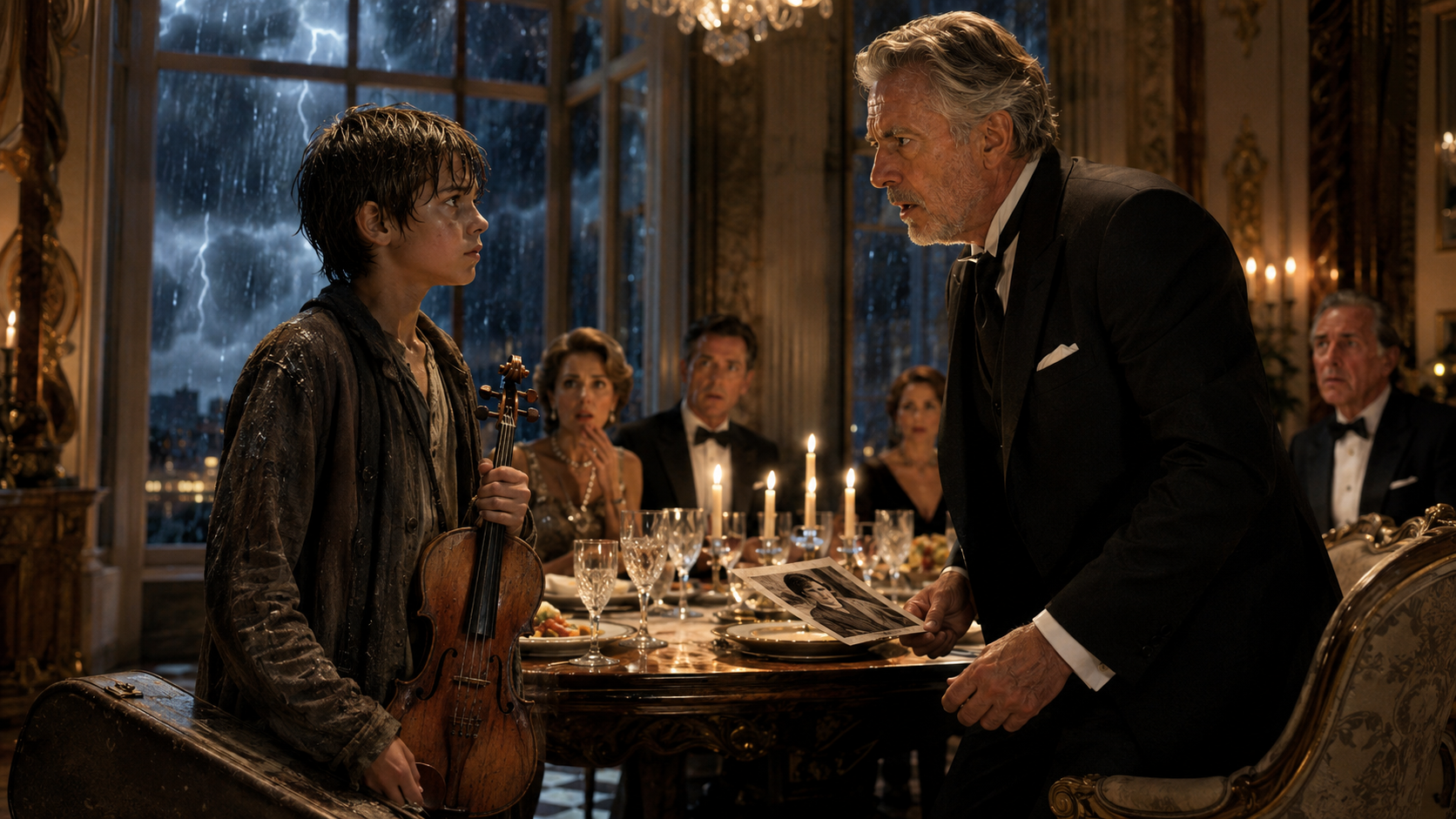
The boy did not belong in the dining room.
Everyone at the table knew it the second he stepped through the double doors with a cracked violin case pressed against his chest and rain dripping from the ends of his sleeves.
The room was too bright for him.
Too polished.
Too expensive.
Crystal chandeliers poured warm gold over a table long enough to seat twenty guests. Silver knives rested beside porcelain plates. Tall candles burned in perfect rows. The wineglasses were thin as ice and worth more than everything the boy owned.
He stood on the edge of the room in shoes with peeling soles, a borrowed jacket too large for his shoulders, and a white shirt that had been washed so many times the fabric had nearly given up.
For a moment, no one spoke.
Forks paused halfway to mouths.
A woman in diamonds lowered her champagne glass.
A man with a red face and a silk tie leaned back as if the child had brought dirt into the room simply by breathing.
At the head of the table sat Victor Hargrove.
He was the reason the room existed.
The mansion, the servants, the private chef, the imported marble floor, the paintings on the walls, the guarded gate outside — all of it belonged to him. Victor Hargrove was the kind of man newspapers called powerful, investors called brilliant, and employees called sir only after practicing the word in their heads.
He was sixty-two, silver-haired, sharp-eyed, and dressed in a black evening jacket that looked as though it had been made for a king who had forgotten how to smile.
His dinner guests were celebrating the closing of a hotel deal worth more money than most families could imagine. They had spent the evening discussing waterfront towers, overseas accounts, private schools, and the kind of problems that only rich people were unfortunate enough to have.
Then the boy appeared.
Small.
Wet.
Silent.
And carrying a violin.
Victor looked up slowly.
“Who let him in?” he asked.
His voice was not loud, but it was cold enough to make the nearest servant stiffen.
A young maid near the door went pale. “I’m sorry, Mr. Hargrove. He was at the kitchen entrance. He said he was hired to play.”
A few guests chuckled.
“Hired?” the red-faced man said. “By whom? The alley?”
The boy’s fingers tightened around the handle of the case.
He did not cry.
He did not lower his eyes.
That was the first thing Victor noticed.
Most children looked afraid when adults mocked them. This boy only looked tired.
The maid swallowed. “He said Mrs. Bell sent him.”
That name shifted the air.
Several guests turned toward an elegant older woman seated halfway down the table. Catherine Bell was Victor’s event coordinator, social secretary, and one of the few people in the city who could tell wealthy men what to do without being punished for it.
Catherine set down her napkin.
“I did,” she said calmly.
Victor’s jaw tightened. “You hired a street performer for my private dinner?”
“I hired a young musician,” Catherine replied. “You asked for something meaningful tonight. Something that would make the evening feel less like a business transaction.”
“I meant a string quartet.”
“The quartet canceled because of the storm.”
“And this is your solution?”
Catherine glanced at the boy, then back at Victor. “His name is Elias.”
The boy flinched slightly when she said it, as if his name sounded strange in a room like that.
Victor studied him.
Elias could not have been more than eleven. Thin face. Dark hair falling into his eyes. A bruise-colored shadow beneath each cheekbone. But there was something in his expression that did not match his age. Something too controlled. Too familiar with disappointment.
One of the guests gave a theatrical sigh. “Well, let him play something quick. We can call it charity.”
Laughter moved softly around the table.
Elias looked at the violin case.
Victor noticed his hands then.
The boy’s hands were clean, though his clothes were worn. His nails were short. His fingers, long and careful, rested on the case like they were protecting something alive.
“You have five minutes,” Victor said. “Then you leave through the kitchen.”
Catherine gave Elias a small nod.
The boy opened the case.
The violin inside was old. Not antique-old, not valuable-old. Just tired. Its varnish had faded in patches. One corner had been repaired badly. The bow was missing hair near the frog. The cloth lining the case was torn, and tucked into one side was a folded photograph, yellowed at the edges.
Elias lifted the violin with a gentleness that made the room quieter.
He placed it beneath his chin.
Someone at the table whispered, “This should be amusing.”
Elias closed his eyes.
And then he played.
The first note was soft.
So soft that at first it seemed almost accidental.
A thin thread of sound rose above the candlelight, trembling for half a breath before steadying itself. Then another note followed. And another.
The melody was simple.
Not the kind of music played in grand halls. Not the kind rich people applauded because they were told it was important. It sounded like something hummed beside a child’s bed. Something remembered from another room. Something a mother might sing when there was no money for medicine, no food in the cupboard, no heat in winter — only her voice, holding back the dark.
The table changed.
The red-faced man stopped smirking.
The woman in diamonds slowly lowered her hand.
The servants near the wall went still.
Even the rain outside seemed to hush against the windows.
Elias did not play perfectly. His violin had a rough edge. One string buzzed faintly. His bow slipped once. But none of that mattered.
Because the song did not sound performed.
It sounded survived.
Victor Hargrove stopped breathing.
At first, he did not understand why.
He had heard thousands of songs. At opera houses. Charity galas. Private islands. His money had bought music from the best performers in the world.
But this melody did not belong to them.
It belonged to a room with blue curtains.
A chipped white piano.
A woman laughing as sunlight caught in her copper-brown hair.
A woman turning from the window and saying, “No, Victor, not like that. You’re counting the notes. You have to feel where they hurt.”
Victor’s fingers curled around the arms of his chair.
The dining room blurred.
For one terrible second, he was thirty years younger.
He was not Victor Hargrove, hotel magnate, feared negotiator, untouchable widower.
He was Victor with paint on his shirtsleeve, no fortune yet, no walls around his heart, standing in a tiny rented apartment while Liana Vale played a melody she claimed she had written in a dream.
Liana.
The name went through him like a knife that had been waiting eleven years to move.
The boy reached the middle of the song.
Victor’s face drained of color.
Catherine saw it. She knew Victor well enough to notice even the smallest crack in his composure. But this was not a crack.
This was collapse wearing a tuxedo.
“Stop,” Victor said.
Elias did not hear him at first.
Or maybe he did and chose to finish the phrase.
Victor stood so abruptly that his chair scraped across the marble.
“Stop playing.”
The bow froze.
The last note died.
The room went silent.
Elias opened his eyes.
Victor stared at him.
“Where did you learn that song?”
The boy hesitated.
“My mother.”
The answer struck Victor harder than the music had.
“Your mother’s name.”
Elias looked down at the violin, then back up. “Mara Rowan.”
Victor blinked.
Not Liana.
Of course not.
Liana was dead.
That was what he had been told.
Eleven years ago.
A letter had come.
No, not a letter. A message. A neat, cruel statement delivered by his own attorney after months of silence.
Liana Vale had left the country. Liana Vale had wanted nothing from him. Liana Vale had married another man. Liana Vale had died in childbirth somewhere in Portugal.
And the child had not survived either.
That was what Victor had believed.
That was what had turned grief into stone inside him.
He looked at Elias again.
Dark hair.
Pale face.
That stubborn lift of the chin.
Not enough.
Not proof.
Only cruelty from memory.
“Your mother wrote that song?” Victor asked.
Elias nodded. “She says she did.”
“Says?”
The boy’s mouth tightened. “She used to say it. Before she got sick.”
Catherine’s expression softened.
Victor’s voice dropped. “Sick how?”
Elias glanced at the guests. He clearly hated being watched.
“She has trouble breathing. And her heart. And sometimes she forgets things when the fever gets bad.” He swallowed. “But she remembers the song.”
Someone at the table shifted uncomfortably.
The red-faced man muttered, “Victor, really, this is becoming—”
Victor lifted one hand.
The man stopped.
Victor stepped away from his chair and walked toward the boy.
Elias did not move, but his shoulders tensed as though he was ready to run.
Victor stopped a few feet in front of him.
“What is your full name?”
“Elias Rowan.”
“How old are you?”
“Eleven.”
The word hit the room like a glass dropped onto stone.
Eleven.
Catherine closed her eyes.
Victor stared at the boy’s face.
Eleven years.
Eleven years since Liana vanished.
Eleven years since Victor buried the only soft thing in him.
Eleven years since he allowed bitterness to replace love because the alternative was grief without a body.
“Who was your father?” Victor asked.
Elias’s expression hardened in a way no child’s face should.
“I don’t have one.”
“That was not my question.”
“My mother said he died before I was born.”
Victor’s jaw flexed.
“What was his name?”
“She never told me.”
“Never?”
Elias shook his head. “She said some names were too heavy to carry until I was older.”
A strange sound came from Catherine. Half breath, half sorrow.
Victor turned slightly. “Did you know about this?”
“No,” Catherine whispered. “I only heard him playing outside the old theater last week. He was raising money for medicine. I thought…” Her voice trembled. “I thought the song sounded familiar.”
Victor looked back at Elias.
The boy had begun to put the violin away.
“Leave it,” Victor said.
Elias froze. “What?”
“The photograph in your case. Take it out.”
The boy’s face changed instantly.
Fear.
Not embarrassment. Fear.
“No.”
Victor’s eyes sharpened. “Why not?”
“It’s mine.”
“I’m not asking to keep it.”
“No.”
The red-faced man laughed nervously. “For heaven’s sake, Victor, don’t argue with the child over some gutter photograph.”
Victor did not look at him.
“I said,” Elias whispered, “no.”
That refusal did something to Victor.
It angered him, yes. He was used to being obeyed. But beneath the anger, something else moved — a recognition he did not want.
Liana had once looked at him that way.
When his father tried to buy her silence.
When Victor tried to convince her that people like them could not survive people like the Hargroves.
When she said, “Your money is loud, Victor, but it doesn’t make you right.”
Victor lowered his voice.
“Elias, I need to see it.”
The boy shook his head. “My mother said never show it to anyone from big houses.”
The room seemed to tilt.
Victor’s throat tightened.
“Why would she say that?”
“Because big houses take things.”
No one laughed this time.
Victor felt the words enter him slowly.
Big houses take things.
He had spent decades building big houses. Hotels. Estates. Towers. Restaurants with marble bathrooms and rooftop pools. He had built an empire of big houses.
And somewhere, an eleven-year-old boy had been taught to fear them.
Victor crouched slightly, bringing himself closer to the boy’s height.
“I won’t take it.”
“You don’t know that.”
“Yes,” Victor said quietly. “I do.”
Elias studied him.
Children who grow up poor learn to read adults quickly. Not words. Words are cheap. They read hands, eyes, posture, the space between a promise and a lie.
After a long moment, Elias reached into the violin case.
He took out the photograph.
It was small.
Faded.
Bent at one corner.
He held it tight for a second before offering it.
Victor accepted it with fingers that suddenly did not feel like his own.
The photograph showed a young woman sitting on the hood of an old blue car, laughing into the sun. Her hair was windblown. Her dress was white. One hand rested over her stomach, not enough to make the pregnancy obvious unless you already knew what you were looking for.
Beside her stood a younger Victor.
No gray in his hair.
No ice in his eyes.
His arm was around her shoulders, and he was looking at her as if the entire world had narrowed to one miracle.
On the back of the photo, written in blue ink, were four words.
For our little song.
Victor stopped breathing.
Catherine rose from her seat.
“Victor?”
He turned the photo over again.
His vision blurred.
He remembered that day.
Liana had refused to attend a formal family luncheon, saying she would rather eat peaches by the river than sit across from people who smiled like knives. Victor had skipped the luncheon too. His father had called him weak. His mother had called Liana a phase.
They had driven until the city disappeared.
Liana had played that melody on a cheap violin under a willow tree. Later, she told him she was pregnant.
Victor had lifted her into his arms and spun her around while she laughed and shouted that he would drop her.
That photograph had been in his study.
Then it vanished.
Just like Liana.
He looked at Elias.
The boy’s face was guarded, but his eyes were frightened.
Victor could barely force the words out.
“Where did your mother get this?”
“She keeps it in a tin box.” Elias’s voice was small now. “She said if anything happened to her, I should keep the picture and the violin. She said the song would tell me who loved me before I was born.”
The dining room had become unbearably quiet.
Victor stared at the boy’s mouth. The shape of it. The left eyebrow, slightly higher than the right. The way he stood with pride covering hunger.
“Your mother is alive,” Victor said.
Elias frowned. “Yes.”
“Where?”
The boy pulled back. “Why?”
“Where is she?”
“I’m not telling you.”
“Elias—”
“You’re scaring me.”
The words stopped Victor.
He looked down at himself — the expensive suit, the commanding posture, the photograph clenched in his hand — and realized the boy was right.
He was not acting like a man who had found a miracle.
He was acting like a man who wanted to seize it.
Victor forced himself to step back.
“I’m sorry.”
The apology seemed to shock everyone more than the boy’s arrival had.
Victor Hargrove did not apologize.
Not to employees.
Not to partners.
Not to judges.
Not to dying friends.
But he had just apologized to a barefoot-thin child with a broken violin.
Elias stared at him.
Victor held the photograph out.
The boy snatched it back and pressed it against his chest.
“Who are you?” Elias asked.
Victor tried to answer.
No word fit.
Stranger.
Millionaire.
Ghost.
Father.
He had no right to the last one. Not yet.
Maybe not ever.
“My name is Victor Hargrove,” he said.
Elias’s eyes widened.
Not with recognition.
With fear.
That hurt worse.
“You know that name,” Victor said.
“My mother cries when she hears it.”
A sound went through the room — not from one person, but from many.
Victor looked as though he had been struck.
“She cries?”
Elias nodded once. “She says she doesn’t hate you anymore. But sometimes at night she says your name like it’s a door she can’t open.”
Victor closed his eyes.
Behind him, one of the guests whispered, “This is not appropriate for dinner.”
Victor turned.
His face had changed.
For most of his life, people had feared Victor Hargrove because he was controlled. Controlled anger. Controlled power. Controlled cruelty when necessary.
But now there was nothing controlled about him.
“Leave,” he said.
The red-faced man blinked. “Excuse me?”
“All of you. Leave my house.”
A woman gasped. “Victor, the deal—”
“The deal can rot.”
No one moved.
Victor’s voice dropped lower. “I said leave.”
Chairs scraped.
Napkins fell.
Servants rushed to open doors.
Guests gathered coats and purses with the stiff awkwardness of people who had just witnessed something wealth could not protect them from.
Catherine stayed.
Elias stayed because he did not know whether he was allowed to move.
When the dining room emptied, Victor turned back to the boy.
“Please,” he said, and the word sounded unfamiliar in his mouth. “Take me to your mother.”
Elias shook his head.
“She won’t want to see you.”
“Then I’ll stand outside.”
“She’s very sick.”
“I’ll bring doctors.”
“We don’t need your money.”
Victor looked at the violin case, the worn shoes, the too-large jacket.
“No,” he said softly. “You needed it for eleven years.”
The boy looked away.
That was answer enough.
Catherine approached slowly. “Elias, did your mother ever tell you why she left him?”
“She didn’t leave.” The boy’s reply came too fast. Too sharp. “She said he sent her away.”
Victor’s head snapped up.
“What?”
Elias’s eyes filled with sudden anger. “She said you chose your family. That your father told her you didn’t want a poor girl and a baby ruining your future. She said she waited two weeks at the boarding house. She said she wrote letters. She said someone came with money and papers and told her if she loved you, she would disappear.”
Victor’s face turned gray.
Catherine whispered, “Oh my God.”
Victor’s father had been dead for six years.
Yet somehow, in that moment, Victor hated him more fiercely than he ever had while the old man was alive.
“No,” Victor said.
Elias glared at him. “Yes.”
“No,” Victor repeated, but not to deny the boy. To deny the years. “I never knew.”
“My mother said you knew.”
“I didn’t.”
“She said your lawyer came.”
“Which lawyer?”
“I don’t know.”
“Name. Did she say a name?”
Elias hesitated.
Victor could see the child debating whether to protect his mother’s story from the man who might have broken it.
Then Elias said, “Mr. Creed.”
The name cut through the room.
Harold Creed.
Victor’s family attorney for thirty-eight years.
Retired now.
Living comfortably in a lakeside home purchased, no doubt, with money from cleaning up Hargrove sins.
Victor walked to the fireplace and gripped the mantel.
His mind began assembling the past with brutal speed.
The missed calls.
The letters that never reached him.
His father insisting Liana had accepted money.
Creed showing him a signed statement.
The death notice.
The tiny coffin Victor never saw because there was no funeral.
Because there was no death.
Because the woman he loved had been alive.
Pregnant.
Alone.
Afraid.
And raising his son.
Victor turned back.
“Where is she?” he asked again.
This time his voice broke.
Elias heard it.
Children know fake grief because they have seen too much of it. This was not fake.
The boy’s anger wavered.
“She’s at Saint Agnes Clinic,” he said quietly. “Not the hospital. The free clinic behind the church.”
Victor looked at Catherine.
“Call my driver. Now.”
Then he looked at Elias.
“You will ride with me. Or I’ll follow behind you. Your choice.”
Elias hugged the violin case.
“My mother said never get in cars with rich men.”
Despite everything, Catherine almost smiled.
Victor nodded. “Smart woman.”
“She is.”
“I know.”
The boy blinked.
Victor swallowed. “I knew.”
Fifteen minutes later, Victor Hargrove stood outside his own mansion in the rain without an umbrella, waiting while Elias climbed into the back of a black car beside Catherine.
He did not sit beside the boy.
He did not try to touch him.
He sat in the front passenger seat, as if he had not earned anything closer.
The car pulled away from the mansion gates and drove into the older part of the city, where the streets narrowed, the buildings sagged, and the glow of wealth ended block by block.
Elias kept one hand on the violin case the entire ride.
Catherine sat beside him, quiet and gentle.
Victor watched the city through the windshield.
Every red light felt like punishment.
Every mile felt stolen.
Eleven years.
What had Liana endured in eleven years?
Had she been hungry while he sat at banquet tables?
Had she held their sick child at night while he negotiated hotel acquisitions?
Had Elias taken his first steps in a rented room while Victor drank alone in a penthouse, believing the boy dead?
The car stopped outside a small clinic connected to an old stone church. A flickering sign buzzed above the entrance. The waiting room light spilled weakly through rain-streaked glass.
Elias jumped out before the driver could open the door.
Victor followed slowly.
Inside, the clinic smelled of antiseptic, old coffee, and wet coats. A nurse behind the desk looked up, annoyed at first, then startled when she recognized Victor Hargrove.
Elias ignored her and hurried down the hall.
“Mom?”
His voice changed when he called her.
It softened.
It became younger.
Victor stopped outside the doorway of a small examination room.
He was suddenly afraid to enter.
Catherine stood beside him.
Inside the room, a woman lay propped against pillows beneath a thin blanket. Her hair, once copper-brown, was threaded with gray and tied loosely at the nape of her neck. Her face was thinner than memory. Her skin too pale. Her breathing careful.
But it was Liana.
Older.
Sicker.
Alive.
Elias rushed to her side.
“Mama, I’m sorry. I played at the house. I know you said not to go, but Mrs. Bell paid me, and we needed the medicine, and then he heard the song and—”
Liana lifted one trembling hand to his cheek.
“Slow down, love.”
Then she saw the doorway.
Her hand fell.
The room went still.
Victor could not move.
Liana stared at him as though death had returned wearing a suit.
“No,” she whispered.
Victor stepped into the room.
One step.
Only one.
“Liana.”
Her eyes filled instantly, but her face hardened.
“Get out.”
Elias turned toward Victor, alarmed.
Catherine remained in the hall, giving them space but not leaving.
Victor’s voice was barely audible. “I thought you were dead.”
Liana laughed once.
A terrible sound.
“No. That was supposed to be my line.”
Victor flinched.
She pushed herself higher against the pillows, fighting for breath. “Your father told me you wanted nothing to do with me. Your lawyer brought papers. He said you had chosen your inheritance. He said if I tried to contact you again, your family would take my baby.”
Victor’s eyes closed.
“I never knew.”
“You expect me to believe that?”
“No. I don’t expect anything.”
“Good.”
“I only need you to know it.”
She looked away, jaw trembling.
Victor reached into his coat and removed the photograph. Elias must have slipped it back to him in the car without realizing, or perhaps Catherine had handed it over. He did not remember.
Liana saw it and went very still.
“I kept a copy too,” she said.
Victor’s lips parted.
“They told me you burned everything,” he said.
“They told me you did.”
The words sat between them like eleven years of ashes.
Elias looked from his mother to Victor.
“What does that mean?”
Neither adult answered.
So Catherine did.
“It means someone lied to both of them.”
Elias frowned. “Why?”
Victor looked at him.
“Because money can make terrible people think they own other people’s lives.”
Liana’s eyes flashed. “Your father was not the only one.”
“I know.”
“You don’t know anything.”
Victor nodded. “Then tell me.”
She stared at him, suspicious of the softness.
Victor Hargrove had been many things in her memory. Passionate. Proud. Reckless. Tender when no one was watching. But never humble.
This man looked as though he had been hollowed out.
Liana’s voice shook. “I waited for you. I waited in that boarding house until the landlady told me I had to pay or leave. I wrote seven letters. Seven, Victor. I walked to your office until security threatened to call the police. Then Creed came. He had documents. He had your signature.”
“Forged.”
“He said you had married someone else.”
“I didn’t.”
“He said the baby would never be allowed near the Hargrove name.”
Victor looked at Elias.
The boy stared back, breathing fast.
“I would have given him my name the day he was born,” Victor said.
Liana’s face crumpled, but only for a second. She rebuilt herself immediately.
“Words are easy after eleven years.”
“Yes,” Victor said. “They are.”
That answer seemed to disarm her more than any defense could have.
He stepped closer, then stopped when Elias moved protectively toward his mother.
Victor respected it.
“I’m not here to take anything,” he said. “Not him. Not your forgiveness. Not your story. I came because our son played your song in my dining room and handed me the only truth anyone has given me in eleven years.”
Liana covered her mouth.
Elias went pale.
“Our son?”
The words came from him like he was afraid they might explode.
Victor looked at Liana.
She closed her eyes.
A tear slipped down her cheek.
“I was going to tell you,” she whispered to Elias. “When you were older. When I could explain without making you hate half of where you came from.”
Elias stared at Victor.
“You’re my father?”
Victor could not speak for a moment.
Then he nodded.
“I believe I am.”
The boy took one step back.
His face did something heartbreaking. It tried to become angry, but beneath it was a child who had spent his whole life pretending not to wonder.
“You were alive?”
“Yes.”
“You were rich?”
“Yes.”
“And we were poor?”
Victor’s eyes filled.
“Yes.”
Elias’s voice cracked. “Then where were you?”
There it was.
The question no lie could soften.
Victor sank slowly into the chair by the wall, not because he wanted to sit, but because his legs no longer trusted him.
“I was grieving a death that never happened,” he said. “And that does not excuse anything. It doesn’t give you back birthdays. It doesn’t give your mother back the years. It doesn’t give you food when you were hungry or medicine when she was sick. I can only tell you I did not know. And from this moment, I will spend the rest of my life proving that.”
Elias wiped his eyes angrily.
“I don’t need a father now.”
Victor nodded.
“I understand.”
“No, you don’t.”
“You’re right.”
“I needed one when Mama coughed blood and told me not to be scared.”
Victor bowed his head.
“I know.”
“I needed one when kids laughed at my shoes.”
“Yes.”
“I needed one when the landlord locked us out.”
Victor looked up sharply.
Liana whispered, “Elias.”
“No,” the boy said, crying now. “He should know.”
Victor’s face twisted with pain.
“He will,” Liana said softly. “But not all at once.”
Elias turned away, pressing his fists to his eyes.
Victor did not move toward him.
Not yet.
The nurse entered then, flustered. “I’m sorry, but Mrs. Rowan needs rest. Her blood pressure—”
“Hargrove,” Victor said quietly.
Everyone looked at him.
Liana’s eyes narrowed.
Victor looked at her. “Only if you choose it. Only if Elias chooses it. But the records will be corrected. The lies will be corrected.”
The nurse blinked. “I… I just meant—”
“Bring the best cardiologist in the city,” Victor said, then stopped himself and looked at Liana. “Please. May I?”
Her pride rose automatically. “I don’t want your charity.”
“It isn’t charity.”
“Then what is it?”
Victor looked at Elias.
“It is eleven years late.”
Liana stared at him for a long time.
Then her strength seemed to leave her.
She nodded once.
Victor turned to Catherine. “Make the calls.”
Catherine was already crying. “I’m on it.”
By dawn, the story had begun to unravel.
Victor did not sleep.
He sat in a plastic chair outside Liana’s hospital room after she had been transferred to a private medical center, not because he wanted to impress anyone with money, but because for the first time in eleven years, money had a purpose that did not disgust him.
Elias slept curled on a couch in the family lounge, still clutching the violin case.
Catherine contacted old staff, retired drivers, former assistants, anyone who might remember the weeks before Liana disappeared.
By noon, Victor had Harold Creed on the phone.
The retired attorney answered with false warmth.
“Victor, what a surprise.”
Victor stood at the end of the hospital hallway, looking through the glass at Elias sleeping.
“I found Liana.”
Silence.
A small silence.
But enough.
Creed recovered quickly. “I’m afraid I don’t know what you mean.”
“She’s alive.”
Another pause.
Victor’s voice turned deadly calm. “So is my son.”
This time Creed said nothing.
“Start talking,” Victor said.
“I was following your father’s instructions.”
“Wrong answer.”
“You don’t understand what it was like then. Your father believed she would ruin you.”
“My father is dead. You are not.”
Creed’s breath shook.
Victor continued, “You forged my signature. You delivered threats. You fabricated a death notice. You stole eleven years from a child.”
“Victor, listen to me—”
“No. You will listen. In one hour, my legal team will be at your door. In two hours, the police will have copies of everything I find. In three hours, every newspaper that ever printed my name will know yours.”
“You would destroy me?”
Victor looked at his sleeping son.
“No,” he said. “You did that years ago. I’m only opening the door.”
He ended the call.
By evening, the first box arrived from Creed’s home office.
Then another.
Then three more from storage.
Documents.
Receipts.
Letters.
Seven letters from Liana to Victor, all unopened by him because they had never reached him.
A forged settlement agreement.
A note from Victor’s father authorizing “permanent separation.”
A private investigator’s report tracking Liana’s movements until she gave birth.
And at the bottom of the final box, wrapped in a yellowing envelope, was a photograph.
The same day.
The same blue car.
The same white dress.
But this copy showed more.
Victor’s father standing in the background, watching from a distance.
Proof that he had known.
Proof that he had followed them.
Proof that the lie had begun before Elias was even born.
Victor sat alone in the hospital chapel with the photo in his hands.
For the first time since boyhood, he wept without trying to stop.
Not the quiet grief of a respectable man.
Not the controlled sorrow of someone aware of appearances.
He bent forward and broke.
Because some losses are not only about what happened.
They are about what should have happened.
He should have held Liana’s hand when Elias was born.
He should have heard his son’s first cry.
He should have bought the tiny shoes.
He should have learned how to warm bottles, how to change diapers, how to hum that song at three in the morning.
He should have been there when Elias fell.
When Elias laughed.
When Elias asked why other children had fathers and he did not.
Eleven years had not passed.
They had been stolen.
And no amount of money could buy them back.
Three days later, Elias found him in the hospital courtyard.
Victor was sitting on a bench beneath a bare tree, staring at nothing.
The boy approached cautiously.
“My mother says I have to be polite,” Elias said.
Victor looked up.
A faint, painful smile touched his mouth. “That sounds like her.”
Elias sat at the far end of the bench.
For a while, neither spoke.
Then Elias said, “Did you really not know?”
Victor answered without looking away from him.
“I really did not know.”
“How can I tell?”
“You can’t yet.”
That surprised the boy.
Victor continued, “Trust is not something I can demand from you. It is something I have to become worthy of.”
Elias picked at a loose thread on his sleeve.
“Are you going to make us live in your mansion?”
“No.”
“Are you going to make Mama marry you?”
Victor almost laughed, but the question was too serious.
“No.”
“Are you going to send me to some rich school where everyone talks like they swallowed coins?”
This time Victor did laugh softly.
“No. Not unless you want that.”
“I don’t.”
“Then no.”
Elias looked at him sideways. “What are you going to do?”
Victor thought about it.
“I’m going to make sure your mother gets the care she needs. I’m going to make sure you never have to play on a freezing sidewalk for medicine again. I’m going to answer every question you ask me, even when it hurts. And I’m going to show up tomorrow. Then the day after. Then the day after that.”
Elias was quiet.
Then he opened the violin case.
Victor looked at the instrument.
“You carry it everywhere?”
“It’s the only expensive thing we had.”
Victor smiled sadly. “It’s not expensive.”
“It is to us.”
The correction landed gently but firmly.
Victor nodded. “Then it is.”
Elias touched the strings. “Mama says you used to play piano.”
“I used to try. She played. I mostly ruined songs.”
“She said that too.”
Victor’s smile trembled.
Elias held out the violin.
“Can you play her song?”
Victor stared at it.
“No.”
“Why not?”
“Because I was never brave enough to learn it properly.”
Elias considered that.
Then he shifted closer on the bench.
Not much.
Only a few inches.
But Victor felt it like sunrise.
“I can teach you,” Elias said.
Victor could not answer at first.
When he did, his voice was rough.
“I would like that.”
Two weeks later, Liana left the hospital.
Not cured.
Not magically healed.
Life was not that kind.
But stronger. Treated. Safe.
Victor did not take her to the mansion.
He rented a quiet house near the park because she said she needed windows that opened and neighbors who argued about normal things. He hired nurses only after she approved them. He sent away decorators who arrived with gold-framed suggestions. He learned that help given without listening is just another form of control.
Elias got new shoes but kept the old ones in the closet.
When Victor asked why, the boy shrugged.
“To remember.”
Victor did not tell him to throw them away.
He understood.
Some things hurt too much to keep, but too much happened in them to let go.
The scandal broke a month later.
The papers called it The Hargrove Heir Cover-Up.
They printed Harold Creed’s name.
They printed the forged documents.
They printed the old photo.
They wrote about Victor’s father, dead but not spared.
They wrote about Liana Vale, the woman erased by a dynasty.
They wrote about the boy with the violin.
For days, reporters camped outside gates and sidewalks, shouting questions.
Victor gave only one statement.
“My son was not missing. He was hidden from me. His mother was not forgotten. She was betrayed. The people responsible will face everything the law can give them. As for the years we lost, those belong to my family, and the world is not invited to them.”
After that, he said nothing.
Privately, he did what he promised.
He showed up.
At first, Elias resisted him in small ways.
He refused expensive gifts.
He called him Mr. Hargrove.
He answered questions with one word.
He watched Victor carefully, waiting for the rich man to grow bored.
But Victor did not disappear.
He came every morning with coffee for Liana and hot chocolate for Elias.
He learned which medicines went with food.
He sat through school meetings.
He burned toast.
He stood awkwardly in grocery aisles while Elias explained which cereal was good and which only looked good because of the box.
He listened when Liana spoke of the years he missed, even when every sentence made him hate himself and his father all over again.
One evening, winter settled softly over the city.
Snow began to fall beyond the windows of the little house near the park.
Liana sat wrapped in a blanket on the sofa, stronger than before, watching Elias tune his violin. Victor sat at the piano across the room, fingers resting uncertainly on the keys.
“You’re late,” Elias said.
Victor glanced at the clock. “By two minutes.”
“Music doesn’t forgive rich people.”
Liana laughed.
The sound filled the room.
Victor looked at her.
For a second, they were young again.
Not because the years had vanished.
They had not.
But because the love had survived the lie, even damaged, even changed, even limping back through the door after eleven years in the cold.
Elias lifted the violin.
Victor found the first chord.
“Ready?” the boy asked.
Victor looked at Liana.
She nodded.
This time, when the song began, it did not sound like grief.
It sounded like a family learning how to breathe in the same room.
The melody rose through the house, no longer trapped in a tin box, no longer played for coins on a sidewalk, no longer used as proof of pain.
It became what Liana had meant it to be from the beginning.
A promise.
For our little song.
And for the eleven years stolen from them, there would never be enough justice.
But there would be mornings.
There would be dinners where no child stood unwanted at the door.
There would be birthdays with candles.
There would be photographs taken openly, placed in frames instead of hidden in cases.
There would be a father learning the shape of his son’s laughter.
There would be a mother watching the truth return, late but alive.
And one day, when Elias was older, he would understand something Victor had only just begun to learn:
Some lies steal years.
But the truth, when it finally arrives, can still open the door.
Even after eleven winters.
Even after silence.
Even after everyone says it is too late.
Because love does not always return the way we prayed it would.
Sometimes it comes back soaked in rain, carrying a cracked violin, standing in a room where it does not belong —
and plays one song that makes the whole world confess.

