The Boy Who Taught Her to Walk Was Running From Men Who Wanted to Own His Miracle

For almost four years, Clara Voss had trained herself not to look down at her legs with anger.

Anger was exhausting.

At first, after the accident, anger had been all she had. It woke with her before sunrise. It sat beside her during physical therapy. It followed her into every hospital room, every charity dinner, every polished interview where people called her brave because they did not know what else to call a woman who had lost the use of half her body and still remembered how it felt to run.

But anger burns fast when there is nowhere for it to go.

So Clara learned quieter things.

She learned how to smile when strangers said, “You’re so inspiring,” even though she had done nothing but survive. She learned how to let nurses help without flinching. She learned how to fold grief into neat corners where no one could see it. She learned how to sit in her wheelchair beneath chandeliers while donors lifted champagne glasses and praised her family’s foundation for funding “medical hope.”

Hope.

That word had become a room she was no longer allowed to enter.

Doctors had been careful with her. Too careful. They never said impossible when they could say unlikely. They never said never when they could say limited. They never said your legs are gone when they could say permanent neurological disruption.

But Clara understood.

Her life had divided itself into two pieces.

Before the bridge.

After the bridge.

Before the rain-slick road, the spinning headlights, the guardrail, the sound of metal folding around her like a fist.

After the hospital bed, the numbness, the wheelchair, the look on her father’s face when he realized his only daughter had become, in his mind, a tragedy he could polish for public sympathy.

So when Clara’s toes moved under the little café table on a cold Tuesday morning, she thought it was a mistake.

A memory.

A cruel trick.

She stared down at her boots.

Her right foot twitched again.

Then her left.

The coffee shop around her went silent.

Not slowly.

All at once.

A fork stopped halfway to someone’s mouth. The espresso machine hissed and died. A woman near the window whispered something that sounded like a prayer.

Clara’s hands tightened on the arms of her wheelchair.

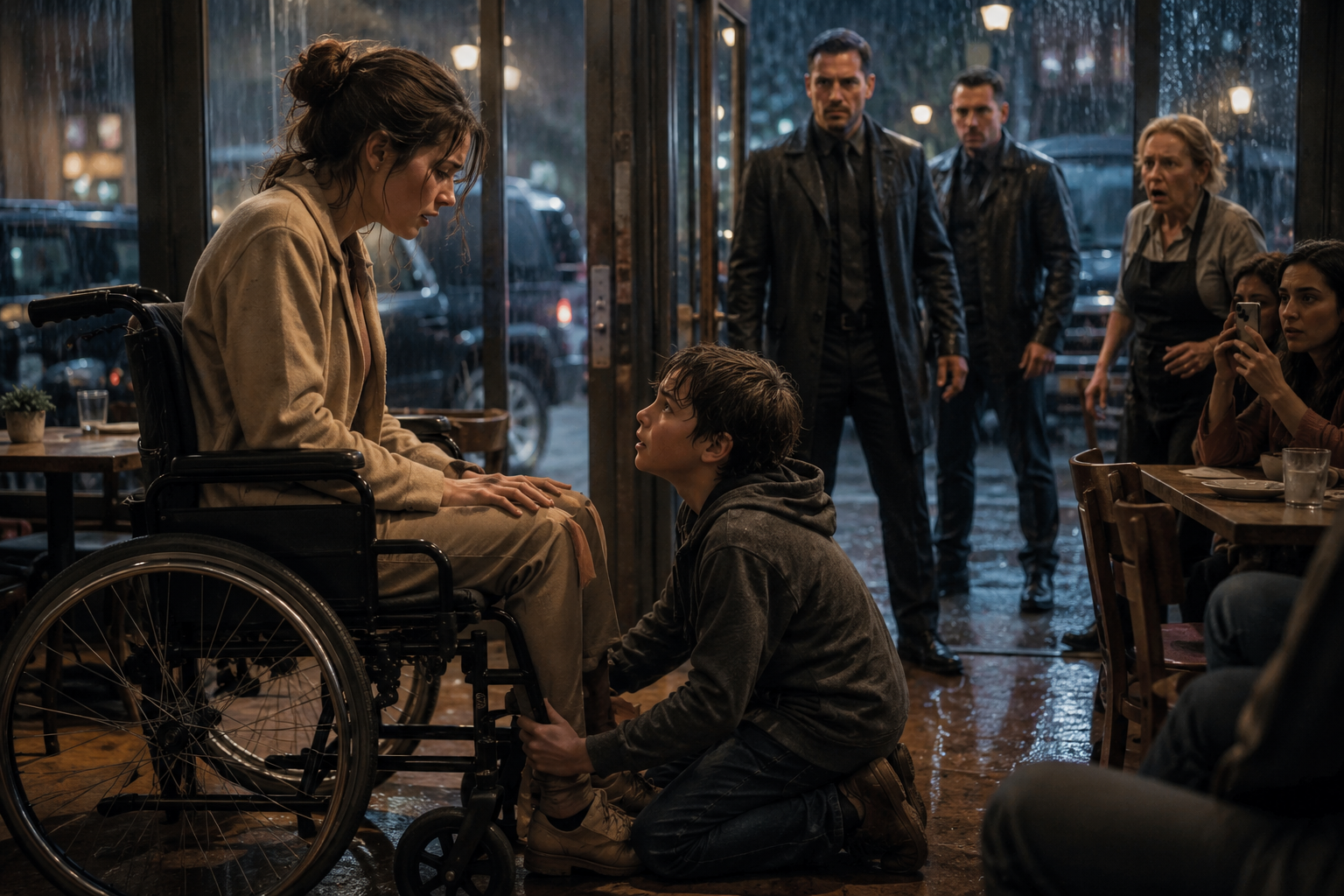
A boy was kneeling on the floor in front of her.

He could not have been older than ten.

His hair was black and messy, plastered to his forehead by rain. His hoodie was too thin for the weather, the sleeves stretched and dirty. His face was pale in the way hungry children become pale, not from illness alone, but from being tired too long. Both of his small hands were wrapped around Clara’s ankles.

His fingers trembled.

His eyes were full of panic.

“Please,” he whispered. “You have to stand up.”

Clara almost laughed.

Not because it was funny.

Because it was the most impossible sentence anyone had said to her in years.

“I can’t,” she breathed.

The boy shook his head so hard tears slipped down his cheeks.

“Yes, you can. Please. I’m sorry. I didn’t mean to do it here.”

A sharp heat climbed from Clara’s feet into her calves.

She gasped.

Pain followed.

Not the dull phantom pain she had learned to ignore. This was bright, electric, living pain. It tore through muscles that had slept for years. It flashed behind her knees, crawled up her thighs, and stole every bit of air from her chest.

Her body remembered something before her mind could catch up.

Movement.

Weight.

Balance.

A man at the next table stood.

“Miss? Are you okay?”

Clara could not answer.

She was staring at the boy.

“What did you do?”

He looked over his shoulder toward the café door.

That was when Clara saw them.

Two men had just stepped inside.

They wore dark coats, clean shoes, and expressions too empty to belong to ordinary customers. They did not glance at the menu board. They did not shake rain from their shoulders. Their eyes moved through the room with cold purpose until they landed on the boy kneeling at Clara’s feet.

The boy’s hands tightened around her ankles.

“They found me,” he whispered.

Something in Clara changed.

For almost four years, the world had looked at her and seen damage.

A woman in a chair.

A rich man’s broken daughter.

A sad face on foundation brochures.

But terror on a child’s face can wake up parts of a person that grief never managed to kill.

Clara gripped the edge of the table.

Her fingers slipped on spilled coffee.

Her legs shook violently beneath her.

The boy looked up, horrified.

“No,” he whispered. “Don’t. It hurts too much the first time.”

The first time.

Clara heard the words beneath the words.

He knew.

He had seen this happen before.

One of the men began walking toward them.

“Mrs. Voss,” he said calmly. “Please move away from the child.”

Clara’s blood went cold.

They knew her name.

The café owner, a broad-shouldered woman with silver braids and an apron dusted with flour, stepped from behind the counter.

“Who are you?” she demanded.

The man did not look at her.

“The boy is a patient under supervised care. He ran from a medical facility. We are here to return him safely.”

The boy made a sound that did not belong in any child’s throat.

“No,” he said. “No, no, no. Not back there.”

Clara looked at the man.

Then at the child.

Then down at her legs.

The pain was terrible now. Her muscles were trembling so hard she thought her bones might crack. But sensation was moving through her body like fire finding a house full of locked doors.

“Behind me,” Clara told the boy.

He stared at her.

“You can’t walk.”

Clara looked at the approaching men.

“For once,” she said, “I’m not sure that’s true.”

She pushed down on the table.

The café gasped.

Her knees buckled.

She nearly fell forward.

But the boy reached up, not to pull her, not to force her, only to steady her wrist.

The heat surged again.

Clara cried out.

And then she rose.

One inch.

Two.

Her body shook. Her teeth clicked together. Her hands turned white around the table edge.

But she stood.

For the first time in almost four years, Clara Voss stood on her own feet.

The café erupted in whispers.

Someone dropped a glass.

The café owner covered her mouth.

The man in the dark coat stopped moving.

His face changed.

Only slightly.

Not shock.

Recognition.

He had expected this.

And that frightened Clara more than anything else.

The second man whispered, “It worked.”

The boy began to sob.

“I’m sorry,” he said. “I didn’t want them to see. I didn’t want them to know I did it again.”

The first man softened his voice.

“Jonah,” he said. “Come here.”

So the boy had a name.

Jonah.

Clara reached down, grabbed his wrist, and pulled him behind her.

Her legs were already failing. Pain clawed up her spine. The café tilted and blurred at the edges. But she kept herself between the child and the men.

“He came in for help,” Clara said.

The man’s jaw tightened.

“You don’t understand what he is.”

“I understand what he looks like,” Clara said. “Hungry. Terrified. Hunted.”

“He is dangerous.”

Clara turned slightly.

Jonah was hiding behind her wheelchair, one hand over his mouth, his small shoulders shaking under that thin wet hoodie.

Dangerous.

The word was disgusting.

Before the man could step closer, the café owner moved between them with a hot coffee pot in one hand.

“I need you to leave,” she said.

“This is official medical business.”

“No,” she said. “This is my café. And I said leave.”

Around the room, people began to stand.

Not everyone.

But enough.

A college student blocked the side aisle with a chair. An old man near the window lifted his cane. A woman in a business suit raised her phone and started recording.

The man in the coat looked around and calculated.

Clara saw the exact second he decided this room had become too public.

For now.

He smiled at Jonah.

“We’ll see you soon.”

Then his eyes shifted to Clara.

“And we’ll see you too, Mrs. Voss.”

The men left.

A black SUV remained across the street for nearly a minute before pulling away.

Only when it disappeared did Clara collapse back into her wheelchair.

The pain hit all at once.

She cried out.

Jonah screamed too, as if he believed he had broken her.

The café owner rushed forward.

“Miss Clara—”

“I’m okay,” Clara lied.

She was not okay.

Nothing in the world was okay anymore.

Jonah stood beside her chair with his head lowered, waiting for punishment.

That broke Clara’s heart more than the pain.

A child should not stand like that.

A child should not expect cruelty as naturally as weather.

“Jonah,” she said gently.

He flinched at his own name.

Clara swallowed.

“Are you hungry?”

He looked up.

For a second, he seemed confused by the question.

Not because he wasn’t hungry.

Because no one had asked him without wanting something in return.

He nodded once.

The café owner wiped her eyes with the back of her wrist.

“My name is Maribel,” she said. “And you, baby, are about to eat like somebody’s grandmother is mad at you.”

Ten minutes later, Jonah sat across from Clara with pancakes, eggs, toast, fruit, soup, and a mug of hot chocolate he held with both hands as if someone might take it away.

At first, he ate too quickly.

Clara reached across the table and touched the edge of his plate.

“No one is going to steal it from you.”

His spoon stopped.

His little chin trembled.

“I didn’t mean to make you walk.”

“You tried to help me.”

“If I help people,” he whispered, “they find me.”

“Who?”

“The doctors.”

Maribel, who had been pretending to wipe a clean counter, froze.

Clara leaned closer.

“What doctors?”

Jonah looked toward the window.

“The ones from the glass building. They call it the Institute.”

Clara had spent too many years around hospitals, research labs, medical donors, experimental boards, and wealthy people who loved renaming ugly things until they sounded noble.

Institute.

Center.

Foundation.

Sanctuary.

People could hide anything behind a beautiful word.

“Were you sick?” Clara asked.

Jonah shook his head.

“My sister was.”

The room seemed to quiet around them.

“What’s her name?” Maribel asked softly.

“Lily.”

“How old is Lily?”

“Six.”

Jonah stared into his soup.

“She had seizures. Bad ones. My mom took her there because they said they could treat her for free. They gave us a room. Food. Medicine. They were nice at first.”

“At first,” Clara repeated.

He nodded.

“Then Lily had a seizure in front of me. I held her hand because she was scared. And then she stopped shaking.”

Clara felt the skin on her arms rise.

Jonah rubbed his palms together.

“I don’t know how it happens. I just feel where the hurt is. Like a buzzing. Like something screaming under the skin. And then I… I ask it to be quiet.”

Maribel whispered, “Lord have mercy.”

“What happened after they found out?” Clara asked.

Jonah’s voice shrank.

“They stopped treating Lily and started testing me.”

Clara’s fingers curled around her coffee cup.

“They put wires on my head. Needles in my arms. Machines everywhere. They brought people in and told me to fix them. If I couldn’t, they got angry. If I did, they brought more.”

“Did it hurt you?” Clara asked.

Jonah did not answer.

He didn’t have to.

Maribel pushed away from the counter.

“I’m calling the police.”

“No!” Jonah grabbed her sleeve. “Please. The police take me back. The Institute has papers.”

Clara went still.

“What kind of papers?”

“They said my mom signed them. They said I belong there until I’m stable.”

Belong.

Clara hated that word.

Children did not belong to buildings.

Children did not belong to doctors.

Children did not belong to rich men with contracts.

“Where is your mother now?” Clara asked.

Jonah stared at the table.

“I don’t know. They said she stopped coming because she didn’t want us anymore.”

Clara heard the lie immediately.

Maybe because she had lived inside softer lies.

You will adjust.

This is your new normal.

Your father only wants what is best.

Your body is finished hoping.

People in power loved telling the vulnerable stories that made obedience easier.

Clara looked at Jonah and made the first reckless decision of her new life.

“You’re coming with me.”

Maribel’s eyes widened.

“Excuse me?”

“So are you,” Clara said.

“What?”

“They know my name. They saw you protect him. If they can find me, they can find you.”

Maribel stared at her for two seconds.

Then she cursed under her breath, grabbed her coat, and took a pie from the display case.

Clara blinked.

“Are you bringing pie?”

“I don’t run from evil men on an empty stomach.”

For the first time, Jonah almost smiled.

They did not go to Clara’s house.

Her penthouse was too obvious. Her driver knew too many people. Her father had connections in every hospital, charity board, and private research fund in the city.

Instead, Maribel drove them in her old green car to her brother’s house on the west side.

Her brother, Theo, opened the door holding a baseball bat.

He was built like a wall and had the suspicious eyes of a man who had once worked security and never forgot how people lied.

Maribel explained everything in one breath.

A starving boy.

A miracle touch.

A woman in a wheelchair standing up.

Men in dark coats.

A medical institute.

Theo looked at Clara.

Then at Jonah.

Then at the wheelchair.

Then at the pie.

Finally, he stepped aside.

“I made stew,” he said.

That was how Clara’s second life began.

Not with a press conference.

Not with doctors.

Not with applause.

With stew, borrowed socks, and a terrified boy sleeping on a couch under three blankets because he was too exhausted to keep running.

That night, Clara sat at Theo’s kitchen table while Maribel made calls and Theo watched the street through the curtains.

Her legs ached beneath the table.

A real ache.

Muscle.

Nerve.

Possibility.

She should have felt joy.

Instead, every time she looked at Jonah sleeping, guilt rose inside her.

He had given her something impossible.

And it had cost him.

Clara searched on her phone until one name made her hand go numb.

The Vale Institute for Restorative Medicine.

She knew the name.

Not because she had been treated there.

Because her family had donated millions after her accident.

Her father had once sat beside her at a gala and said, “If your suffering helps others, then at least it has meaning.”

Your suffering.

As if her broken spine belonged to him too.

Clara opened the Institute’s board page.

Photos loaded slowly.

Doctors in white coats.

Children holding stuffed animals.

Glass hallways full of light.

Donors in tuxedos.

At the bottom of the advisory board, she saw it.

Malcolm Voss — Founding Patron.

Her father.

The room seemed to tilt.

Theo glanced over.

“You okay?”

“No,” Clara said.

And for once, she did not pretend otherwise.

By morning, Clara called the only medical person she still trusted.

Dr. Leona Hale had been her physical therapist during the first year after the accident. She had never promised miracles, but she had never murdered hope for convenience either.

When Leona arrived at Theo’s house and saw Clara standing between two kitchen chairs, she dropped her medical bag.

“Clara,” she whispered.

“I need you to examine me,” Clara said. “Then I need you to examine him.”

Jonah stood behind Maribel in Theo’s oversized sweatshirt, the sleeves hanging past his hands.

Leona’s face softened.

“Hi, sweetheart.”

Jonah looked at Clara first, asking without words if the doctor was safe.

That trust landed on Clara like a weight.

“She’s safe,” Clara said.

Leona spent two hours testing Clara’s reflexes, sensation, strength, range of motion, and balance.

Every time Clara’s foot responded, Leona looked both amazed and frightened.

Finally, she sat back.

“This should not be happening.”

“I know.”

“No,” Leona said. “I mean medically, structurally, scientifically, this should not be happening. But it is.”

Jonah began to cry silently.

Leona noticed at once.

She moved toward him and knelt, careful not to touch.

“Did someone hurt you when you helped people?”

Jonah nodded.

“Can you show me?”

He slowly pushed up one sleeve.

Clara stopped breathing.

His arm was marked with pale scars and tiny puncture wounds.

Maribel turned away, one hand over her mouth.

Leona’s face became very still.

Good people often looked most terrifying when they were trying not to break in front of a child.

“Jonah,” she said softly, “none of this was your fault.”

He stared at her.

“They said if God gave me hands, I had to use them.”

Leona’s eyes filled.

“God does not give children pain so adults can make profit from it.”

Jonah wiped his nose on his sleeve.

For the first time since the café, his shoulders relaxed.

Just a little.

Then Theo called from the window.

“We have company.”

Two black SUVs turned slowly onto the street.

Jonah froze.

“They came.”

Maribel grabbed him.

Leona stuffed her tools back into the bag.

Clara stood too quickly and nearly screamed from the pain.

Theo lifted the bat.

“Nobody’s taking a kid out of my house.”

But Clara knew a bat would not stop men like that.

Running would only delay them.

Hiding would only make Jonah smaller.

Clara looked at her phone.

Then at the Institute’s page.

Then at Jonah.

For years, the world had known her face. They had watched her disappear after the accident, then reappear at careful public events, smiling beside her father while donors called her courageous.

People trusted her suffering because it looked clean from a distance.

Maybe it was time to make that trust useful.

Clara opened her camera.

Maribel stared at her.

“What are you doing?”

Clara turned the phone toward herself.

“Going live.”

The SUVs stopped outside.

Doors opened.

Clara pressed the button.

At first, hundreds joined.

Then thousands.

Then tens of thousands.

People knew her face.

They knew the wheelchair.

They knew the accident.

Now they saw her standing in a stranger’s kitchen, pale and shaking, with a frightened boy hiding behind her.

“My name is Clara Voss,” she said. “Almost four years ago, I was told I would never walk again. Yesterday, a starving child named Jonah touched my legs in a café, and I stood.”

Comments exploded.

Clara ignored them.

“The men outside this house are here for him. They claim he belongs to a medical facility called the Vale Institute for Restorative Medicine. My family has donated to that Institute. My father is one of its founding patrons.”

Someone pounded on the door.

Theo shouted, “Back up!”

Clara kept her eyes on the camera.

“This child has needle marks on his arms. He says he was forced to heal people while his sick sister was used to control him. I do not yet know who knew. I do not yet know who lied. But I know this.”

She reached back and took Jonah’s hand.

“He is not property. He is not research. He is not a miracle for sale.”

The pounding came again.

A voice outside called, “Mrs. Voss, open the door. We are here to retrieve the minor.”

Clara turned the camera toward the door.

Later, millions of people would say that was the moment everything changed.

Not when Clara stood.

Not when Jonah healed her.

But when the world heard grown men demanding a child while calling it care.

The live stream spread faster than the Institute could control.

Journalists joined.

Lawyers joined.

Doctors joined.

Parents began commenting names, dates, missing records, unanswered calls.

Neighbors came out with phones.

The men outside tried to leave, but the street had filled with witnesses.

And that was what powerful people feared most.

Not anger.

Witnesses.

By noon, the Vale Institute released a statement saying Jonah Reed was “a medically vulnerable minor unlawfully removed from supervised treatment.”

By one, Dr. Leona Hale posted photographs of his injuries with his face hidden and demanded an emergency investigation.

By two, three families had come forward claiming the Institute had taken their children into long-term programs they could no longer access.

By sunset, Clara’s father called.

She stared at his name on the screen.

Malcolm Voss.

The man who taught her how to smile for donors before he ever taught her how to tell him no.

She answered on speaker.

His voice was tight.

“Clara, what have you done?”

She almost laughed.

Not because it was funny.

Because it was exactly what he would ask.

Not are you safe.

Not can you walk.

Not who hurt that child.

What have you done?

“I told the truth,” she said.

“You exposed a respected medical institution based on the word of a disturbed boy.”

Jonah flinched.

Clara’s vision sharpened with fury.

“Do not call him that.”

“You are emotional.”

There it was.

The word people used when they wanted a woman back in her cage.

Emotional.

As if anger at cruelty were an illness.

As if compassion were hysteria.

As if her wheelchair had made her decorative and standing had made her dangerous.

“You’re on the board,” Clara said. “What did you know?”

Silence.

Too much silence.

“Dad.”

He sighed.

“You don’t understand what the Institute was trying to accomplish.”

The kitchen went still.

Even Maribel stopped breathing.

Clara’s voice became very quiet.

“What did you know?”

“They were studying rare regenerative responses. Do you understand what that means? It could have changed medicine. It could have helped people like you.”

“People like me?”

“Yes. People trapped inside bodies that—”

“Stop.”

He stopped.

Clara looked at Jonah, wrapped in a blanket on Theo’s couch, staring at her with wide, frightened eyes.

“Did you know they were using children?”

Her father said nothing.

That silence was the answer.

Something broke inside Clara.

Not her heart.

Not exactly.

It was the final collapse of the daughter who had still wanted her father to be better than the institutions he funded.

“You paid for the place that tortured him,” she said.

“Progress has costs, Clara.”

There it was.

The sentence monsters said when they wore expensive suits.

Progress has costs.

“Yes,” Clara said. “And this time, you’re going to be one of them.”

She hung up.

Then she sent the recorded call to three journalists.

The investigation began before morning.

Not a polite internal review.

Not a quiet board meeting.

A real investigation.

Because now the public had the story by the throat, and no powerful person could bury it without being seen holding the shovel.

For the next week, Theo’s house became a command center.

Lawyers came.

Reporters called.

Social workers arrived with emergency protection orders.

Families appeared with folders, photographs, medical bills, and stories that sounded too much like Jonah’s.

A girl who could calm seizures.

A boy whose touch reduced swelling.

A toddler whose blood showed impossible healing markers.

Children taken from poor families with promises of free care, housing, medicine, scholarships, hope.

Hope, Clara learned, was the easiest thing to sell to desperate parents.

Jonah barely spoke through most of it.

He stayed close to Maribel, sometimes close to Clara. At night, he woke screaming for his sister.

Lily.

Six years old.

Missing.

That was the truth that finally shattered him.

He had not run only from testing.

He had run because Lily had disappeared.

“They said she got transferred,” he sobbed one night. “But they wouldn’t tell me where. I tried to feel her. I can always feel her when she’s close. But she was gone.”

Clara made him a promise she had no right to make.

“We’ll find her.”

Maribel looked at Clara, terrified by the size of that promise.

But Jonah nodded.

Because children in pain do not need perfect odds.

They need one adult willing to stand between them and despair.

Three days later, Leona found the clue.

A billing code buried in leaked files pointed to an off-site facility in northern Michigan, officially listed as a pediatric recovery retreat.

Unofficially, according to a nurse who contacted reporters anonymously, it was where the Institute moved children whose cases had become “sensitive.”

By then, Clara could walk short distances with braces and two canes.

Every step hurt.

Every step felt like stealing herself back from the grave.

When federal agents told her to stay behind during the raid, she refused.

They said it was unsafe.

Clara said unsafe was a word people had used too late around Jonah.

So before dawn, she waited in a van outside the facility with Maribel, Theo, Leona, and Jonah while agents entered the building.

Jonah held Clara’s hand so tightly her fingers went numb.

“What if she’s not there?” he whispered.

Clara did not lie.

“Then we keep looking.”

“What if she hates me for leaving?”

“She won’t.”

“You don’t know.”

“No,” Clara said. “But I know what it feels like to be alone and think no one is coming. If Lily knows you, she knows you came back.”

The facility doors opened.

Agents came out with children wrapped in blankets.

One.

Two.

Four.

Seven.

Then Jonah screamed.

“Lily!”

A tiny girl with a shaved patch near her temple turned her head.

For one terrible second, her face was empty.

Then she saw him.

“Jo!”

He broke away from Maribel and ran.

Lily ran too, stumbling in oversized socks, and the two children collided in the middle of the parking lot so hard they almost fell.

Jonah held his sister like she might disappear if he left even an inch of space between them.

Everyone cried.

Agents.

Doctors.

Theo.

Maribel, loudly and without shame.

Clara stood beside the van with her canes beneath her hands, shaking from pain, cold, and the force of what she was seeing.

Leona stood beside her.

“You should sit,” she whispered.

“Not yet,” Clara said.

Because some moments deserved to be witnessed standing.

Lily was alive.

Not unharmed.

Not untouched.

But alive.

And when Jonah looked back at Clara over his sister’s shoulder, his face changed.

For the first time since the café, he looked like a child who believed morning could arrive without fear.

The trial lasted almost a year.

Malcolm Voss resigned before he could be removed, which was exactly like him. He called it stepping away for the good of the foundation.

Prosecutors called it conspiracy, obstruction, and criminal negligence.

Clara testified.

So did Leona.

So did Maribel.

So did families who had been told their children were receiving care when they were actually being isolated, studied, pressured, and used.

Jonah did not testify in open court.

Clara made sure of that.

His statement was recorded privately with a child advocate present, and even then, he only spoke because Lily sat beside him holding his hand.

The world wanted to make Jonah a miracle.

Clara fought to make him a boy.

That became her mission.

Not walking.

Not headlines.

Not the fame that came roaring back after people saw her take steps on camera.

She created the Jonah and Lily Trust with Maribel and Leona, built to protect vulnerable children from medical exploitation. It funded legal advocates, family housing, independent oversight, emergency guardianship help, and second opinions for experimental treatment programs.

People donated because they loved the miracle story.

Clara used the money to fight the machines that tried to own miracles.

One year after the café, Clara returned.

Not for cameras.

Not for publicity.

Just breakfast.

Maribel had bought the café with help from Theo and one silent investor who refused to stay silent for very long.

That investor was Clara.

A small brass plaque near the front window read:

No child leaves hungry from this place.

Jonah sat across from Clara in a clean blue sweater, eating pancakes slowly because he no longer had to fear the plate would vanish.

Lily sat beside him, arranging strawberries into the shape of a crooked heart.

Maribel brought coffee to the table and pretended not to cry.

“You walking in here still gets me,” she said.

Clara looked down at her legs.

She wore braces beneath her jeans. She still used one cane. Some days hurt more than others.

But she was standing.

Living.

Moving.

Not cured like a fairy tale.

Healed in a way medicine still could not explain and trauma still could not take away.

Jonah watched her carefully.

“Do they still hurt?” he asked.

“My legs?”

He nodded.

“Sometimes.”

His face fell.

Clara reached across the table.

“Jonah, look at me.”

He did.

“You did not hurt me. You gave me a door. I’m the one learning how to walk through it.”

His eyes filled.

“I was scared if I helped you, they would find me.”

“They did,” Clara said gently. “And then everyone found them.”

Lily looked up from her strawberries.

“Does that make Jonah a superhero?”

Maribel snorted.

“No, baby. It makes him a child who needs to finish his breakfast before it gets cold.”

Jonah smiled.

A real smile.

Small.

Shy.

Beautiful.

That smile was better than any miracle.

Later, as the café filled with people, an older woman approached their table with tears in her eyes. She looked at Jonah, then at Clara, then seemed to swallow whatever request she had almost made.

Instead, she said, “I saw your story. Thank you.”

Jonah looked uncomfortable.

Clara squeezed his hand under the table.

The woman left money with Maribel to pay for meals for children who needed them and walked out quietly.

That happened often now.

People came because of the story.

Some came hoping to be healed.

Some came hoping to see the boy.

But the rules were firm.

No touching.

No requests.

No cameras without permission.

Jonah was not a cure.

He was not a show.

He was not proof for anyone’s faith, theory, business plan, or desperation.

He was a boy who liked pancakes, comic books, astronomy, and sitting near the kitchen while Maribel sang badly over boiling soup.

That afternoon, Clara stood outside the café as snow began to fall.

The city moved around her, loud and gray and alive.

Jonah stepped beside her.

“Do you ever wish I hadn’t done it?” he asked.

Clara looked at him.

“No.”

“Even with everything that happened?”

She thought carefully before answering.

“I wish you had never been hurt. I wish you had never been hungry. I wish the world had protected you before you had to protect anyone else.”

He leaned lightly against her side.

“But no,” Clara said softly. “I don’t wish you walked past my table.”

For a while, neither of them spoke.

Then Jonah slipped his small hand into hers.

Not to heal.

Not to ask.

Just to hold on.

And that was the ending no headline understood.

The story had never really been about a starving boy making a paralyzed woman stand.

It was about what happened after.

A café full of strangers chose not to look away.

A woman who thought her life was over found a reason to fight again.

A child who had been treated like a miracle finally got to become ordinary.

And sometimes, that is the greatest miracle of all.

The Boy Who Taught Her to Walk Was Running From Men Who Wanted to Own His Miracle
They were beauties without Photoshop or plastic surgery. Top 20 beauties from the 90s