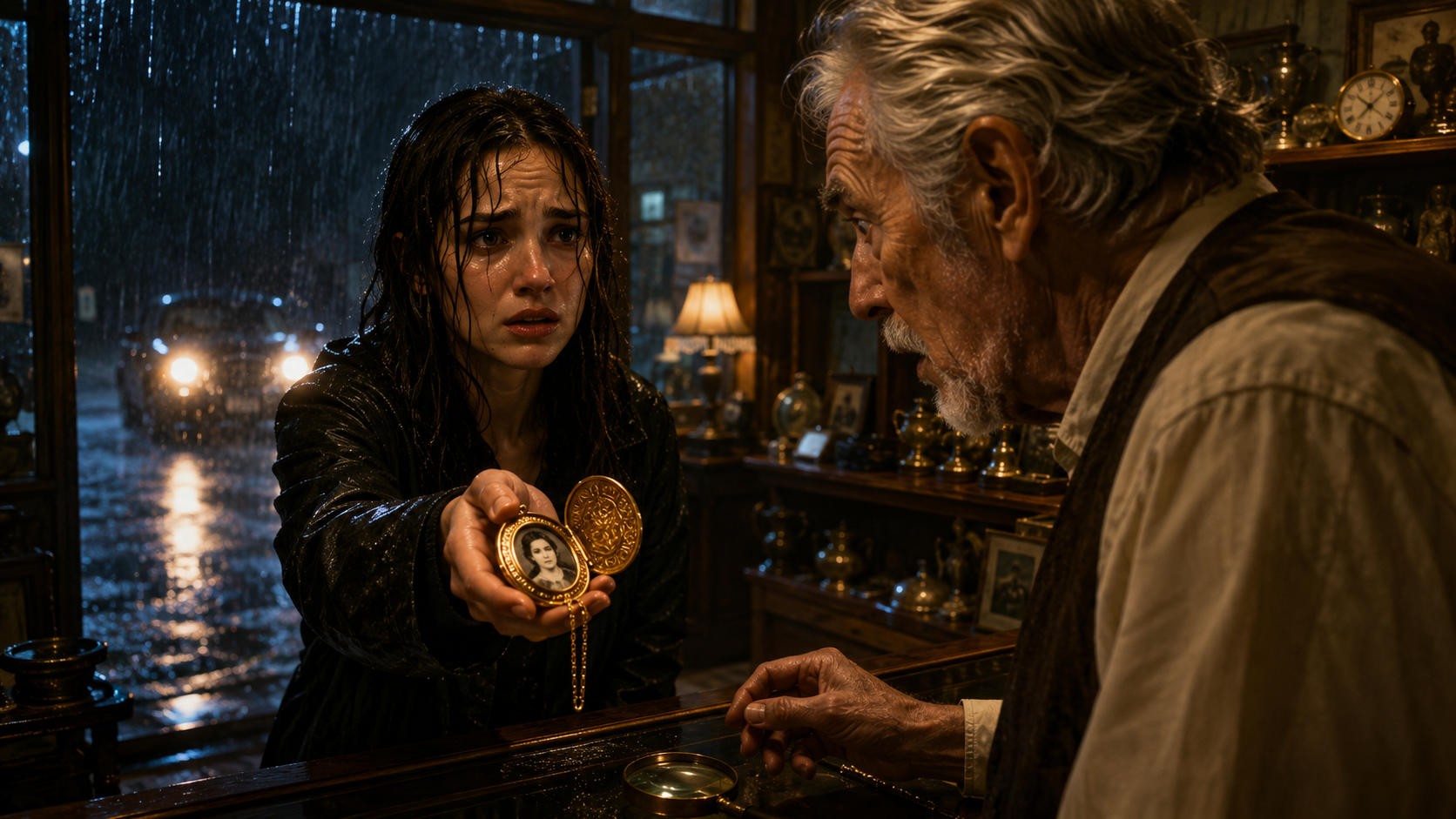
The door of the pawnshop slammed open so hard the bell above it nearly tore from its hook.
For a second, the sound cut through everything.
The rain hammering against the windows.
The soft jazz playing from an old radio behind the counter.
The quiet ticking of antique clocks lined along the back wall.
Then a young woman stumbled inside.
She was soaked through, her dark coat clinging to her thin shoulders, her hair plastered to her cheeks. Water streamed from her sleeves and gathered in shining puddles on the floor. She looked as if the storm had not merely followed her, but chased her.
Behind the counter, Silas Merrick slowly lowered the magnifying glass he had been using to inspect a cracked pocket watch.
He was an old man with sharp eyes, silver eyebrows, and hands that still moved with the patience of someone who had spent a lifetime handling fragile things. His shop sat on the corner of Briar Street and Camden Avenue, squeezed between a closed bakery and a laundromat that flickered all night.
For forty-three years, people had brought him broken jewelry, stolen-looking watches, family silver, wedding rings after divorces, and heirlooms sold with shaking hands.
Silas had learned to read desperation.
This girl was drowning in it.
She rushed to the counter and dug into the pocket of her coat.
“I need money,” she said.
Her voice cracked on the last word.
Silas did not answer immediately.
The girl opened her palm.
A necklace lay there.
Gold.
Old.
Beautiful in a way new money could never imitate.
The chain was thin but strong, and at the end of it hung a small oval locket carved with tiny leaves so delicate they looked alive beneath the yellow shop light. It was not flashy. It did not scream wealth.
It whispered history.
Silas’s expression did not change.
But something in his chest tightened.
“How much do you want for it?” he asked.
“As much as you can give me.”
“That is not an answer.”
She swallowed. Her lips were pale. Her eyes kept moving toward the window, toward the street, toward the dark blur of rain outside.
“Please,” she whispered. “I don’t have time.”
Silas reached for the locket.
The girl hesitated before handing it over, as if some part of her body refused to let go.
When the gold touched his palm, the old man went still.
It was heavier than it looked.
Not because of the metal.
Because of memory.
He turned it over carefully. The back was worn smooth where fingers must have rubbed it for years. Near the hinge, almost hidden in the engraving, was a tiny maker’s mark.
Silas knew that mark.
He had made it himself.
A lifetime ago.
The shop around him seemed to fall away. The clocks faded. The rain blurred. The girl’s frightened breathing became distant.
His thumb found the nearly invisible seam.
Click.
The locket opened.
Inside was a photograph, faded with age but protected behind a curved sliver of glass.
A little girl sat on the shoulders of a younger man. She was laughing, one hand tangled in his hair, her smile wide and missing a front tooth.
The younger man in the photo had dark hair.
No wrinkles.
No silver eyebrows.
No grief carved into the corners of his mouth.
But Silas knew his own face.
He knew the child too.
His fingers began to tremble.
The girl noticed.
“What?” she asked quickly. “What is it?”
Silas could not speak.
For eighteen years, he had dreamed of that face.
For eighteen years, he had woken from those dreams into silence.
His daughter had vanished when she was four years old. Vanished with her mother on a cold October night while he was away delivering a private estate collection to a bank vault. The police had told him there were signs of flight. Later, they told him there were signs of crime. Eventually, when no bodies were found and no ransom ever came, people stopped using careful words.
They said his wife had run.
They said his child was likely dead.
Silas had buried them without graves.
Now the proof of his missing life lay open in his palm.
“Where did you get this?” he asked.
The girl’s eyes hardened with fear.
“It’s mine.”
“No.”
Her face changed.
“What do you mean, no?”
“This locket belonged to my daughter.”
The words entered the room like thunder.
The girl stepped back.
“I didn’t steal it.”
“I didn’t say you did.”
“You’re looking at me like I did.”
“I’m looking at you like a man who has just seen the dead walk through his door.”
She froze.
Silas came around the counter too fast for his old knees. The girl turned toward the door, but he raised one hand.
“Please,” he said. “Do not run from me.”
“Then don’t call the police.”
“I won’t.”
“You don’t know me.”
His eyes moved from her face to the photograph and back again.
“What is your name?”
She looked at the door again.