The Bully Thought He Destroyed the Quiet Boy’s Future — Until the School Speakers Played the Truth

For a moment, the entire school forgot how to breathe.

The hallway outside the auditorium had always been loud at Northbridge Academy. Lockers slammed. Sneakers squeaked against polished floors. Students shouted across the corridor as if every conversation were more important than the last.

But that morning, after the first recording played through the ceiling speakers, even the air seemed afraid to move.

No one laughed.

No one whispered.

No one even pretended not to stare.

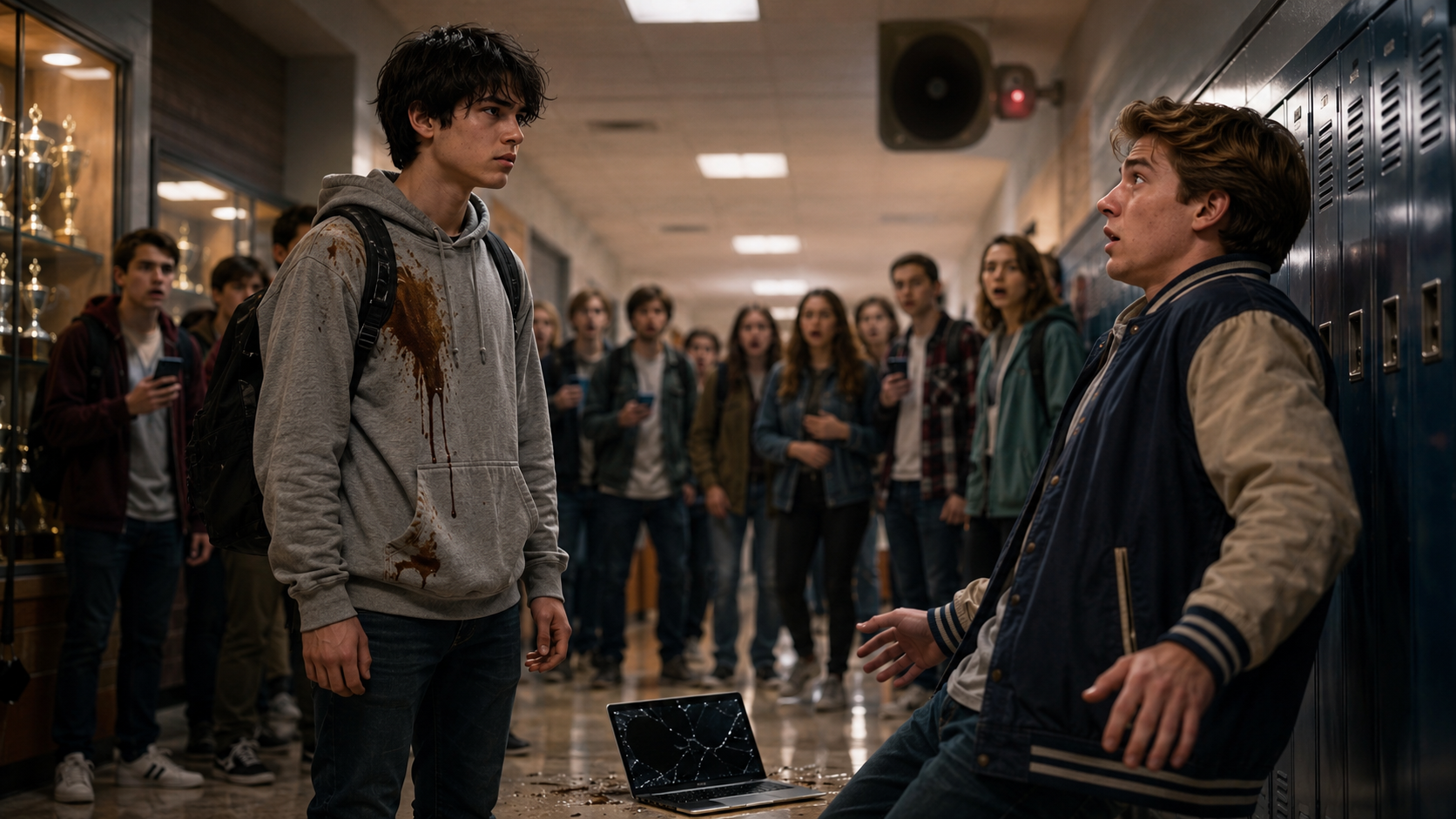
Evan Cole stood near the trophy case with cold coffee dripping from his hoodie, one hand pressed around the small recorder hidden inside his sleeve. At his feet lay the broken pieces of his laptop, its screen cracked like black ice, its keyboard drowning in a brown puddle.

Across from him, Blake Hargrove looked as if someone had pulled the ground out from under him.

Only minutes earlier, Blake had been smiling.

He had smiled when he knocked Evan’s backpack out of his hands.

He had smiled when he lifted the coffee cup.

He had smiled when he poured the whole thing slowly over Evan’s laptop while half the junior class filmed it on their phones.

“Oops,” Blake had said. “Guess the little genius won’t be submitting anything today.”

Everyone knew what he meant.

Today was the final submission deadline for the BriarTech Future Innovator Scholarship — a full ride to any university in the country, plus a summer internship at one of the biggest technology companies in the state.

Everyone also knew Evan had a real chance.

That was why Blake had done it.

But now Blake was no longer smiling.

Because the voice that had just played over the school speakers had been his.

Clear.

Sharp.

Impossible to deny.

“Make sure his laptop is useless before lunch,” Blake’s recorded voice had said. “If Evan submits that project, I’m finished. My dad already promised the board I’d win.”

The speaker hissed.

Then came another voice.

Older.

Lower.

A man’s voice.

“Blake, don’t be stupid. You don’t have to beat him fairly. You just have to make sure there’s nothing left for the judges to see.”

A girl near the lockers dropped her phone.

Someone whispered, “That’s Mr. Hargrove.”

Blake’s face turned pale.

His father, Grant Hargrove, was not just some parent.

He was the man whose name was printed on the new football stadium.

He was the man whose company sponsored the scholarship banquet.

He was the man who shook hands with principals, donated computers to classrooms, and appeared in school newsletters wearing expensive suits and generous smiles.

He was also, apparently, the man who had told his son to sabotage a quiet boy’s future.

Blake lunged forward.

“Give me that thing!”

Evan stepped back.

Two students grabbed Blake by the arms before he could reach him. Not because they had suddenly become brave. Not because they had loved Evan all along. They grabbed Blake because cameras were still recording, and no one wanted to be seen helping him now.

“Turn it off!” Blake shouted.

Evan looked at the ceiling speaker.

Then he looked back at Blake.

“No.”

One word.

Soft.

Almost calm.

But it hit harder than any punch Blake had ever thrown.

For two years, Evan Cole had been the boy nobody expected to speak. He sat in the back of classrooms. He ate lunch near the library windows. He answered questions only when teachers called on him, and even then, his voice barely rose above the hum of the lights.

Blake had mistaken that silence for weakness.

So had everyone else.

But silence was not always surrender.

Sometimes silence was storage.

Sometimes it was memory.

Sometimes it was a locked room full of evidence, waiting for the right moment to open.

Principal Mercer came rushing down the hallway, his tie crooked, his face red with anger.

“What is going on here?”

No one answered.

Students moved aside.

The principal saw Blake first.

Then Evan.

Then the ruined laptop.

Then the coffee still dripping onto the floor.

His expression shifted so quickly most students missed it.

But Evan saw it.

It was not surprise.

It was fear.

Principal Mercer lowered his voice. “Evan, hand me the device.”

Evan did not move.

“This is a school matter,” the principal said.

Evan looked down at his laptop.

Then back at him.

“So was that.”

A murmur passed through the crowd.

Principal Mercer’s jaw tightened.

Nobody spoke to him like that. Not teachers. Not students. Not parents who wanted recommendation letters or athletic approvals or a place on the board’s favorite list.

Especially not Evan Cole.

“Do you understand the seriousness of what you’re doing?” Mercer asked.

Evan’s hand tightened around the recorder.

“Yes, sir.”

Blake shook off the students holding him.

“He edited it!” he shouted. “He’s a freak. He probably used some AI thing. That’s not me.”

Evan’s eyes stayed on him.

“You said it yesterday behind the gym.”

Blake opened his mouth, but no words came out.

That was when Mrs. Linton pushed through the crowd.

She was Evan’s engineering teacher, a small woman with silver glasses and the kind of calm voice that made even angry students lower theirs. She took one look at Evan’s soaked hoodie, the broken laptop, and Blake’s panicked face.

Then she turned to the principal.

“What happened?”

Principal Mercer answered too quickly.

“There was a misunderstanding.”

Mrs. Linton looked at the laptop.

“A misunderstanding doesn’t destroy a computer.”

“There was an incident,” he said. “I have it under control.”

“No,” she replied. “You don’t.”

The hallway went silent again.

Mrs. Linton faced Evan, and her voice changed.

“Evan, are you hurt?”

His throat tightened.

Not because of the question.

Because she had said his name.

Not “young man.”

Not “buddy.”

Not “the quiet one.”

Evan.

Like he existed.

He shook his head.

“My laptop is dead.”

Her eyes softened.

“What was on it?”

Evan swallowed.

“My scholarship project.”

Blake’s mouth twitched.

Principal Mercer stepped in. “We can discuss that privately.”

Mrs. Linton ignored him.

“What project, Evan?”

He looked at the cracked screen.

Then at the crowd of students who had spent months walking past him while Blake shoved him into lockers, stole his notes, mocked his clothes, and called him names loud enough for teachers to hear.

“The WitnessNet system,” Evan said.

A ripple moved through the hallway.

Someone whispered, “That was him?”

Mrs. Linton nodded slowly.

“Yes,” she said. “That was him.”

WitnessNet was not just another student project.

It was an anonymous reporting platform Evan had built from scratch. A system where students could upload videos, voice recordings, screenshots, and written reports without revealing their identities. It automatically timestamped every file. It sent copies to multiple trusted adults. It prevented a single administrator from deleting a complaint before anyone else saw it.

Evan had built it because he knew exactly how schools protected their image.

He had built it because every hallway had witnesses.

But witnesses were afraid.

And fear made cowards out of good people.

Blake let out a sharp, nervous laugh.

“Of course he built a snitch machine.”

Nobody laughed with him.

That frightened him more than anger would have.

Mrs. Linton turned to the principal.

“That project was due today at noon.”

“I’m aware,” Mercer said.

“And you told the scholarship committee Blake Hargrove was the school’s strongest candidate.”

“Blake has leadership experience.”

Mrs. Linton’s voice hardened.

“Blake once asked me how to unzip a folder.”

A few students made choking sounds, trying not to laugh.

Blake’s ears turned red.

“This is inappropriate,” Principal Mercer snapped.

“No,” Mrs. Linton said. “This is overdue.”

That word moved through Evan like electricity.

Overdue.

That was what it was.

Not sudden.

Not dramatic.

Not one accident in a hallway.

Overdue.

Overdue was the freshman Blake made cry in the cafeteria.

Overdue was the girl whose science project he threw in the trash because she wouldn’t let him copy her notes.

Overdue was the boy who transferred after Blake spread a rumor about him.

Overdue was every teacher who looked away because Blake’s father funded their programs.

Overdue was every administrator who called cruelty “conflict” and fear “miscommunication.”

Then the speakers crackled again.

A third recording began.

Blake’s voice filled the hallway.

“Mercer said if Cole misses the deadline, nobody can prove anything. Just make sure the laptop doesn’t turn on again.”

This time, the hallway exploded.

Students shouted.

Someone cursed.

A few people turned their cameras toward Principal Mercer.

His face drained of color.

Blake backed into the lockers.

“No,” he said. “No, that’s not—”

The recording continued.

Then Grant Hargrove’s voice came through again.

“After the scholarship, your application looks clean. My company gets the donor spotlight, Mercer gets his board position, and that quiet kid goes back to being invisible.”

Invisible.

Evan closed his eyes.

That word should have hurt.

It had once.

But now, hearing it through the speakers while hundreds of students watched Blake and Mercer fall apart, the word felt different.

It sounded less like a sentence.

More like a mistake.

Because Evan was not invisible now.

Everyone could see him.

Coffee-soaked hoodie.

Shaking hands.

Broken laptop.

Recorder in his sleeve.

Flash drive in his pocket.

Truth in the air.

Principal Mercer stepped toward him again.

“Evan, give me the recorder now.”

Half the hallway moved.

Not far.

Not aggressively.

Just enough.

A wall of students between Evan and the principal.

For the first time, Mercer stopped walking.

That was when Evan understood something he would never forget.

Power looked enormous when everyone stood alone.

But when people finally stood together, power had to count bodies.

And sometimes it discovered it did not have enough.

The school security officer arrived next, breathing hard.

Behind him came two assistant principals, then the campus liaison officer.

For once, no adult seemed completely sure who was supposed to be protected.

Blake kept saying the recordings were fake.

Mercer kept saying everyone needed to calm down.

Mrs. Linton stayed beside Evan, one hand gently on his shoulder, not pushing him forward, not pulling him back.

Just making sure he was not alone.

Then Evan’s phone buzzed.

A message from his mother.

Did you submit it yet? I’m so proud of you either way.

Evan stared at the words.

His mother had worked double shifts at the hospital cafeteria for four months to help him buy the used laptop now lying broken on the floor. She had taken buses in the snow because the car needed repairs, and the repair money had gone toward software parts, cloud storage, and application fees.

That laptop had not been expensive.

But it had cost more than money.

It had cost sleep.

Pain.

Sacrifice.

Hope.

Blake had not destroyed a machine.

He had tried to destroy every hour Evan’s mother spent standing on tired feet so her son might get one door open.

Mrs. Linton saw his face change.

“Evan,” she said quietly, “tell me you backed it up.”

The hallway seemed to hold its breath.

Evan reached into his backpack.

Blake went still.

Principal Mercer stopped speaking.

Evan pulled out a small black flash drive attached to a faded keychain shaped like a rocket. His mother had bought it from a discount bin near the pharmacy register.

Three dollars.

Maybe four.

The cheapest thing he owned.

The most valuable thing in the building.

Evan held it up.

“Flash drive,” he said. “Cloud backup. Email timestamp. And a copy already submitted at 7:12 this morning.”

For one second, there was silence.

Then someone clapped.

Once.

Awkwardly.

Then another student joined.

Then another.

Within seconds, the hallway filled with applause.

It was not polished applause like at assemblies.

It was messy.

Uneven.

Loud.

Real.

Evan did not smile.

His hands were shaking too badly.

Blake stared at the flash drive as if it had betrayed him personally.

Mrs. Linton took off her blue cardigan and placed it around Evan’s shoulders.

“You’re coming with me,” she said. “And so is that drive.”

Principal Mercer stepped forward again.

“This evidence must be reviewed by administration.”

Mrs. Linton looked him straight in the eye.

“No,” she said. “It needs to be reviewed by people who are not on the recording.”

The sentence landed like a door slamming shut.

The liaison officer cleared his throat.

“I think district legal needs to be contacted immediately.”

Mercer’s mouth opened.

Then closed.

For the first time since Evan had known him, the principal had nothing useful to say.

Evan walked beside Mrs. Linton through the crowd.

Students stepped away to make room.

Some looked ashamed.

Some looked impressed.

Some looked like they wanted to apologize but did not know how to do it without making the moment about themselves.

Near the stairwell, a girl named Riley stepped forward.

She held her phone against her chest.

Her eyes were wet.

“I filmed it,” she said. “All of it. I’m sending it to you.”

Evan looked at her.

Riley had laughed at Blake’s jokes before.

Not loudly.

Not cruelly.

But enough.

Enough to make silence feel crowded.

Now she looked smaller than he remembered.

“I should’ve helped sooner,” she whispered.

Evan wanted to say it was okay.

But it wasn’t.

So he told the truth.

“Then help now.”

Riley nodded quickly.

“I will.”

By the end of the day, the video had reached parents, alumni, local reporters, and three members of the district board.

By evening, Principal Mercer had been placed on administrative leave.

By the next morning, Grant Hargrove had resigned from the scholarship committee.

By Friday, Blake was gone from Northbridge Academy.

No assembly announced it.

No email explained everything.

The school used careful words.

Investigation.

Conduct.

Review.

Appropriate action.

But everyone knew.

The hallways knew.

The lockers knew.

The trophy case knew.

And for once, the truth did not disappear into an office drawer.

Two weeks later, Evan stood in the auditorium wearing the only suit jacket he owned. It was a little too big in the shoulders because it had belonged to his older cousin, but his mother had ironed it so carefully that it looked almost new.

The BriarTech committee sat in the front row.

Mrs. Linton stood near the stage curtain.

His mother sat in the second row, gripping a tissue in both hands.

When Evan walked to the podium, the room became quiet.

Not the old kind of quiet.

Not the kind that erased him.

This quiet was attention.

Respect.

Waiting.

Evan placed his hands on the podium and looked out at the crowd.

For a second, he saw everything again.

The coffee.

The broken laptop.

Blake’s smile.

Mercer’s hand reaching for the recorder.

His mother’s message.

The flash drive.

The applause.

Then he opened his presentation.

“My project is called WitnessNet,” he said. “I built it because most schools already have witnesses. What they don’t always have is protection for the people brave enough to tell the truth.”

His voice shook once.

Only once.

Then it steadied.

He explained the system.

The encrypted uploads.

The automatic timestamps.

The multi-recipient reporting chain.

The student safety controls.

The audit trail that prevented evidence from being quietly deleted.

By the end, nobody was looking at him like the quiet boy anymore.

They were looking at him like a builder.

A survivor.

A warning.

A future.

When the scholarship chair walked onto the stage with the envelope, Evan heard his mother begin to cry before his name was even called.

The chair smiled.

“This year’s BriarTech Future Innovator Scholarship goes to Evan Cole.”

The room stood.

His mother covered her face.

Mrs. Linton clapped with both hands high, smiling through tears.

Evan walked forward, and for the first time in a long time, he did not feel small.

Later, when the reporters asked him what he wanted people to learn from what happened, Evan thought about giving a polished answer.

Something about resilience.

Something about technology.

Something about justice.

But then he thought of every kid sitting alone in a cafeteria, every student pretending not to care, every hallway full of witnesses waiting for someone else to move first.

So he told the truth.

“Bullies don’t win because they’re strong,” Evan said. “They win because everyone else stays quiet.”

He looked toward his mother.

Then at Mrs. Linton.

Then at the students watching from the back of the auditorium.

“And the moment people stop staying quiet,” he said, “they’re not as powerful as they look.”

That night, Evan’s mother taped the scholarship letter to the refrigerator.

Not because she wanted to show off.

Because for months, that refrigerator had held overdue bills, work schedules, grocery lists, and reminders of everything they could barely afford.

Now it held proof that sacrifice had not been wasted.

Evan stood in the kitchen while his mother made tea.

The apartment was small.

The floor creaked.

The heater clicked too loudly.

Nothing about their life had magically become easy.

But something had changed.

His mother turned and looked at him.

“You were very brave,” she said.

Evan shook his head.

“I was scared the whole time.”

She smiled softly.

“That’s what brave means.”

For a while, neither of them spoke.

Then Evan reached into his pocket and pulled out the little rocket keychain with the flash drive attached.

His mother laughed through tears.

“I almost didn’t buy that,” she said.

Evan looked at the cheap plastic rocket in his palm.

Then he smiled.

“Good thing you did.”

Outside, the city moved on like nothing had happened.

Cars passed.

Windows glowed.

People hurried through ordinary lives with ordinary worries.

But inside that small kitchen, beside a refrigerator now holding a future, Evan Cole finally understood something.

Blake had tried to ruin him in front of everyone.

Instead, he had given everyone a reason to finally see him.

And once the truth had a voice, it did not whisper.

It played through every speaker in the school.

The Bully Thought He Destroyed the Quiet Boy’s Future — Until the School Speakers Played the Truth
My grandmother whispered her last words to me – on Christmas morning I set out to fulfil her last wish