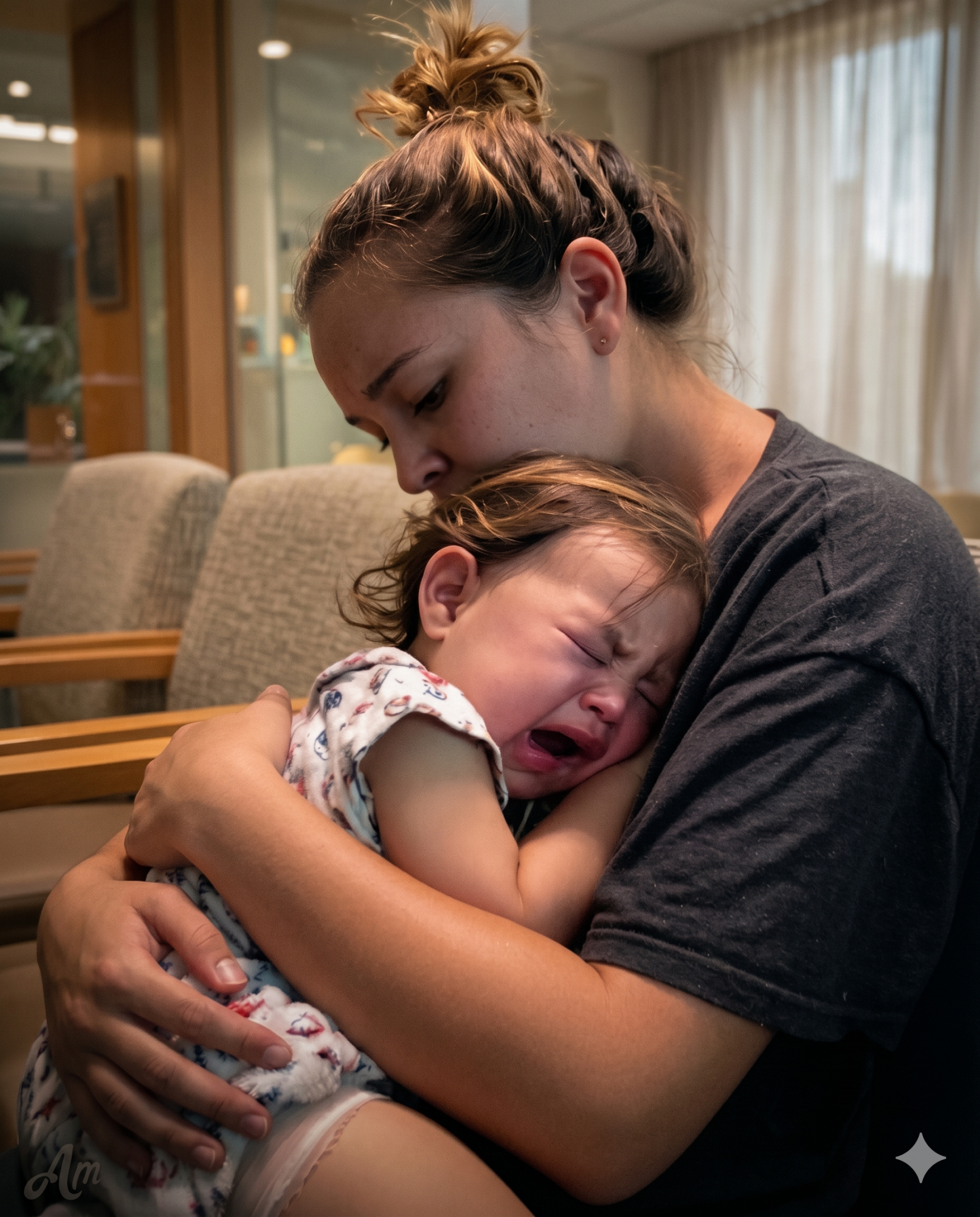
I brought my six-month-old daughter, Lily, to the emergency room after three days of fever and barely eating—and I already felt like the most inadequate mother there. Then a man sitting nearby made sure everyone else would see me that way too.
Lily had been running a fever for three days before I finally took her in.
I know how that sounds.
But I’d called her pediatrician twice. The second time, they told me if she still refused to take a bottle by morning, I should bring her to the ER.
By morning, she was barely eating… barely crying… barely even reacting.

That’s what scared me most.
Not just the heat of her skin pressed against mine.
Not just the fever.
It was the exhaustion in her eyes.
Lily was usually strong-willed—she protested everything: diaper changes, naps, even burping.
But now, she just lay against me, her eyes half-open, like even crying was too much work.
I threw diapers, wipes, bottles, and a spare outfit into our worn diaper bag, buckled her into the car seat, and drove while talking to her at every red light.
“Stay with me, baby. I’m right here.”
She made weak little sounds—barely even a cry.
By the time we reached the hospital, I looked like I’d been through a storm.
My shirt was stained with formula.
My hair was a mess.
The zipper on my bag was fraying—it had been secondhand to begin with.
And Lily just whimpered softly in my arms.
Triage moved quickly—temperature, oxygen levels, questions.
They told me we’d be seen soon.
So I sat in the waiting room, holding her close, trying not to panic.
Her sounds were thin and tired, not real cries—just fragile little whimpers that made my stomach twist.

“I know,” I whispered. “Mommy’s here.”
The room was full.
An older man clutching his side.
A teenager with a bandaged wrist.
A woman holding a sleeping child.
And one man in a crisp shirt tapping his foot loudly against the floor.
At first, he just sighed every time Lily made a noise.
Long, exaggerated sighs.
I shifted my seat and kept rocking her.
Then he spoke.
“Can you make your baby quiet?”
I turned, thinking I’d misunderstood.
He looked at me like I’d brought in noise on purpose.
“She’s sick,” I said quietly.
“So is everyone else,” he replied.
Lily whimpered again.
I kissed her forehead. “It’s okay, sweetheart.”
He muttered, “Unbelievable.”
I tried to ignore him.
I really did.
I focused on Lily, on the doors, on breathing.
Then he flagged down a nurse.
“Can you do something about this?” he said sharply.
The nurse stopped. “About what?”
He gestured toward me.
“The noise. Some of us are trying to sit in peace.”
The nurse looked at Lily, then back at him.
“She’s an infant in an emergency room.”
That should have ended it.
It didn’t.

“Then maybe she should be taken in faster,” he snapped. “Or maybe someone should calm her down.”
Heat rose in my face.
Not anger—at first.
Shame.
I know now I shouldn’t have felt that.
But when you’re exhausted, scared, and someone is publicly judging you… it gets to you.
So I said the word I wish I hadn’t.
“I’m sorry.”
The nurse—Tasha—gave me a look like she wanted to stop me.
But it was too late.
The man grew bolder.
“Some of us have real emergencies,” he added.
Tasha’s tone hardened. “That’s enough, sir.”
But he leaned closer, lowering his voice just enough to make it worse.
“Maybe if you’re this overwhelmed, you should’ve thought twice before having a kid.”
That one hit.
Not because it was true.
But because I was too tired to block it.

I held Lily tighter. “You’re okay,” I whispered, even as my voice shook.
Then the doors opened.
A staff member stepped out, scanning the room.
He looked at a clipboard—and walked straight toward me.
“Mia?” he said. “We need to take your baby right now.”
The room fell silent.
I stood, barely steady.
“Is she—?”
“We saw something in triage,” he said gently. “The pediatric team wants her immediately.”
Tasha appeared with a wheelchair. “We’ve got you.”
I held Lily close as they moved us quickly inside.
Behind me, the man spoke again. “Wait—what?”
The staff member turned.
“Sir,” he said firmly, “we prioritize based on medical need—not noise or convenience.”
The man went quiet.
No one was looking at him anymore.
Once inside, everything moved fast—but calmly.
Nurses asked questions while checking her vitals again.
A pediatric nurse gently took Lily to move more quickly, and every instinct in me screamed to grab her back—but I didn’t.

They were helping.
“Fever duration?”
“Three days.”
“Eating?”
“Almost nothing.”
“Diapers?”
“Less than usual.”
Then the doctor came in.
“I’m Dr. Reyes.”
He examined her carefully—listened to her chest, checked her ears, pressed her stomach.
He ordered fluids and tests.