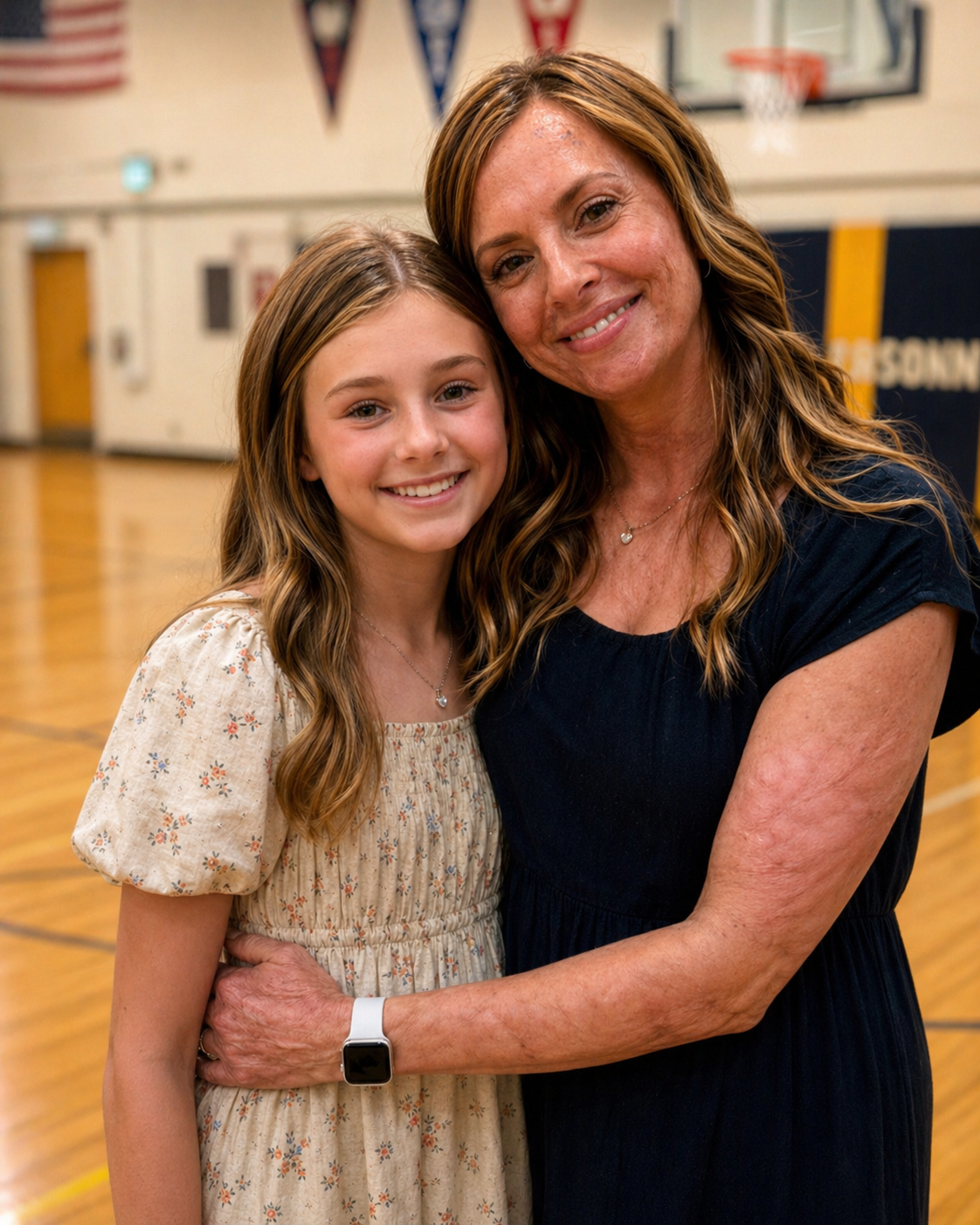
When my daughter asked me to stop coming to her school because the other children mocked my face, I thought that was the most painful thing I would ever hear. I was wrong. The following morning, I walked into her school ready to share one truth—but instead, a stranger stepped forward and revealed something far greater than I had ever intended to say.
Every morning before leaving for work, I pause in front of the mirror. The same reflection greets me—a face divided by time and fire. The left side still carries what I lost two decades ago. The scars stretch from my cheek down along my jaw and fade into my neck in uneven, raised lines. Makeup softens them, but it never truly conceals them.
Twenty years is long enough to adapt to a face that no longer feels like the one you were born with. Long enough to endure stares. And long enough to distinguish between curiosity and cruelty.
I’ve raised my daughter Clara on my own. My husband passed away after a prolonged illness when she was just three years old. Since then, it’s been the two of us, with my mother, Rose, living nearby and helping whenever she can.

I work in tech, splitting my time between home and the office. Clara has always been gentle and affectionate—a child full of warmth and endless questions. When she was younger, she would trace the scars along my neck with careful fingers and ask softly, “Does it hurt, Mom?”
I would tell her no, and she would accept that answer without hesitation.
But everything changed the day she asked me not to come back to her school.
It was one of my remote workdays, so I decided to pick her up myself. I parked and watched as children poured out of the building. Then I spotted Clara. She stood with a group of classmates—two girls and three boys. One of the boys glanced toward my car, whispered something, and suddenly they all laughed.
I didn’t hear what he said. I didn’t need to. I saw it in Clara’s body—the way her shoulders stiffened, the way her head dropped.
She got into the car without a word, tossed her backpack aside, and stared out the window as I drove.
“What happened?” I asked gently.
“Nothing,” she muttered. Then, after a pause, “Mom… can you stop coming to my school?”
The words hit harder than anything I expected.
“I love you,” she added, her voice breaking, “but I can’t handle them laughing at me anymore.”
Some words don’t just reach your ears—they settle deep in your chest. I kept my eyes on the road because I knew if I looked at her, I might fall apart.

She explained everything in fragments. Their class was preparing for a Mother’s Day event where each child would bring their mom on stage and say something about her. Clara had been excited at first. But then the teasing began.
They said things about “the monster mom.” One boy called her “the monster’s kid.” Another drew a distorted face and slid it across his desk when the teacher wasn’t looking.
“I’d rather Grandma come,” Clara said quietly. “Nobody laughs then.”
My hand instinctively moved to the scar along my jaw.
After a long silence, I asked, “Do you really know how I got these scars?”
She hesitated. “From a fire.”
“Yes,” I said softly. “But not just any fire.”
When I was sixteen, our apartment building caught fire in the middle of the night. People were rushing out, but I heard children screaming upstairs. I went back in. I brought them out. I saved them… and the fire took my face in return.
It wasn’t a story I shared often. I never wanted my life to be defined by one moment.
I reached for her hand. “I’m still coming tomorrow,” I said. “You shouldn’t have to feel ashamed of something that isn’t wrong.”
She pulled her hand away. “You don’t understand what it’s like.”
“I do,” I replied quietly. “More than you think.”
At home, my mother saw Clara’s tearful face and said nothing, just continued preparing food in silence.
I knelt in front of my daughter. “If people laugh at you because of me, then they need to learn the truth.”
“Please don’t make it worse,” she whispered.
“I’m going to make it stop.”
The next morning, I dressed carefully—not because I believed clothes could protect me, but because strength sometimes looks like preparation. I styled my hair, applied makeup, and stood ready.
“My daughter is hurting,” I told my mother. “I can’t stay home.”
She nodded. “Then go and make them think.”
At school, Clara walked beside me in silence. The auditorium buzzed with voices. As we entered, whispers spread. I felt her grip tighten.
One by one, children went on stage with their mothers. Applause followed each story. Clara shrank further into herself with every clap.
Then her name was called.
She froze.
I stood and held out my hand. Together, we walked toward the stage.
Halfway there, something struck my shoulder—a crumpled paper ball. I opened it. A drawing of a monster stared back at me.
A voice from the back shouted, “There’s the monster’s daughter!”
Laughter rippled through the room.
I stepped forward, took the microphone, and spoke.
“These scars,” I said, “are not the worst thing I’ve experienced. The worst thing is seeing my child hurt because of them.”
I began telling the story.
But before I could finish, the doors burst open.
A man hurried in, his voice cutting through the room. “You’re all laughing at her—but you don’t know the truth.”
He turned to Clara. “Your mother has kept something hidden for twenty years.”
I recognized him then—Scott, the school’s music teacher.
He stepped onto the stage. “She didn’t just save three children in that fire,” he said. “She went back in again.”
Silence fell completely.
“I was the one still inside,” he continued. “She came back for me.”
The atmosphere shifted instantly.
“The firefighters told her to stay out,” he said. “The building was collapsing. But she didn’t listen. She found me and carried me out.”
Clara looked at me, stunned.

“She didn’t lose her face saving three kids,” Scott said. “She lost it saving me.”
No one laughed anymore.
“When my parents tried to thank her,” he added, “she asked them not to tell anyone. She didn’t want me growing up feeling guilty.”
I stepped closer. “You were just a child,” I said softly.
Clara looked at me as if seeing me for the first time.
I knelt before her. “I never wanted you to feel sorry for me. I just wanted you to understand that scars don’t define a person.”
Tears filled her eyes. “I was ashamed,” she whispered.
“No,” I said, pulling her close. “You were hurting.”
A small voice from the audience spoke. “I’m sorry.”
Then another.
And another.
Clara took the microphone, her hands trembling—but her voice steady.
“This is my mom,” she said. “And she’s the bravest person I know.”
The applause that followed was overwhelming.
Later, as we drove home, she asked quietly, “Why didn’t you ever tell me about him?”
“I didn’t want that moment to define my whole life,” I said. “I wanted to just be your mom.”
She looked down. “I made it worse.”
“You were learning,” I told her.
That evening, she stood behind me as I looked into the mirror.
“Do you still hate your face?” she asked.
I shook my head. “No. It reminds me that I survived. And now… it reminds me that you see me clearly again.”
She smiled through tears.
For years, I believed my scars were the heaviest thing I carried.
But I was wrong.
The hardest part was watching my daughter fear them.
And the most beautiful part… was watching her finally understand.