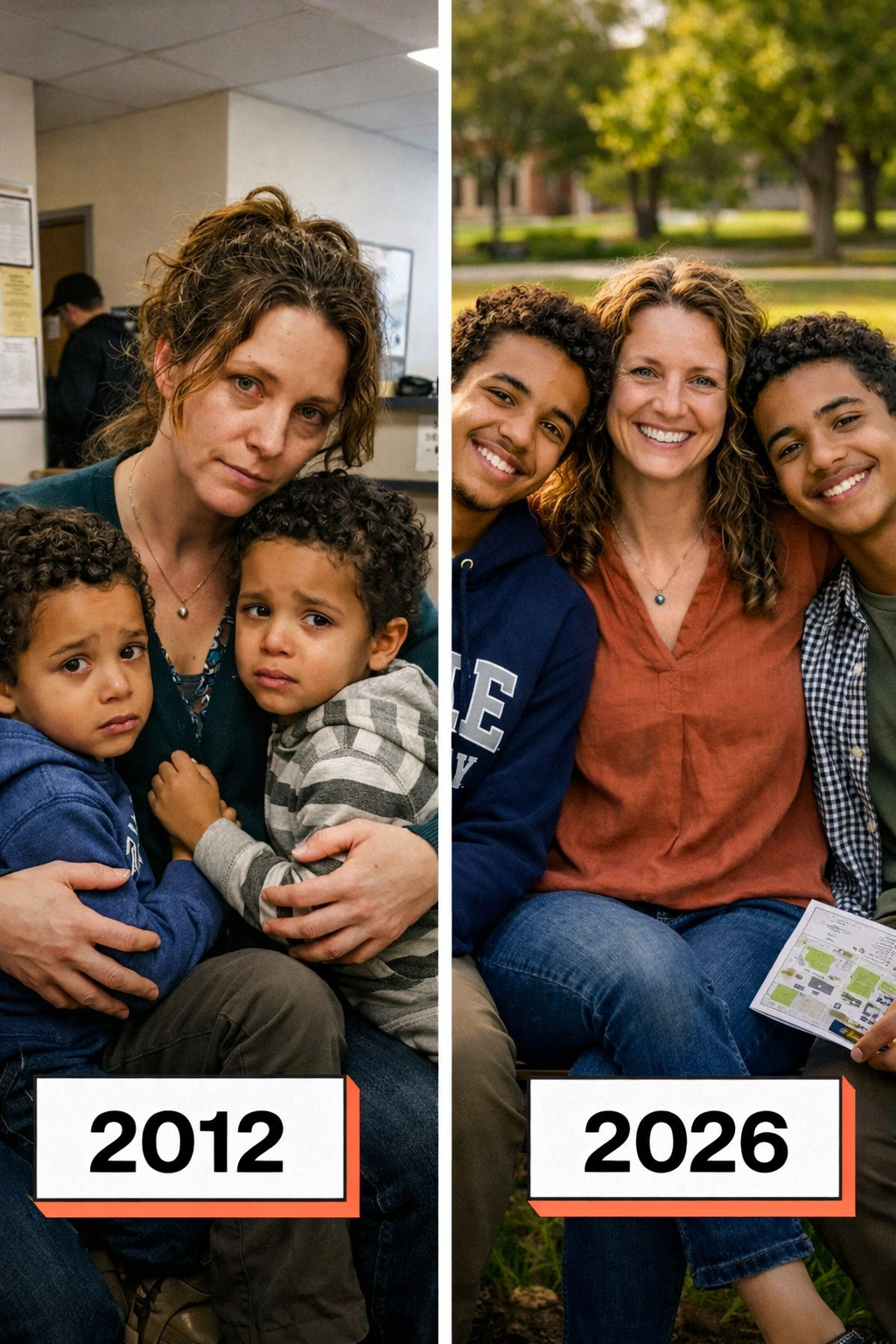
I believed my husband had died fourteen years ago… at least, that’s what I was told.
But last week, he appeared on my doorstep — alive — and calmly asked to take back the twin boys I had raised on my own all these years.
And strangely enough, that wasn’t even the most painful part.
What truly cut deep was the casual way he said, “Thanks for raising them,” as if I had been looking after his pets for a few days instead of dedicating my life to two children he abandoned.
I stood frozen in the doorway, hand still gripping the knob, staring at a man I had grieved, resented, forgiven, and mentally buried countless times over more than a decade.
Yet even that wasn’t the worst of it.
Because standing beside him… was her.
I recognized her immediately, even though we had never formally met back when it mattered. Back then, she had only existed as proof that he hadn’t been alone.
Now she stood right in front of me — the woman whose eyes my boys had inherited — as if we were simply neighbors having a casual visit.
For a moment, it felt like I had been thrown back in time. I was standing again on the street, staring at the charred remains of what used to be my home while a police officer spoke to me in a cautious, measured tone.
He had told me, “There are signs your husband may not have been alone when the fire started. A woman was with him.”
“What do you mean — a woman?” I had asked, my voice shaking.
“They found fragments of jewelry near his watch. And a neighbor reported seeing a woman arrive earlier that evening.”
My legs had given out beneath me.
“Are there any survivors?” I whispered.
He shook his head. “I’m sorry. The damage was too severe.”
That was all I had left back then: ruins… and the belief that my husband was gone.
My entire life had turned to ashes while I was away on a work trip.
The only thing I had left was my grandmother’s lake house, two hours away. A week after I moved there, I received a call from social services.
“There are children involved,” the woman on the phone said carefully.
“What children?” I asked, confused.
She paused before continuing. “The woman who was with your husband had twin boys. They’re four years old.”
“My husband’s?” I asked quietly.
“Yes. According to their birth certificates.”
“And what happens to them now?”
“They need a home. There’s no one else willing to take them.”
I let out a hollow laugh. “So you’re calling me because his mistress died, and now no one wants the children he had behind my back?”
“I’m calling because legally, you’re the closest connection they have,” she replied softly.
I should have refused. Anyone would have.
I had just lost everything — my home, my marriage, the life I thought I knew.
But instead, I said, “I’ll come.”
The first time I saw the boys, they were sitting quietly in a small office. They looked almost identical, except one had a faint scar near his eyebrow.
They were thin, silent, and clung tightly to each other, as if letting go might mean losing everything.
I crouched in front of them.
“Hi,” I said gently.
They looked at me with eyes far too old for their age.
“Do they know?” I asked the social worker.
“Only that their parents are gone.”
I looked back at them — one gripping his brother’s shirt, the other trying to appear brave.
And in that moment, one thought became crystal clear:
None of this is their fault.
“I’ll take them,” I said.
That’s how Eli and Jonah came into my life.
The early years were hard. They had nightmares, often waking in tears. Some nights they ended up sleeping on the floor beside my bed, wrapped in blankets like shields.

Nothing about it was easy.
And as they grew older, the questions began.
“What was our mom like?” Eli asked when they were eight.
“She loved you,” I said — the part of the truth I chose to hold onto.
“And Dad?”
That question was always harder.
“He made choices that hurt people,” I would say carefully.
I never lied to them. But I refused to let them carry his mistakes as their burden.
Years passed quickly.
They grew taller. Stronger. Kinder.
Eventually, they began calling me “mom.”
I worked endlessly to give them everything they deserved — a stable life, opportunities, a future.
When they turned eighteen, they had become remarkable young men.
Eli wanted to study engineering. Jonah leaned toward political science, always ready for a debate — and usually winning.
The day their college acceptance letters arrived, they opened them at the kitchen table.
“We did it,” Jonah said.
“No,” I replied through tears. “You did.”
They both looked at me.
“We,” Eli corrected softly.
I drove them to campus myself.
And then sat in my car, crying for twenty minutes.
I thought we had made it.
I thought the hardest part was behind us.
Three days later, someone knocked on my door.