A successful, wealthy woman with her own private jet.

Elena closed her eyes for a moment, and in that brief pause—almost as fleeting as a breath taken before diving into icy water—the whole Year 1 class seemed to freeze. On her lap lay a volume by Gabriel García Márquez: the pages were slightly worn by time, giving off the scent of old paper and a faint aroma of lavender, which her grandmother had once loved to place between the pages. Her fingers — slender, calm, without a single ring — rested motionless on the cover. They did not clench, did not tremble, but simply lay there as if they knew: any movement, even the slightest, would now say too much.

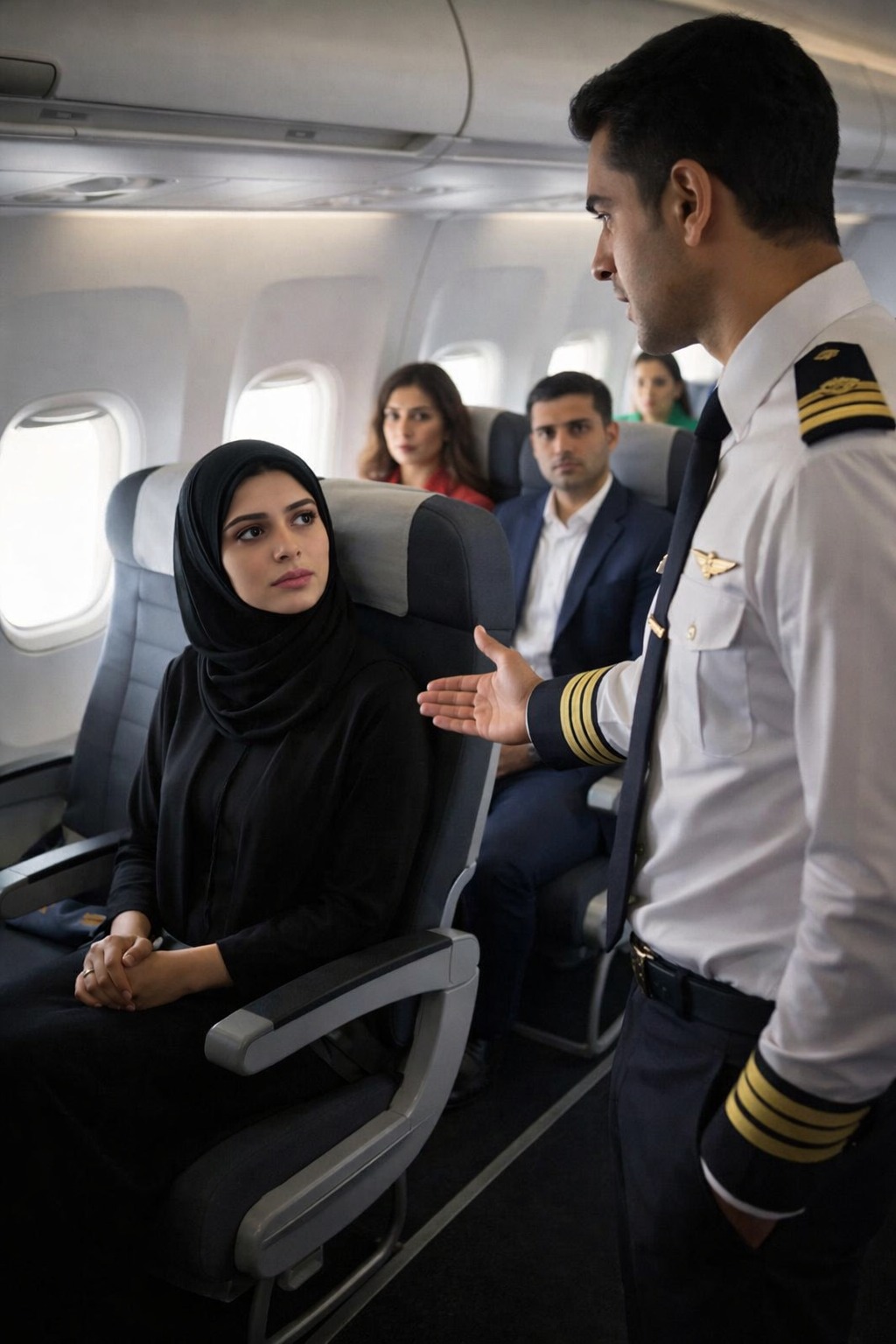
Standing over her was Alejandro Martinez—tall, fit, in a perfectly tailored uniform. He wore the silver in his hair with the same dignity with which others wear medals. Thirty years in the air had taught him to read people instantly: by their posture, their pauses, the way they averted their gaze at an awkward moment. But this woman did not look away. Her gaze—grey-green, like the raging sea off the coast of Biscay—was direct, steady, calm. Without insolence. Without fear. There was none of that fawning submissiveness he had seen all too often in economy class passengers. Only silence. Heavy, deep, like the hold of an old ship where things have been stored for years that it is not the done thing to speak of aloud.

‘Señorita,’ he said, his voice carrying the familiar chill of authority honed by years of issuing orders that no one dared to defy. ‘This seat is reserved for VIP passengers. My wife…’
Victoria, sitting across the aisle, sighed briefly and demonstratively, running her fingers through the pearls around her neck. That necklace was probably worth more than the entire wardrobe of the stranger opposite. Her perfume—rich, sweet and heavy, with notes of musk, patchouli and vanilla—slowly filled the cabin, as if trying to supplant the simple, almost pristine freshness of Elena’s linen dress. Victoria said nothing. She didn’t need to. A single glance from her said it all: a habit of privilege, a certainty of her own right, honed over years of marriage to a man for whom his own word had long been law at an altitude of ten thousand metres.

Elena didn’t move. She merely tilted her head slightly, and her braid swayed gently, like a pendulum counting down the final seconds before the inevitable. Somewhere deep inside, in that quiet chamber of memory where her mother still lived, an old reminder surfaced: ‘Don’t judge by appearances, hija. Glitter blinds. The truth always speaks in a whisper.’ Lucía never raised her voice. She simply fell silent, and in that silence people suddenly began to hear themselves — their own pettiness, greed, and feigned importance. Elena had picked this up from her. And now she was putting that lesson to use here, in this sterile cocoon of leather, metal and aluminium, where the hum of the turbines had already begun to vibrate beneath her feet, like the heartbeat of a huge beast preparing to pounce.

Three rows back, in seat 2D, the airline’s director, Enrique Santos, was drenched in sweat. Not because of the heat—the climate control was working perfectly—but because of that particular inner heat that comes when you know too much and realise you have no right to say a word. His fingers crumpled the edge of the newspaper, leaving damp marks on the paper. He saw Alejandro approach, his shadow falling over Elena, as if trying to erase her very presence. ‘God,’ flashed through his mind, ‘if only she wouldn’t stand up. If only she wouldn’t give in to that fool… Although no. She won’t give in. She never stands up. That’s precisely why she bought us all six months ago — not for the sake of power, but to see just how deeply we ourselves were mired in our own illusions.”

Alejandro felt a twinge of irritation—subtle, sharp, like a needle piercing the fabric of a glove. This woman did not argue, did not raise her voice, did not call the flight attendants, did not wave her ticket about. She simply remained where she was — unperturbed, like a rock in the middle of a current, around which the water itself was forced to change direction. And there was something agonising in that silence: not open defiance, but a mirror. In it, he unexpectedly saw himself — a captain long accustomed to believing that the sky belonged to him, and that passengers were merely cargo to be distributed efficiently. Victoria had already begun to shift nervously in her seat, and he knew: another moment — and she would erupt into her usual avalanche of complaints, which would then have to be appeased with champagne, compliments and special attention in the lounge.

‘I repeat,’ said Alejandro, now more quietly, but with that very tone that usually made flight attendants turn pale and rush to carry out his orders. ‘Move seats. This is not a request.’

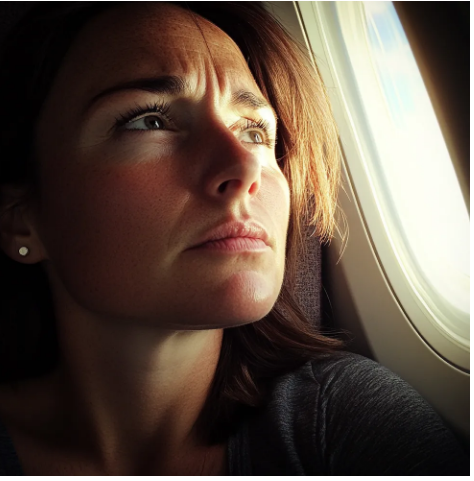
Elena slowly picked up the book and closed it, barely marking the page. She already knew the text by heart—every comma, every inflection, every pause in Macondo. The gesture was gentle, almost tender, yet there was a sense of finality to it. She turned towards the window, beyond which the lights of Madrid’s runway were already flashing — yellow, like the watchful eyes of a nocturnal predator. In the reflection of the glass, she saw her own face: plain, without make-up, with barely noticeable dark circles under her eyes after sleepless nights spent not on entertainment or balls, but poring over reports from children’s homes she was secretly helping. Four billion euros. A figure that rang hollow, like an echo in an empty hall where there was no one to applaud. Books and Literature

‘I know,’ she replied at last.

Her voice was low and velvety, with a barely audible Bilbao accent that she had never tried to hide.

‘But I’m staying.’

There was neither triumph nor defiance in those three words. Only weariness—not from the journey, but from an endless game in which she had always been forced to stay one step ahead, because it was she who had to write the rules. Something ancient stirred within her once more: the loneliness she carried with her like a second skin. New York awaited her not for contracts, not for yachts and social engagements, but for a secret meeting of which no one knew — a meeting with a woman who had once been her nanny and was now slowly dying in a cramped flat in Brooklyn. Money could buy a plane. It could buy company. But it couldn’t buy the extra time needed to say ‘I’m sorry’ for all those years when Elena had hidden behind figures and business reports.

Alejandro blinked. For the first time in thirty years of flying, he felt as though the ground were shifting beneath his feet — not because of turbulence, but because of that unflinching gaze. Victoria had already opened her mouth, ready to intervene, but at that moment Enrique Santos stood up and coughed as if the air in the cabin had suddenly become too thick. He understood perfectly well: one wrong word — and the whole fragile facade, built on lies and self-assurance, would crumble. And Elena simply waited. She waited as only the ocean knows how to wait: calmly, without malice, without haste, knowing that every wave would return to him sooner or later.

The plane shuddered as it began its take-off run. In that vibration—in the faint tremor of the seat beneath Elena’s palms, in the barely perceptible smell of kerosene seeping through even the filters—there was something akin to a promise: the most important part was yet to come. And none of those on board had yet any inkling of how painful the fall would be for those accustomed to looking down on others from above.

The plane lifted off the ground with a gentle, almost imperceptible jolt — as if a huge living creature had finally decided to trust the air. Through the window, Madrid began to shrink, turning into a scattering of lights, like smouldering embers in an old fireplace. Elena stared down motionless and felt the familiar heaviness in her chest gradually lift. At altitude, where gravity and human hierarchies lost some of their power, she always found it easier to breathe.

Alejandro Martínez returned to the cockpit, but his irritation hadn’t gone away. It had settled inside him like fine metal dust beneath the skin: invisible, yet making its presence felt with every movement. He sank into the captain’s seat, mechanically checking the instruments with movements honed by thousands of flying hours, yet his thoughts stubbornly returned to the woman in 2A. To her calmness, in which there was neither submission nor arrogance. To the way she held the book — not as a symbol of refinement, but as something with which one could sit in silence for hours, as if with a close friend. From the other side of the door came Victoria’s muffled voice—she was already demanding champagne. He knew that tone well: resentment mixed with the firm conviction that the world was obliged to immediately compensate her for any, even the slightest, discomfort.

In first class, the air seemed to have thickened. Stewardess Sofia—still very young, with a flawless smile and eyes in which weariness had already taken root—approached Elena with a glass of water. No ice. No lemon. Just as she usually asked for when flying incognito. Enrique Santos noticed this from his seat and felt his stomach clench painfully. He knew Elena’s itineraries better than his own schedule. He knew how much she hated being recognised. And he understood that her modesty was neither a game nor a mask, but perhaps the only way left for her to breathe in a world where every other person was trying to take a bite out of her name.

Elena took the glass, nodding almost imperceptibly. Sofia’s fingers lingered on the glass for a fraction of a second—a touch so light, so casual, as if the girl had sensed something real through the transparent crystal. Hidden within that barely perceptible gesture was a silent admission: ‘I see you. Not the one the others see.’ Elena replied in kind — with a tiny smile that barely touched the corners of her lips. But her eyes remained far away — there, in the memory of her mother, who had whispered before she died: ‘Don’t let them turn you into a statue, hija. Statues are beautiful, but they are cold. Stay alive.’

Victoria, unable to bear the prolonged silence, turned to Elena across the aisle. Her perfume now seemed excessively sweet, almost suffocating, like overripe fruit that was about to fall and shatter on the ground.

‘You simply don’t seem to understand who you’re talking to,’ she said in the tone she reserved for waiters, drivers and people she considered beneath her. ‘My husband is the captain of this flight. In a sense, this is his aeroplane.’

The words hung in the air, heavy as drops of mercury. Elena did not reply straight away. She set her glass down on the armrest and slowly ran her finger along its rim, as if tracing an invisible boundary between two worlds. There was much in that gesture: weariness from endless explanations, quiet pity for people who did not understand how fragile their imagined importance could be. She remembered how her father had taught her to read balance sheets, and her mother, the human heart. And after they were gone, she had to learn to read both at the same time, finding the same lies in the figures as in the smiles at charity galas.

‘I understand,’ she replied at last, very quietly, almost in a whisper, so that her words were almost drowned out by the roar of the engines. ‘But the aeroplane, señora, does not belong to man. It belongs to the sky. And we in it are merely passengers.’

Enrique Santos coughed, covering his mouth with his hand. He saw that Victoria had already opened her mouth for a fresh attack, but at that moment the plane entered a slight patch of turbulence—nothing serious, just enough to make the glasses clink softly and the general sense of confidence in the cabin sway imperceptibly. Elena closed her eyes and let the tremor pass through her, as if through a thin membrane. In that brief jolt, she thought she could hear her mother’s breathing — warm, ragged, filled with a love that never demanded anything in return.

In the cockpit, Alejandro felt the same turbulence, but his hands on the wheel remained steady. And yet, something had shifted inside him. It wasn’t fear—no, he hadn’t been afraid of the air for a long time. Rather, a vague sense that the order he had built around himself over the years had suddenly begun to resemble a house of cards placed on the deck of a ship during a storm. He did not know the name of the passenger in 2A. But he could already feel her presence—like a change in pressure before a storm.

Elena opened the book again. The pages rustled softly beneath her fingers, like a whisper in an empty old house. And with that rustle, it was as if a new chapter were beginning — not the one Márquez had once written, but the one that life itself was writing at that very moment: a story of how modesty sometimes becomes the most dangerous weapon against vanity, and how solitude, lived in silence, sometimes proves to be the only true wealth.Books and literature

The plane continued to climb. New York was still a long way off, but the distance between the people in the cabin was already beginning to shrink — slowly, inexorably, like the horizon, which always seems closer than it really is. And yet no one suspected that this flight would change not only the direction of their journey, but also how each of them would subsequently view themselves once the landing gear touched the ground again.

Elena turned the page, and the paper made a barely audible rustle—a sound reminiscent of dry leaves crunching underfoot in an autumn garden, a memory she still held from her childhood in Bilbao. The turbulence was behind them, but a tension still hung in the first-class cabin — invisible yet palpable, as if the air had been stretched tight as a string. Sofia walked past with a trolley, and her gaze lingered on Elena a little longer than it should have. There was no idle curiosity in that look — only the recognition of something familiar, almost dear: a quiet strength hidden beneath simplicity, like a root hidden beneath the earth, holding a tree steady in a storm.

Victoria had no intention of giving in. She leaned back in her chair, and her fingers once again slid nervously over the pearls, as if fingering the beads of a rosary of guilt she would never admit to. The scent of her perfume now mingled with the aroma of the leather upholstery and the faint hint of ozone from the air conditioning — a strange mixture that made Elena feel slightly dizzy.

‘Are you always so… stubborn?’ asked Victoria, and there was no longer anger in her voice, but a kind of almost childish resentment, as if her favourite toy had suddenly been taken away from her. She leaned in a little closer, and Elena felt the warmth of her breath — the warmth of a person accustomed to the space around them obediently expanding to suit their desires.

Elena closed the book again and cupped the cover in her hand, as if shielding a dear old friend from prying eyes. The gesture was slow, almost ritualistic: her fingers slid over the worn spine, and she remembered how, in the last months of her life, her mother had held this very book in her trembling hands and read aloud to distract herself from the pain. ‘The world is full of people who loudly demand what is theirs,’ Lucia used to say, ‘but true strength belongs to those who know how to remain silent and yet do not fade away.’

“Stubbornness is when a person clings to what does not belong to them,” Elena replied quietly, but every word rang out like a drop of water wearing away a stone over the years. “And I’m just sitting in my seat.”

She didn’t even turn towards Victoria. Her gaze drifted back to the window, where night had already closed in completely around the aeroplane. Rare clouds drifted slowly past the glass, illuminated by the cold silver of the moon, and for a moment it seemed to Elena that the features of her mother’s face were emerging from one of them — blurred, almost ephemeral, like a memory that could vanish at any second. A familiar wave of loneliness rose in her chest — not sharp, as in the first years after her parents’ death, but deep, muffled, like the distant sound of the ocean heard through a seashell. Four billion euros could not fill this void. They merely gave her the chance to fly to where her old nanny lived, to take her by the hand and, perhaps for the first time in many years, tell the unvarnished truth.

In the cockpit, Alejandro Martínez was checking the heading and altitude, but his thoughts were elsewhere entirely. He caught himself picturing the woman from 2A over and over again: her simple plait, her lack of make-up, that imperturbability in which there was neither pretence nor weakness. It was precisely this calmness that annoyed him more than an open scandal. It made him feel… small. As if all his thirty years in the air, all the authority he’d built up, all the respectful glances from the crew — were nothing but a thin layer of gilding on an old, cracked tree. He turned to the co-pilot, Raúl, and said something trivial about the wind, but his own voice sounded unusually muffled to him.

Enrique Santos sat motionless, staring at the back of the seat in front of him. The sweat on his forehead had already dried, but inside he was still seething. He recalled the day Elena became the company’s owner: she had walked into the office in the same simple linen dress, without security, without assistants, without fanfare. And she asked to see not the financial statements, but the reports on the salaries of flight attendants and mechanics. ‘The people who lift these planes into the sky,’ she said then, ‘must also feel that the sky belongs to them.’ At that moment, Enrique decided that this was just another whim of a rich heiress. Now, however, he understood: it was no whim. It was her quiet, stubborn revolution.

The plane entered a steady cruising phase. The hum of the engines became almost lulling—low, steady, and bone-deep. Elena felt her body gradually relax, but her mind remained on guard. She knew that silence was her greatest weapon. And at the same time, her heaviest burden. There was no sense of victory in it. Only sadness at how easily people build walls out of their own assumptions and prejudices. Victoria had already turned away, but her shoulders were still tense, and her fingers still clung to the pearls. Alejandro in the cockpit gripped the steering wheel a little tighter than necessary. And Elena simply breathed — slowly, deeply, inhaling air that belonged to no one.

Somewhere over the Atlantic, in this metal capsule suspended between sky and water, a crack was beginning to form in the familiar order of things. Not loud, not dramatic — just a thin, almost invisible fissure through which the truth could already seep. Elena knew: when the plane landed in New York, one of them would no longer be able to look at the world as they had before. And that person, most likely, would not be her.

She opened the book again. The pages, warmed by her palms, felt almost alive. There were still seven hours of the journey ahead — more than enough for the silence to do its work better than any words could. And New York awaited her with its lights and promises, which, like so much in her life, might turn out to be nothing more than a beautiful reflection in the windowpane — bright, mesmerising, but not real.

A successful, wealthy woman with her own private jet.
My Future Sister-in-Law Borrowed My Late Mom’s Wedding Dress — What She Did Next Shattered Me