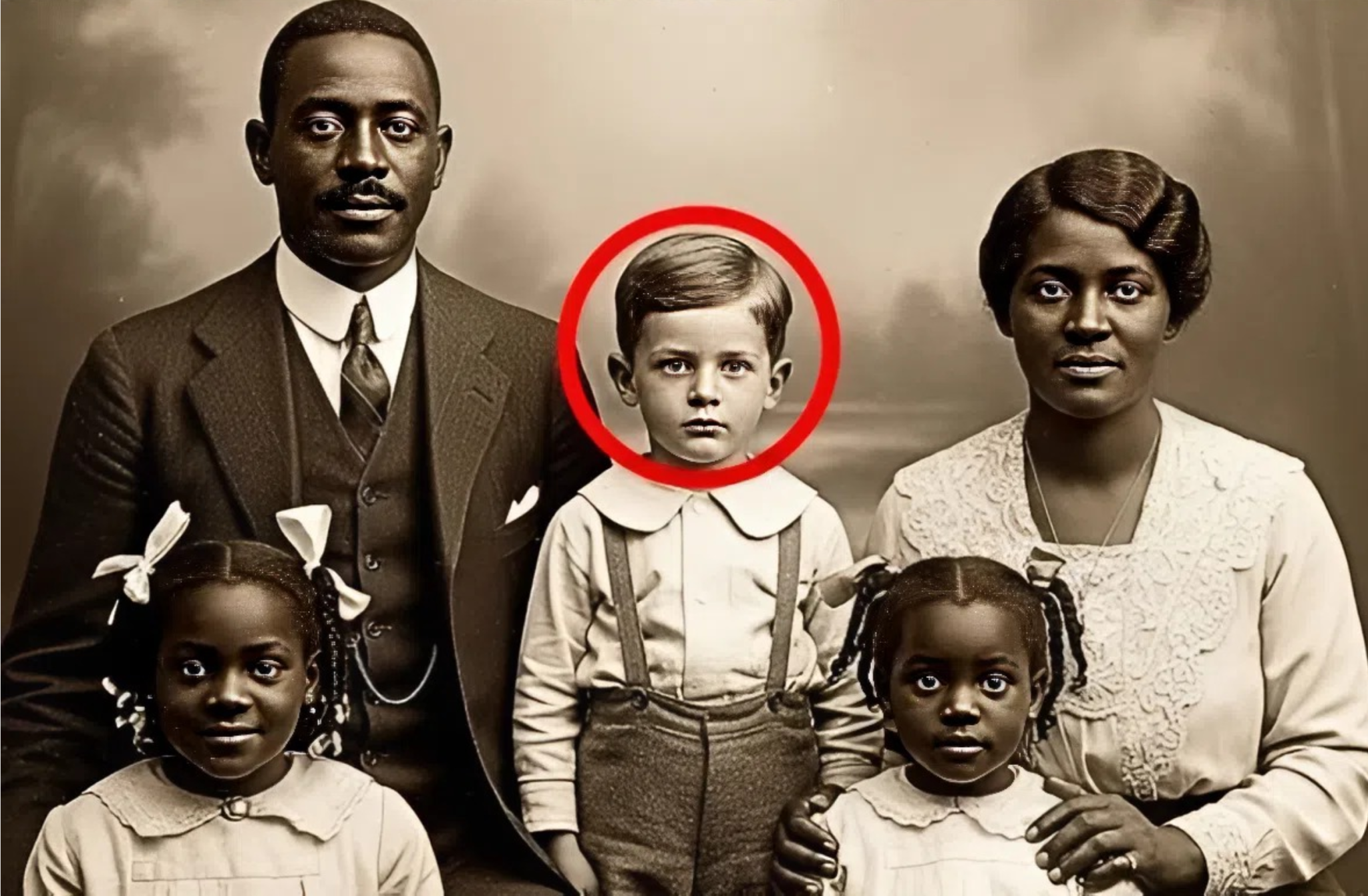
The basement archive of the Greenwood County Historical Society smelled of dust, glue, and the faint, sweet scent of decaying paper. Neon lights hummed on the ceiling. Closing time was approaching when James Mitchell, a 38-year-old professional genealogist from Chicago, opened the last box.
A mundane box.
A box labelled ‘miscellaneous personal items, 1918-1925’.
A box that was about to rewrite history.
Inside were crumpled envelopes, scraps of ribbon, fragile letters… and then, carefully wrapped in tissue paper, a photograph, untouched despite a century of dampness.
James felt his breath catch in his throat.
A portrait. Studio quality. Mounted on thick cardboard. Stamped: Crawford Photography, Greenwood, Mississippi — March 1920.
In the centre sat a dignified black couple. The man in an immaculate dark suit had a steady gaze, proud but gentle. The woman in an immaculate dress folded her arms with restrained grace. Two girls, perhaps eight and ten years old, stood on either side of her, their immaculate white dresses neatly tied with ribbons in their braids.
And in the middle, between the girls, stood a boy.
A white boy. Pale skin. Light brown wavy hair. Eyes that, even in sepia, still shone with undeniable clarity.
He stood next to the man—his arm protectively draped over the white child’s shoulder—with a puzzling naturalness, as if he were part of him.
James turned the photograph over. The names were crossed out in pencil: Samuel, Clara, Ruth, Dorothy, and Thomas. 14 March 1920.
Four of the names were plausible. One was impossible.
In 1920, in the segregationist state of Mississippi, a black family proudly photographed with a white child was not just unusual, it was unthinkable. Dangerous. Potentially deadly.
James took the photograph to the archivist, Mrs. Patterson, a woman with silver hair who had devoted half her life to preserving these documents. At the sight of the picture, a flicker passed over her face.
Recognition. Fear. Souvenir.
‘It was Samuel and Clara Johnson,’ she whispered. ‘A respectable family. He was a carpenter. She was a seamstress.’
‘What about the boy?’ James asked.
Mrs. Patterson hesitated. ‘I’ve heard stories. Stories that good people don’t tell anymore. If you want to know the truth, you need to talk to Evelyn Price. She’s ninety-three years old. Her mother was friends with the Johnsons.’
She handed the photograph back to him.
No one had claimed it in seventy years. ‘Perhaps,’ she said, ‘it’s time someone finally did.’
The Lost Child of Greenwood
That evening, in his hotel room, James began looking through census records and land registers. The 1920 census mentioned Samuel and Clara Johnson with their two daughters, Ruth and Dorothy.
But no sons.
No Thomas.
Birth records from 1912 to 1914 yielded nothing relevant.
Then he found this.
Greenwood Commonwealth, 3 February 1920:
“A married couple from this area died in a tragic accident.
Mr Robert Hayes, aged 34, and his wife Margaret, aged 29, died in a fire at their home on 1 February.
They leave behind a six-year-old son.”
Wire. Sixth birthday.
The perfect age.
The perfect time.
And then… nothing. No follow-up articles. No trace of what happened to the child.
James’s research assistant emailed him additional information. The Greenwood County children’s home, where the boy was to be placed, was under investigation for abuse, forced labour and even the disappearance of children.
If Samuel and Clara had taken the boy before the county arrived…
If they had saved him…
The pieces of the puzzle began to fall into place.
James established a timeline:
1 February 1920 — Hayes’ parents die in a fire.
3 February — Newspaper reports the birth of an orphaned son.
14 March — Johnson family portrait with a white boy named Thomas.
Six weeks. Enough time for a desperate and dangerous act of compassion.
He stared at the photograph again.
A white boy, safe between two black girls in Mississippi.
Protected. Loved.
What did they risk by doing this?
And what happened to the child?
James made a promise to himself.
The photograph was donated to the Smithsonian Institution.
Five years later, in 2030, the families gathered again at Mount Zion.
This time, it was a place of joy.
Sarah Hayes, daughter of Thomas Jr., married Marcus Williams III, grandson of Pastor Williams.
White and black families, once divided by the cruel laws of Jim Crow, were now united by love.
During the ceremony, they laid flowers at the portraits of Samuel and Clara.
‘We will give their names to our future children,’ said Sarah. ‘So that they will never be forgotten.’