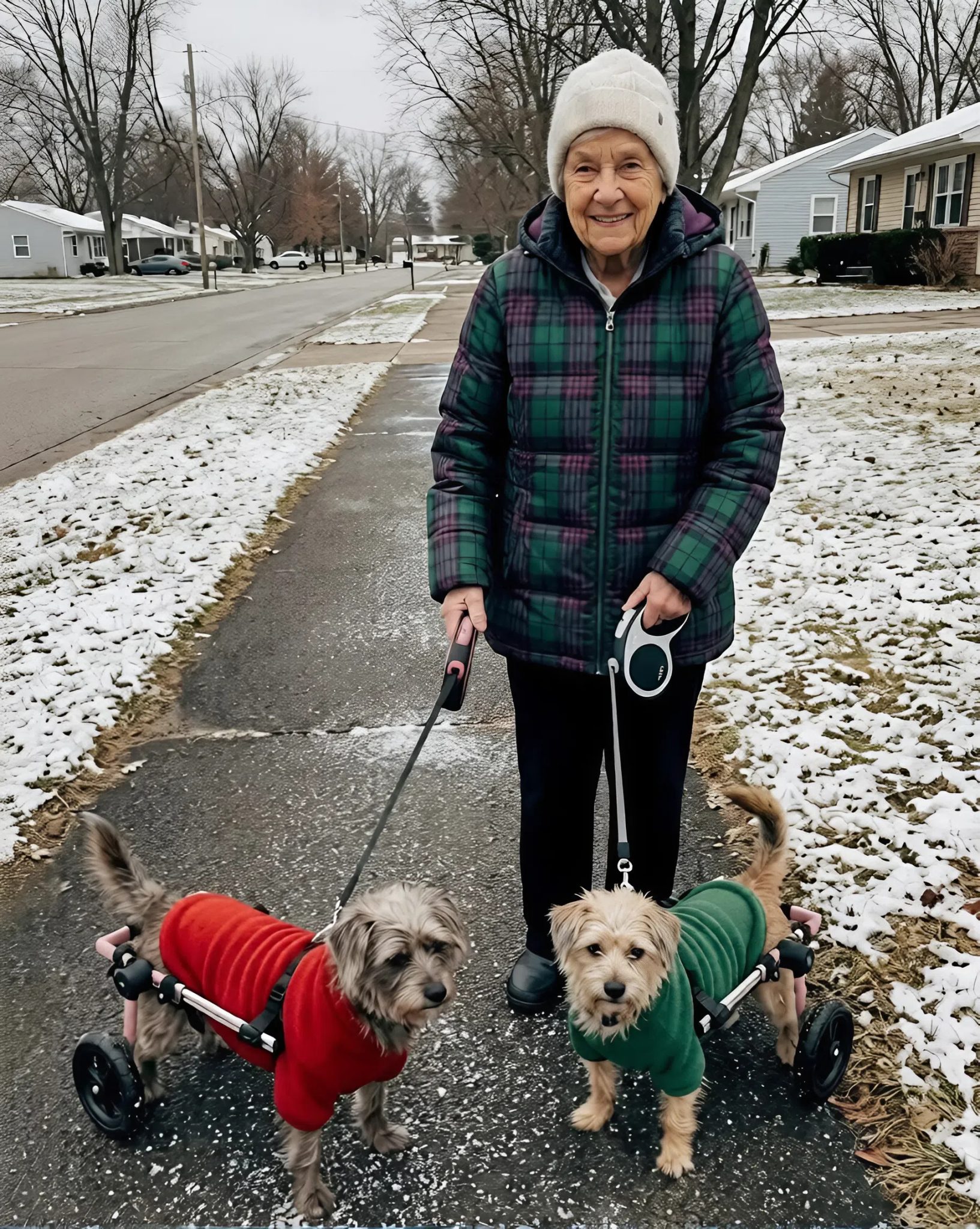
I am 75 years old and was born and raised in Tennessee. My whole life has been spent caring for those who have been left behind or abandoned. I never specifically planned to become a rescuer — it just happened naturally: first a wounded bird’s nest by a stream, then stray cats, and after my husband died, dogs came into my life. Not the puppies that everyone lined up for, but the ones that no one wanted: scared, crippled, abandoned.
That’s how Pearl and Buddy came into my life. Both are small, less than 9 kg, and both cannot use their hind legs. Pearl was hit by a car, and Buddy was born with a problem. The rescue service found them wheelchairs, and that changed everything. They don’t walk, they ‘roll.’ Their wheels click quietly on the pavement, and when they move, it seems as if their bodies are smiling. Their tails wag with pure joy.

When we go for a walk, people usually smile. Children wave and ask questions, adults look closely and reach out to pet them. You can see in their hearts that these dogs have been through a lot — and yet they are full of trust and the will to live.
One day, as usual, we were walking down the street: Pearl was looking into every mailbox, Buddy was rolling around my ankles. Suddenly, Marlene came out of her house — our neighbour three houses down, about 55 years old, always neatly dressed, the one who used to watch everything through her curtains. She looked at Pearl’s wheels with an expression as if she saw something disgusting. And she said loudly, ‘These dogs are disgusting!’
I froze. My hands involuntarily tightened their grip on the reins. Pearl raised her head—a kind, trusting expression—and Buddy stopped and simply spun his wheels. Marlene stepped closer and commanded, “This isn’t a shelter. No one wants to see this. Get rid of them!‘ For a second, I was speechless. But then I remembered my mother’s ’Bless her.‘ I replied calmly, ’Bless you. These dogs saved me, not the other way around.”
She frowned and threatened, ‘Either you get rid of them, or I’ll make sure you do,’ and went back into the house, slamming the door behind her. I felt heavy-hearted, but I decided not to argue. I chose something else: patience with a purpose.

The next day, I began to change the time and route of my walks. I walked earlier, later, at different times, trying to meet neighbours to hear what they knew about Marlene. People who had seen her nitpicking before told me: she complained about my Christmas lights, she called the city about a ramp for her grandson. I didn’t badmouth her, I just listened — that’s how the neighbours themselves began to share their memories.
A few days later, Marlene took the next step: an animal control vehicle pulled up outside our house. A young inspector politely informed us that a complaint had been made about animal welfare and safety in the neighbourhood. I called over a few neighbours, and while the inspector was making his remarks, people began to come out onto the street: Mrs Donnelly and two others. Marlene, who came out with a fake smile, denied the accusations, but the neighbours’ testimonies were straightforward. I talked about how I wake up alone and how these dogs give me a reason to get up, how Pearl has started to trust people again, how Buddy has learned to be happy. Pearl rolled up to the inspector’s boot and wagged her tail — the atmosphere changed.
The inspector said that no violations had been found and politely reminded Marlene that repeated false complaints could be considered harassment. Marlene got angry and left. The next day, a note appeared in my mailbox: ‘We love your dogs. Keep walking them.’ Children who wanted to walk with us followed, neighbours smiled from their porches, and some people began to arrange their schedules so they could meet us.
Mrs. Donnelly suggested doing something nice: ‘For whom?’ I asked. ‘For Pearl and Buddy,’ she replied. That’s how our impromptu ‘parade on wheels’ came about — neighbours gathered on Saturday, some with dogs, some with children, and happily walked around the neighbourhood. Someone rang a bell when Pearl drove by. Marlene watched from behind the curtains, but I didn’t want to look in her direction. At the end of the route, Mrs. Donnelly smiled and said, ‘You did the right thing, old girl.’ I laughed and replied that everyone had done the right thing — the dogs and the people.

In the evening, I sat on the porch with Pearl at my feet and Buddy sleeping nearby. The street sounded different — warmer. I think about how easy it would have been to shut myself off out of fear, but I chose to stand up for what was important. Pearl propped her head up and wagged her tail quietly. Buddy snored in his sleep. For the first time in a long time, it felt like the whole neighbourhood was home, and that Marlene would no longer interfere with our lives.
This story raises the question: what advice would you give to the participants? Share your thoughts in the comments.