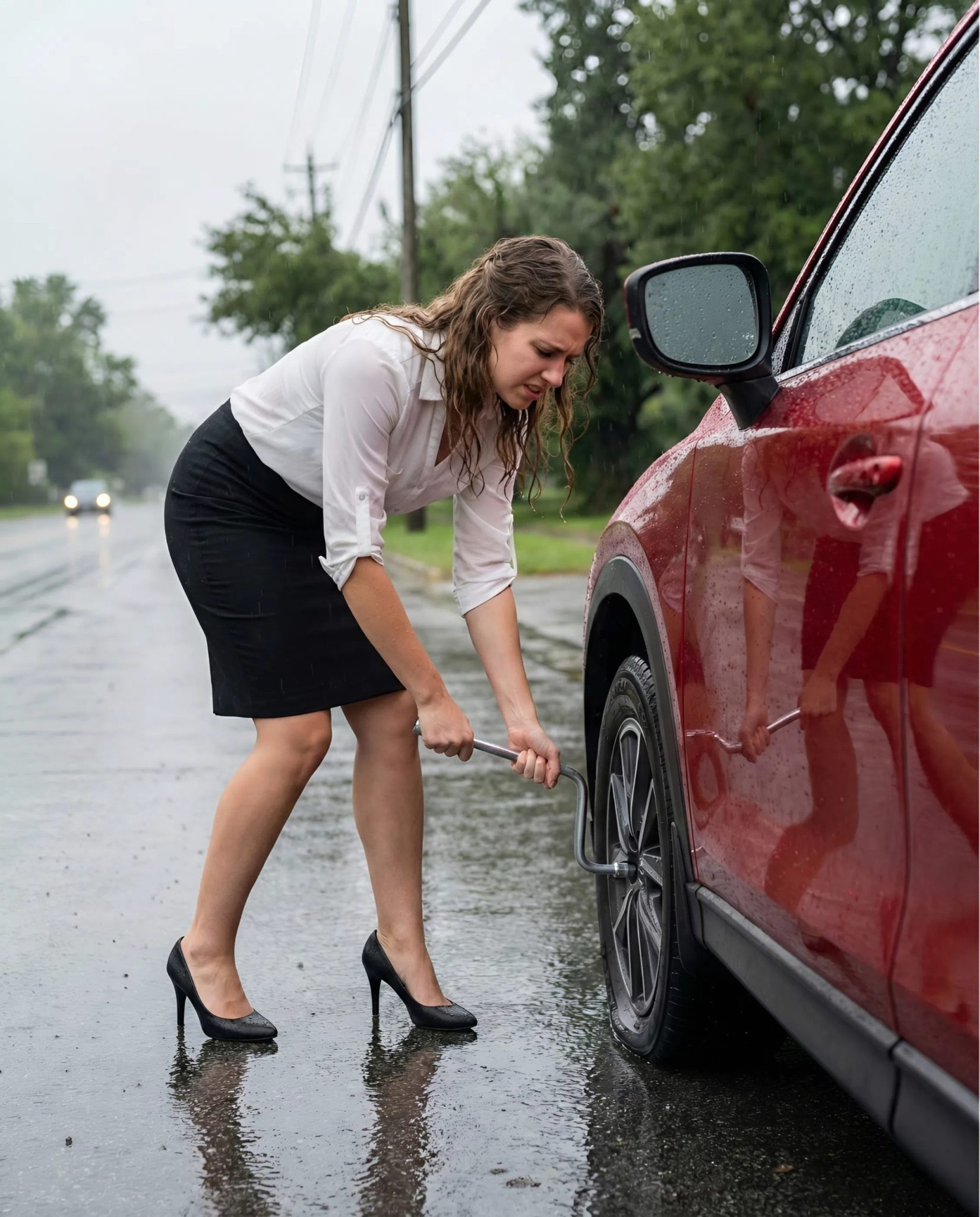
At 6:37 AM, Andrés Herrera turned the key in his apartment door with the same shaky hands that had kept him up all night. His nerves were shredded, his eyelids heavy and swollen, and inside his cheap briefcase lay the only thing holding his life together: a USB drive with a video that could prove his innocence. He had less than an hour to reach the downtown courthouse. One wrong move, one delay, and everything was over.
His beat-up white sedan sputtered and stalled twice before the engine finally caught, trembling like it was as tired of fighting as he was. Out of habit, Andrés crossed himself, then merged into the morning rush, threading through traffic with the frantic focus of someone racing a ticking clock.

Near the industrial district, he spotted her: a woman standing beside a gray sedan with its trunk open, a spare tire on the ground. She looked both furious and stranded, waving her powerless phone in the air as though sheer anger could make it reconnect. Andrés hit the brakes before he even thought it through. Late or not, the urge to help overpowered the fear coiled in his gut.
He rolled his window down. “Do you need help?”
She turned toward him. Dark hair pulled back, neat professional clothes, cool eyes trying to cover her frustration. She looked like the kind of person who usually had control over everything—except, clearly, flat tires at sunrise. “Yes, please. I’m late for something important.”
A line he knew too well. Andrés parked, grabbed his jack and tools, and went to work. She watched him closely, saying little, studying him like she was taking mental notes.
“You in a hurry too?” she asked after a moment.
“Very,” he replied, still focused on the lug nuts.
“First day at a new job,” she said. “Terrible start.”
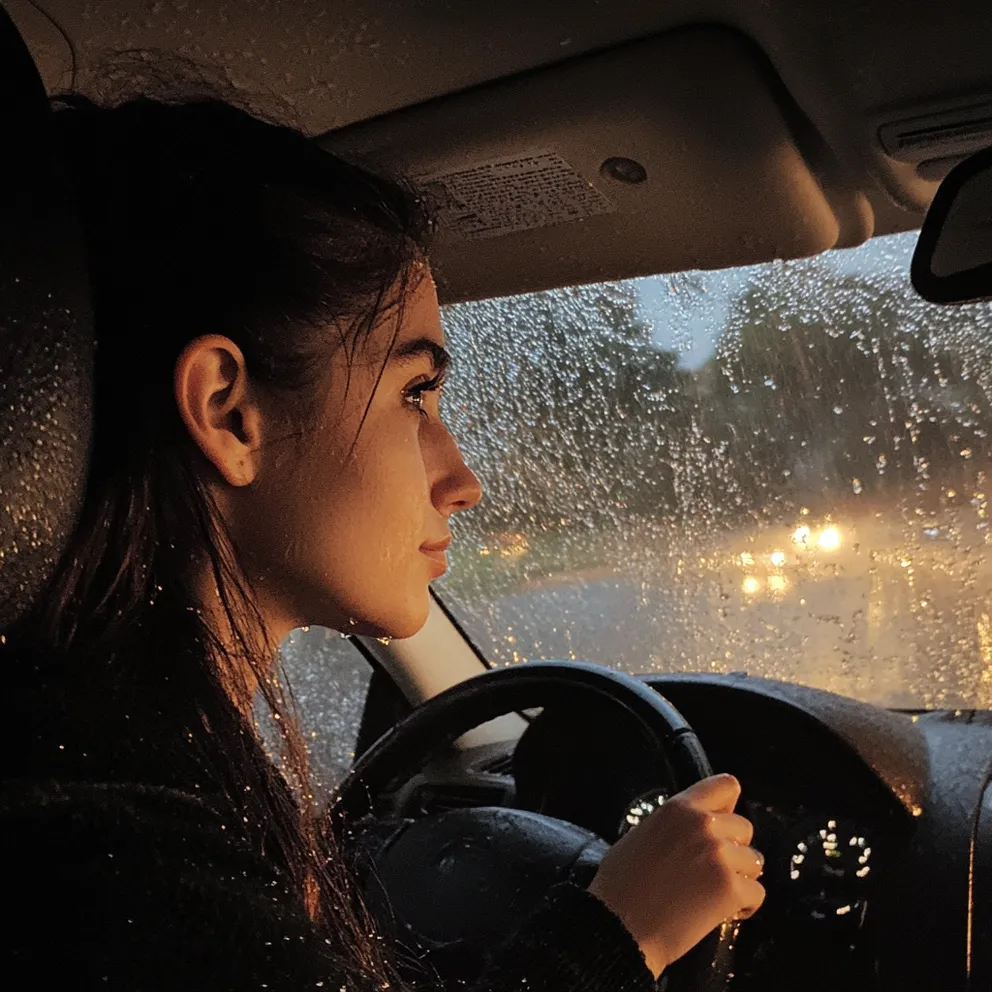
“Maybe it’ll get better from here,” Andrés said quietly as he tightened the last nut.
Ten minutes later, the tire was on. She asked his name. He gave it. She thanked him with a warmth that surprised him, then pulled away into traffic. Andrés never noticed that, in the shuffle, the USB drive from his briefcase had slipped onto the passenger seat of her car.
He reached the courthouse at 7:42, sweat soaking through his shirt. The Fifth Civil Court building loomed like a threat. Inside Courtroom 2B, he spotted the people who’d been dismantling his life for weeks: attorney Salgado, wearing his usual smug expression, and Paula Aguilar, the supervisor who had testified that he stole a company laptop with confidential data.
Then he saw the judge.
The same woman from the side of the road.
Their eyes met. She froze for the briefest instant—not in shock, but in recognition.
The clerk called his name. Andrés stepped forward, heart hammering. The judge’s composure snapped back into place at once; her voice turned crisp and formal as she opened the hearing. Salgado launched into his rehearsed accusations, painting Andrés as a thief and manipulator. Paula sat beside him, chin lifted, gaze icy.

“Mr. Herrera,” the judge said, “how do you plead?”
“I’m innocent,” he answered. “And I have video proof that Paula is the one who took the laptop. The evidence is on a USB drive.”
He opened his briefcase.
It was empty.
Cold dread washed through him. He rifled through folders, pockets, cables—nothing. The USB was gone. Salgado’s smirk deepened. Paula folded her arms, confidence radiating off her.
The judge leaned forward. “Mr. Herrera, without that evidence, your allegation carries no weight.”
He tried to explain, but she lifted a hand to stop him. “This court will take a recess. Locate your evidence.”
He staggered out into the hallway, the world blurring around him as he replayed the morning in his mind, minute by minute, until the realization hit hard.
The flat tire.
Her car.
His briefcase, sitting open on her passenger seat.

He ran through the courthouse, pleading with security to let him into the judges’ parking area, insisting he’d left something crucial in a judge’s vehicle. Eventually, a guard relented and led him to a gray Mazda. Andrés’s pulse pounded in his ears as he opened the passenger door and reached under the seat. His fingers brushed plastic.
The USB drive.
Back in the courtroom, he handed it over to the technician. The video appeared on the screen: Paula entering the office after hours, empty-handed. A few minutes later, she exited carrying a large bag. The timestamp matched perfectly with the night the laptop disappeared.
Silence fell.
Salgado scrambled to object, but the judge cut him off immediately.
“We will verify the authenticity of this video,” she said coolly. “This hearing is not concluded.”
The session adjourned. For the first time in weeks, Andrés felt like he could breathe.
Outside the courthouse, Salgado intercepted him, Paula at his side. The lawyer held a manila envelope.

“Twenty thousand pesos,” he said quietly. “Tomorrow, you plead guilty to a lesser offense. No prison. This all goes away.”