The bell rang, signaling the end of recess at Oakwood Elementary School, its familiar tone marking the end of lunch. I, Rebecca Collins, stood at my classroom door, watching my second graders slowly return, bringing with them the faint scent of chocolate milk and peanut butter sandwiches.
Nineteen, twenty, twenty-one…
One missing.
Lily Parker.
Again.

I glanced at my watch. For the third time this week. The last two times, I found her in the library, where she claimed to have lost track of time while reading. But the librarian told me she hadn’t been there yesterday.
“Katie, could you lead the class in silent reading while I step out?” I asked my assistant, a serious little girl with tortoiseshell glasses.
“Yes, Miss Collins!” she replied, beaming with joy at the responsibility.
I stepped out into the hallway, my dark blue ballet flats clicking softly on the waxed linoleum. The October chill seeped through the old school windows, and I pulled my sweater tighter around me. Three years of widowhood had made me hypersensitive to absence—to the feeling that someone or something should be there but isn’t.
Something was wrong with Lily.
I checked the girls’ restrooms, the water fountains, and then headed for the cafeteria. The cooks were already mopping the floor.
“Marjorie, have you seen Lily Parker? She has dark hair and a purple backpack,” I asked.
“The quiet one with the big eyes?” she replied. “I haven’t seen her since lunch started. Come to think of it, she doesn’t eat much. She takes a tray, but she just tosses it around.”

I felt guilty. I noticed that she was just pushing her food around instead of eating it. I thought it was typical for children—upheaval at home, a new baby, maybe arguments between her parents.
The playground outside was almost empty. I looked at the swings, the climbing frames, the asphalt. No sign of Lily. I was about to give up when a purple flash caught my eye—the corner of a backpack sliding down the side of the building toward the small forest behind the school.
My heart started racing. Students weren’t allowed to go there alone.
I ran across the asphalt, torn between fear of overreacting and a heavy feeling in my stomach. Lily had always been one of my brightest students: focused, kind, willing to please – until recently.
I slowed down when I reached the trees, not wanting to scare her. About fifty meters ahead of me, I saw her—Lily, with her purple backpack bouncing as she walked along the narrow forest path between the maple trees. I hesitated. Following a student off school grounds without telling anyone wasn’t in the handbook. Neither was letting a seven-year-old wander through the woods alone.
I quickly texted the school secretary:
Checking on Lily Parker after school. Will be back in 10 minutes.
Then I followed her—keeping far enough away that she wouldn’t notice me, but close enough that I wouldn’t lose sight of her purple backpack. The woods weren’t dense, just a buffer between the school and the neighboring neighborhood, but dense enough that the building soon disappeared behind the trees.
Lily stopped by a large oak tree, looked around, then knelt down and unzipped her backpack. I hid behind the tree trunk and felt strangely like a spy.
She took out her lunch box and carefully opened it. Inside was the same lunch I had seen her pack and which she hadn’t eaten: a sandwich, an apple, carrots, pudding. My heart sank. Hadn’t she eaten at school?
She closed the box, put it in her front pocket, and continued on her way.
I followed her. The trees parted to reveal a small clearing by a narrow stream. The sight stopped me in my tracks.
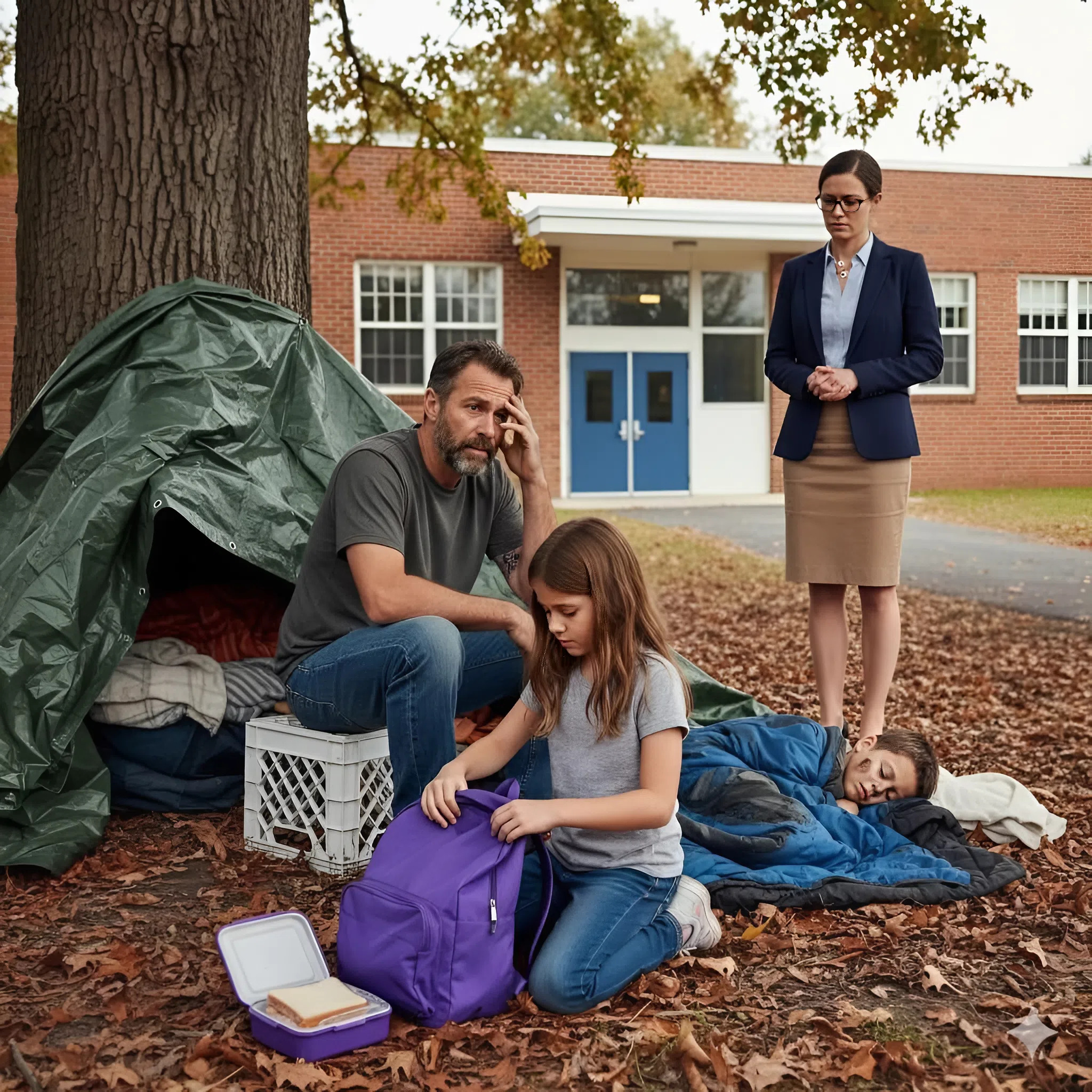
There was a makeshift shelter by the bank—tarps, an old tent, pieces of wood. A man sat hunched over on an overturned milk crate, his head in his hands. Next to him, a little boy—about four years old—was sleeping on a worn sleeping bag, his face red as a lobster.
“Daddy?” Lily called. “I brought lunch. Is Noah feeling better?”
The man looked up, and I noticed the dark circles under his eyes, the stubble on his cheeks, and an exhaustion that ran deeper than just a lack of sleep. His posture and features suggested that he hadn’t always lived like this.
“Hi, sweetheart,” he said in a hoarse voice. “He still has a fever. I’m running out of Tylenol.”
Lily knelt beside him and unzipped her backpack. “I brought lunch. And they had chocolate pudding today!” she said, proudly handing it to him.
His face twisted for a moment, but then relaxed. “That’s great, sweetie. But you should eat it. You need to eat to have energy for school.”
“I’m not hungry,” she insisted. “Noah likes pudding. Maybe it will help.”
“Lily,” he said gently. “You haven’t been hungry for two weeks.”
I stepped forward, leaves crunching under my shoes.
“Lily?”
She turned and paled. The man quickly got up and stood between me and the sleeping boy.