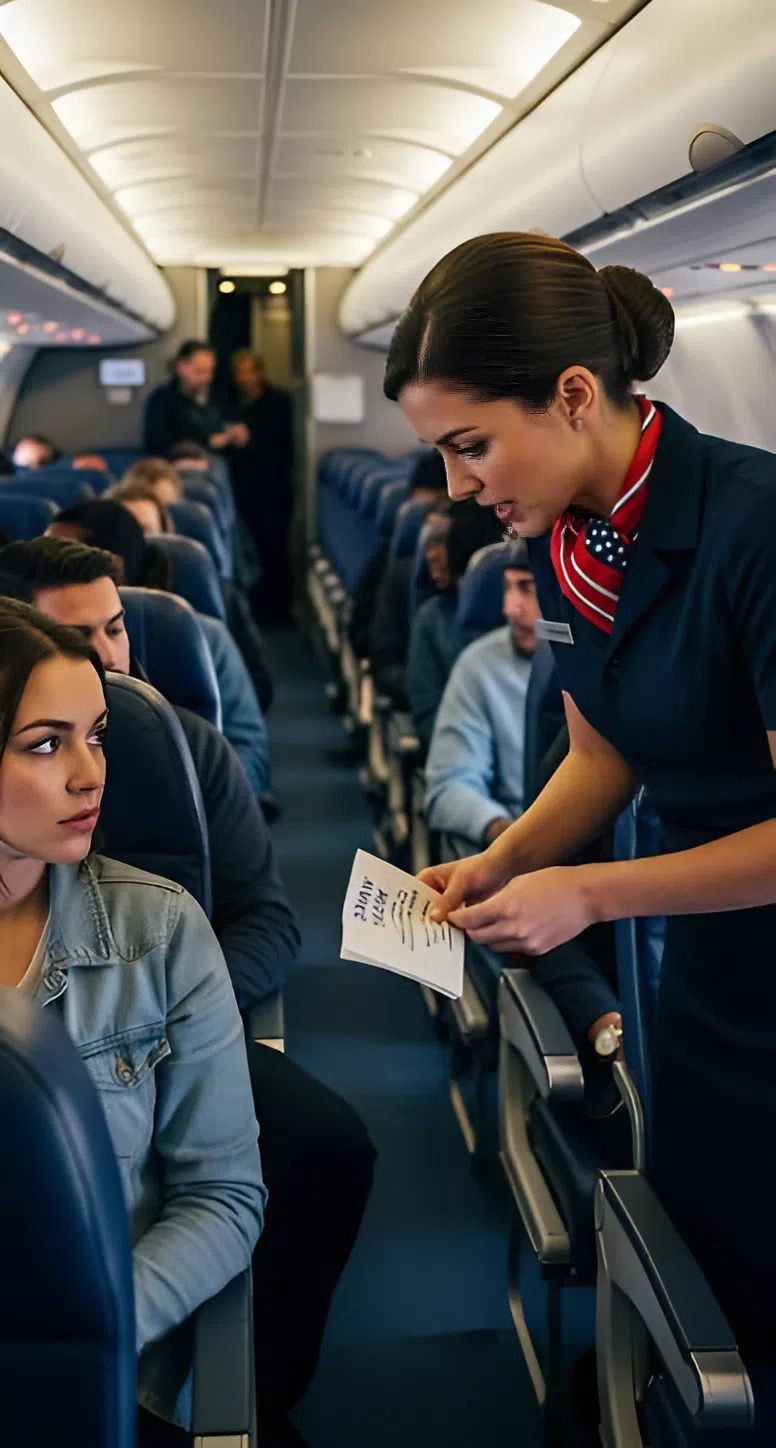
My flight attendant slipped me a napkin: ‘Pretend you’re sick. Get off this plane.’ I ignored her — she came back: ‘Please. I beg you.’ Two hours later…

The stewardess placed a napkin on my folding table.

Her hands were shaking. In hasty, uneven handwriting, it said:
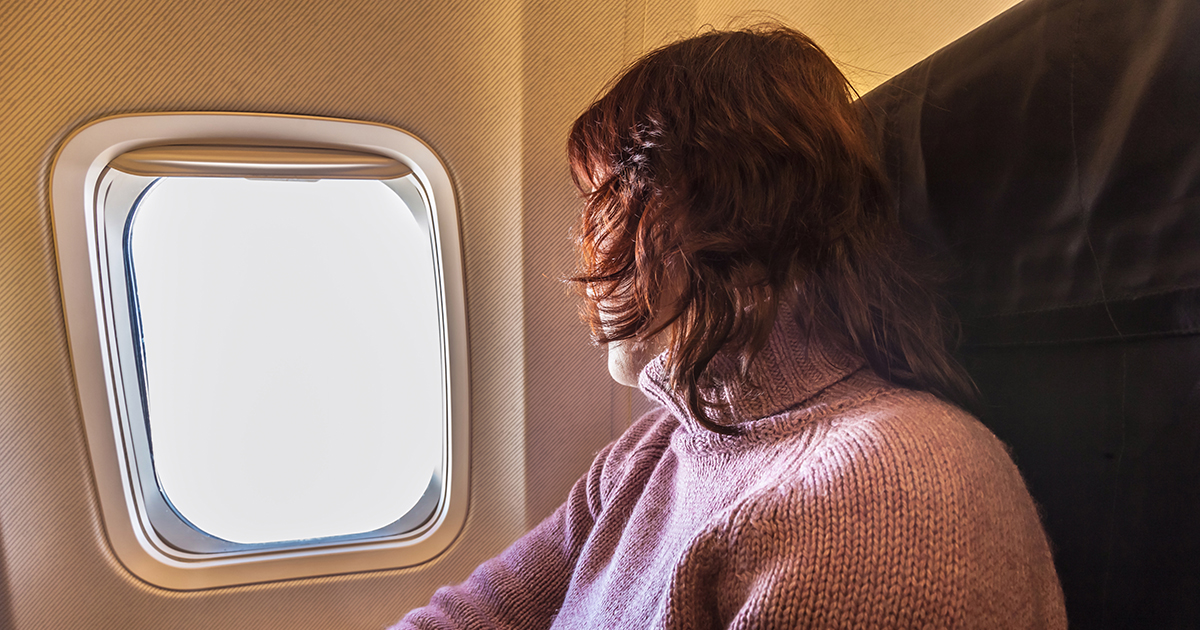
‘Pretend you’re sick. Get off this plane immediately.’

I looked at her in shock. There was panic in her eyes.

It wasn’t irritation, it wasn’t confusion. It was pure fear.

She leaned towards me and whispered:

‘Please. I beg you.’

At that moment, I didn’t know if it was a joke, a mistake, or something much more serious.

But what happened two hours later proved one thing:

her warning wasn’t just real… it was the reason I’m still alive.

My name is Isela Warren.

I’m 30 years old and I work as a visiting nurse.

I’ve seen enough human suffering to last a lifetime.

I’ve held patients’ hands as they took their last breath and comforted families in hospital corridors.

After months of non-stop work, I decided to take a break and surprise my mother with a visit to Boston.

She had just recovered from heart surgery, and I couldn’t wait to see her face when I showed up unannounced.

It was a typical day at LAX.
People were laughing, children were pressing their faces against the terminal windows, and business travellers were tapping away at their laptops.

I felt tired but calm.

As I boarded the plane, I noticed that the flight attendants greeted passengers with rehearsed, forced smiles.

But one of them, with a badge that read ‘Alyssa,’ was different from the rest. She wasn’t just polite—she was observant. Her eyes scanned everyone who entered the salon, as if she were memorising their faces.

When our eyes met, she froze for half a second — as if she recognised me — and then quickly looked away.

My seat was in the middle of the cabin, by the aisle. A man in a black jacket was sitting in front of me, visibly nervous.

He opened the overhead compartment twice, even though he hadn’t put anything in it.

Next to him, a teenager was clutching a backpack to his chest.

Nothing looked obviously suspicious, but the atmosphere was not what it usually was.

There was a barely perceptible tension in the air, like a quiet storm approaching.

I texted my sister, Chloe:
“I’m on the plane now. Mum has no idea I’m flying.

Get ready to film her reaction.”

She replied with heart emojis.

Everything seemed normal enough as I fastened my seatbelt.

But then I saw Alissa again.

She was walking slowly down the aisle, pretending to check the overhead bins, but her gaze wasn’t on the suitcases.

She was looking at people. She was afraid of someone… but I didn’t know who.

When she reached my row, she leaned over as if to put a napkin on my tray table.

She didn’t meet my gaze. Then she just walked on.

I unfolded the napkin.

You’re not safe.

Pretend you’re sick. Get off this plane immediately.

My mind went blank.

A joke?
A social experiment?

But when I turned around, Alyssa was standing at the end of the aisle.

She slowly turned and stared straight at me.

There was no trace of a smile on her face. Only desperate urgency. My pulse quickened.

The napkin lay on my lap like a time bomb.

My instincts were screaming, but logic held me back.

I glanced at Alyssa — she was standing by the kitchen, tense.

I tried to convince myself that I was overreacting.

Maybe she had just confused the passenger.

But then she turned around again.

For just a second, our eyes met again, and I saw something that destroyed all my excuses: pure, undisguised horror.

It wasn’t the face of someone who was pretending.

It was the face of someone desperately trying to save someone’s life.

I glanced around the cabin. The man in the grey hoodie sat frozen, his fingers clenched around the armrests.
Across the aisle, a woman in a business suit tapped her foot nervously, her eyes fixed on the front of the cabin.

But what really got to me was the man in the black jacket by the emergency exit.

He didn’t look nervous; he was too calm.

His gaze shifted from the cockpit to Alice, as if he were waiting for some kind of signal.

Then I noticed something that sent a chill down my spine.

The overhead bins in first class were secured with yellow straps.

I had only seen this once before — in a training video about safety risks on board.

My experience as a nurse taught me to read situations quickly.

Something was wrong.

My experience as a nurse taught me to read situations quickly.

Something was wrong.

Before I could process it, Alyssa stepped towards me, pretending to check my seatbelt.

She leaned in, her voice barely audible:
“Do it now. Tell them you’re feeling sick, that you’re dizzy.

If you stay on this flight, you won’t make it alive.”

I wanted to ask questions, but the look on her face wouldn’t let me.

It wasn’t fear for herself. It was fear for me.

Goosebumps ran down my body as adrenaline rushed through my veins.

I slowly reached for the flight attendant call button.

But I hesitated. If all this was true, what if drawing attention would only make things worse?

My fingers had already touched the button when a loud bang came from the back of the plane.

All heads turned at once. One of the stewards ran towards the sound.

Behind him, the teenager with the backpack was breathing heavily, repeating:

‘I can’t, I can’t do it…’

Suddenly, the sound of the engines changed.

We were taxiing onto the runway and starting to accelerate. My heart was pounding as if it wanted to burst out of my chest.

Once we were in the air, any chance of getting out safely would be gone.

My phone vibrated. A message from my sister.

‘Send me a photo from the plane.’

A sharp pain pierced me. She didn’t know anything.

I quickly wrote:

‘Something’s wrong. Pray for me.’

Send.

The plane turned towards the runway. A real, physical nausea came over me, caused by fear.

My vision blurred slightly. Doing nothing was the most dangerous decision.

I unbuckled my seatbelt and stood up, trembling. Several passengers looked at me irritably.

When I stepped into the aisle, a man in a black jacket slowly turned his head.

His eyes were cold and appraising, like a predator that had noticed an unexpected movement.

At that moment, Alyssa appeared beside me, placing her strong hand on my forearm.

Her voice sounded calm on the surface, but her words were chilling.

‘Come with me if you want to live.’

Alyssa held my hand as if she were supporting a sick passenger, but there was too much intention in her grip.

The man in the black jacket narrowed his eyes suspiciously and stood up, pretending to stretch.

Alyssa led me down the aisle.

‘Breathe deeper, ma’am. I’ll bring you some water,’ she said loudly enough for others to hear.

When we reached the front kitchen, she leaned closer.

“Don’t turn around. You’re being watched.

Your seat wasn’t chosen at random.

My chest tightened as she sat me down in the crew recliner. Her lips barely moved as she continued:

“The person who chose this seat thinks you’re someone else.

If you stay on this flight or return to your seat, they will act as soon as we reach cruising altitude.”

My thoughts raced. Mistaken identity?

Alyssa contacted the cockpit and requested an emergency return to the gate due to a ‘medical complication.’

There was clear hesitation in the captain’s voice. And then I saw it:

Alyssa looked over my shoulder, past the curtain, and stared at someone specific.

Her face became hard.

The captain announced a short delay and that we were returning to the gate.

The atmosphere changed instantly. The passengers began to buzz and loudly express their indignation.

But beneath the noise, I could almost feel the panic of some people whose plans were falling apart.

The man in the black jacket stood up, no longer trying to hide anything.

He looked at the cockpit, then at me, then at the sealed luggage compartments.

The teenager clutched his backpack even tighter.

The woman in the suit took out her phone and began typing frantically.

Alyssa stood between them and me, blocking their view.

‘Decide now,’ she whispered with a perfect professional smile.

“If you get off this plane, your life will change forever.

But if you stay, you won’t get a second chance to walk away alive.

I thought of my mother waiting for me in Boston.

Of my sister. If Alyssa was right, I would never see them again.

The plane was already turning back, but we were still moving.

If the danger was really that great, they might try to act before we reached the gate.

Suddenly, the teenager jumped up, white as a sheet.

‘I want to get off!’

Please!” he cried desperately.

Before we could do anything, the man in the black jacket opened his briefcase.

Alyssa stepped forward.

‘Sir, please sit down!’

He froze. But not because of her.

He froze when he saw the cockpit door open and two uniformed air marshals walk down the aisle from first class.

It was much more serious than I had thought.

This wasn’t just a flight attendant acting alone.

This was an active federal operation, and somehow I was at the centre of it.

As the agents approached, Alyssa looked at me; her voice was soft but firm:

‘You were never the target. But now you are the key.’

My breath caught in my throat. This was the point of no return.

I nodded once.

‘I want to get off the plane,’ I said loudly.

That phrase was my choice. Alyssa exhaled and signalled to the marshals. I had made my decision.

The plane had barely come to a stop when everything exploded into chaos.

The agents rushed towards the man in the black jacket.

He stood up, not at all surprised. His hand slid under his jacket.

‘Federal agent! Don’t move!’ one of them shouted. The man froze.

But that was only the first detonator.

The second man, sitting by the emergency exit, lunged for the lever.

Screams rang out in the cabin. One of the flight attendants tried to stop him and was roughly pushed away.

The teenager shouted in despair:

‘Don’t open it! It’s not what you think!’

As if he knew exactly what was about to happen.

The woman in the suit tried to run forward, but another marshal stopped her.

‘You don’t understand! It’s about to activate!’

Activate?

I saw Alissa grab the intercom.

“Stay in your seats.

Do not touch the overhead luggage compartments.

One of the agents opened a specific compartment.

Right above the seat… the very one that had been assigned to me: 14C.

There was no luggage inside.

There was a sealed device with wires, about the size of a lunchbox.

And a flashing light.

There was complete silence.

The man in the black jacket smiled.

The agents acted swiftly. One pinned him down and handcuffed him.

The second examined the device without touching it.

The teenager cried:

“This flight wasn’t even supposed to happen today.

They changed the target. They changed the plane.”

He wasn’t an accomplice. He was a victim or a forced witness.

The captain came out of the cockpit, deathly pale.

‘Is it active?’ he asked.

Alyssa nodded.

Then she turned to me.

‘The bomb was under seat 14C. Under your seat.’

My breathing became ragged. I had changed flights that same morning.

My seat had been changed too. It wasn’t a coincidence. It was an interception.

The evacuation began. A woman in a suit shouted:

‘They’re activating it from the ground!’

The horror grew.

When it was my turn, Alyssa put her hand on my shoulder.

‘It was never about you,’ she said.

“They thought a federal informant would be sitting there.

Someone with important documents. This flight was marked.

You took his place.

On the jet bridge, I saw armed agents running toward the terminal.

Screams at the gate. Chaos.

A teenager being led away looked at me through tears.

They said that no one would find out… that only the target would die.

It wasn’t a random terrorist attack. It was a carefully disguised assassination.

And I almost became the wrong person in the wrong place.

When we entered the terminal, my phone screen lit up. Messages, missed calls, notifications.

There was a voicemail from an unknown number. Shaking, I pressed ‘play.’

A distorted voice said:

‘We know you got off the plane. This isn’t over yet.’

An agent approached me.

He explained the scope of the operation.

The suspects belonged to a dangerous internal organisation.

They were trying to eliminate the whistleblower. My seat was the target.

A few hours later, in a separate room, I saw Alissa again.

It turned out she was an undercover federal agent.

That napkin was the first signal that saved dozens of lives.

When our eyes met, I burst into tears.

‘I want you to know something,’ she said, putting her hand on my shoulder.

“You should never have been in danger.

But when I saw your eyes, I knew you were strong enough to hear the truth.

I gave hours of testimony. The teenager had been forced to participate.

The woman in the suit was an undercover agent. Several agencies were involved in the operation.

My reaction changed the course of the entire operation.

That night, when I was placed under federal protection, I couldn’t sleep.

My family cried on the phone. So did I.

I was minutes away from becoming tragic news.

But instead of feeling weak, I felt something unexpected: meaning.

In the days that followed, I helped expose the entire network.

My story never became fully known. But it changed me.

I promised myself I would never ignore my instincts again.

Someone’s life may depend on a decision you never imagined you would have to make.

You may never receive a napkin with a warning.

But if you ever feel that something is wrong…

If everything inside you tells you that something is not right…

Listen to it.

It’s not paranoia.

It’s protection.

Rate this article
My flight attendant slipped me a napkin: ‘Pretend you’re sick. Get off this plane.’ I ignored her — she came back: ‘Please. I beg you.’ Two hours later…
‘Blonde copy of Grandpa Elvis.’ Presley’s 80-year-old widow showed off the 17-year-old granddaughters of the King of Rock and Roll.