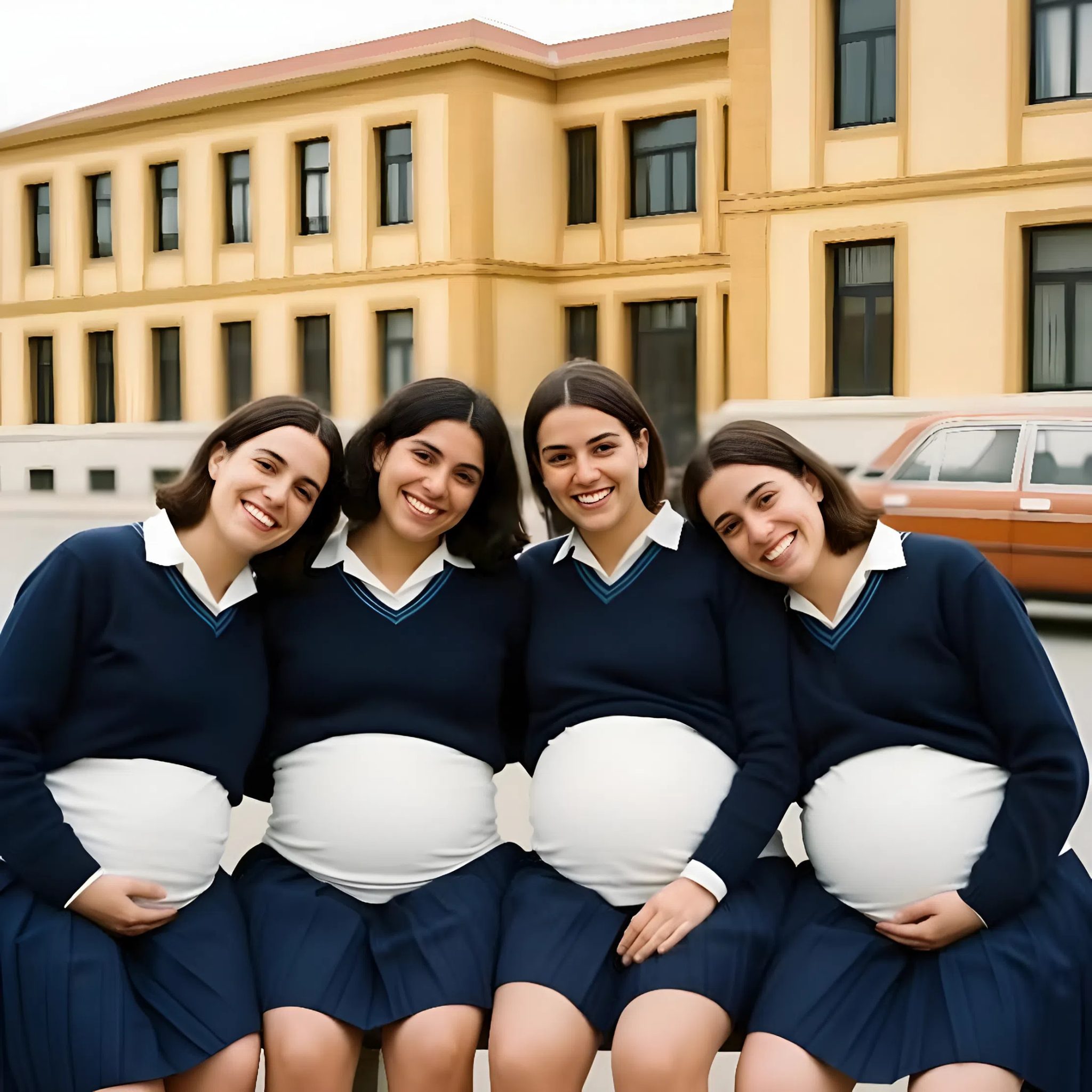
In 1991, the Alto del Prado state school, located on the outskirts of Santander, was an ordinary place: a grey building, tired teachers and teenagers eager to leave school as soon as possible. Nothing foreshadowed that this school year would become memorable for the entire community. But soon, tragic news broke: four students from the same class, Nerea Salvaterra, Clara Busto, Marisa Ceballos, and Julia Arcona, all aged 16, found themselves in a predicament.
Rumours of the incident spread rapidly. Families, bewildered and ashamed, tried to keep quiet, while teachers did not dare to comment on the situation. People’s imaginations ran wild: thoughts of a conspiracy between the girls, a shared father, or a joke that got out of hand. But no one could have prepared for what followed. One April morning, Nerea did not come to class, and a little later Clara disappeared, then Marisa, and finally Julia. Each of them vanished without a trace, as if they had dissolved into thin air.

The police reports generated by the investigations offered little hope: interrogations, searches in the surrounding forests, and road checks yielded no results. There were no traces. The regional press, full of sensational headlines, was ultimately forced to stop following the case due to a lack of substantial evidence. The school lost students, its corridors became quiet, and the community was plunged into confusion and fear. Over time, the memory of the four missing students became a kind of taboo.
Thirty years passed, and in 2021, the school, although undergoing some renovation, continued to function. The current caretaker, Eusebio Santina, was one of the few who had worked there since the nineties. He had a secretive nature and a unique memory. One day in October, while checking one of the old storage rooms slated for demolition, he discovered that the old ventilation grille was loose. Underneath it, he noticed a hole in the wall: narrow and deep, covered with a layer of dust. Inside was a damp folder wrapped in a transparent plastic file from the nineties.
When he began to examine it, he was overcome with anxiety and confusion. Inside were photographs of four girls mixed with plans, timetables, lists of names and, finally, a handwritten note dated March 1991. The handwriting was unclear, and the signature was Julia Archona.

Eusebio, with cold hands and a racing heart, realised that he could not ignore this. He had unwittingly become the keeper of a secret. Now, several decades later, he had to take a decisive step.
‘I have to show this to someone,’ he whispered.
But first, he wanted to read what Julia had written.
What he discovered would forever change the official version of events…
The note was handwritten in faded blue ink. Some of the words were smudged due to dampness, but the main meaning remained clear. Eusebio sat down on a bench in the corridor, trying to pull himself together to take in the meaning of the words.
‘If anyone finds this, please don’t judge us. We had no other choice.’
Julia began by explaining how she and her friends had not planned anything drastic at first. Each of them was going through their own personal crisis caused by pregnancy: fear, confusion, uncertainty. Surprisingly, she noted, all four found out about their pregnancies at the same time. None of them were in serious relationships, and none of them wanted to admit who the father was. But they all agreed on one thing: they had confided in the same person.
That name was highlighted in the letter and appeared at least several times in the notes in the folder: Alfonso Mera, a temporary history teacher who had been invited to work only for that school year and who was described by the students as ‘charming,’ ‘young,’ and ‘overly intimate.’
According to Julia, Mera manipulated each of the girls in his own way. He pretended to be Nerea’s best friend, Clara’s protector, Marisa’s academic mentor, and Julia’s understanding confidant. In other words, he acted as a predator, masquerading as a caring teacher.
Julia went on to describe how, when the girls began to suspect him of repeatedly abusing his authority, they decided to confront him. But Mera reacted coldly and manipulatively: he made them believe that they had no one on their side, that he had connections, that he would be able to deny everything, and that the girls would forever be labelled ‘false witnesses.’ He offered them an alternative: a temporary move to a country house, which he assured them belonged to his family, where they could ‘live through their pregnancies in the most comfortable way possible.’
As the girls waited, listening to their inner feelings, none of them wanted to turn on their parents, and they all felt an unnatural fear. So, in the end, they agreed.
On 14 March 1991, after school, Mera drove them in pairs to an abandoned house near Picos de Europa. Julia wrote that at first it seemed like a peaceful refuge. However, they soon realised that it was not a refuge, but a trap. The doors were locked from the outside, there was no telephone connection, and Mera visited them every few days, leaving food and repeating that