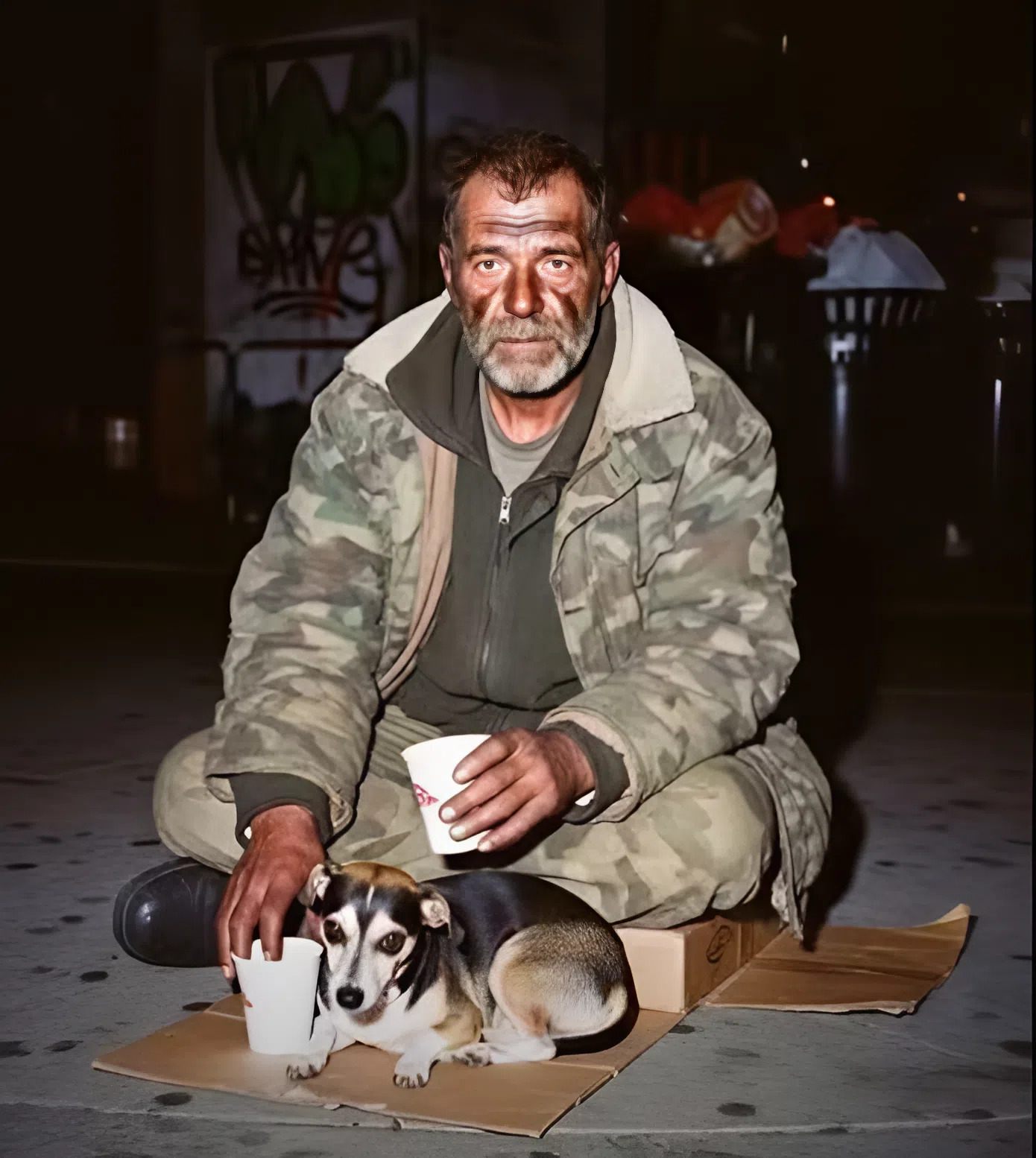
I had been living on the streets with my dog, Dibs, for almost four years. He was more than just a companion—he was the last living connection to my brother, who placed him in my arms before succumbing to an overdose. In that time, Dibs became my anchor, my reason to get up every day, and my only real family. Around town, people knew us. Some offered snacks or a kind word, while others looked right through us as if we were invisible. That was fine. I didn’t need attention. I just needed to keep Dibs safe.
Last winter tested us harder than any before. The cold was merciless, seeping through layers of clothes and blankets as if they weren’t even there. I woke up one morning with ice in my hair and Dibs pressed against me, trembling. That day, a shelter van pulled up. The driver leaned out and offered me a cot and a hot meal. Then came the catch: “No pets.” It wasn’t even presented as negotiable. For me, it was. Dibs and I were a package deal, and I told him no. The van drove away, leaving us in the snow.
Later, a woman in a polished coat approached me near the bridge where I camped. She spoke quickly, smiled often, and introduced herself as working for a “placement organization.” She explained that she could board Dibs free of charge while I got back on my feet. She promised warmth, food, and daily walks. She slid a clipboard toward me and waited for my signature. I hesitated, but then she pressed: “You want him to freeze out here?” Against my instincts, I signed.
That decision has haunted me ever since.
Within five days, the number she gave me was disconnected. The address she listed didn’t exist. The supposed boarding facility was nowhere to be found. Dibs had vanished. I reported what happened to outreach vans, to a police officer who dismissed me, and even to a local librarian who went out of her way to search. No one could trace him. For eleven long weeks, I slept in fits, my stomach tied in knots, my mind stuck replaying the moment I handed him over.
Then, one night, I saw a flyer stapled to a telephone pole outside a thrift store. It was a blurry photo, but unmistakable. A golden dog with a small white patch on his chest and a single drooping ear—the way it always hung low, as if listening to secrets whispered by the ground. The name was different, but I knew it was Dibs. The flyer read, “Available for Adoption,” with an address for a rescue called Silver Paws on the other side of town.
I couldn’t sleep that night. Rage and determination fueled me more than food could. The next morning, I started walking. It took six hours, and by the time I reached the gates of Silver Paws, my feet were covered in blisters.
Inside, the facility looked like a boutique hotel for dogs. Gleaming glass, polished steel, smiling faces on the posters. At the front desk, a woman greeted me with a half-smile that was polite but wary. I slid the flyer across the counter. “This dog,” I said. “His name is Dibs. He’s mine.”
She squinted at the paper, then disappeared into the back. When she returned, she wasn’t alone. A man followed her, holding a clipboard like it was both weapon and shield. He introduced himself curtly. “We have no record of a prior owner,” he said.
“I didn’t surrender him,” I replied. “A woman took him. She claimed she worked for an organization and promised to board him. Then she disappeared. I never gave him up.”
The man’s expression softened slightly but remained guarded. “Do you have proof of ownership?” he asked.
Proof. The word hit me like a wall. I had no microchip, no vet bills, no receipts. Dibs’s collar was second-hand. All I had were years of nights under the bridge, mornings waking to his bark, the way he warned me if anyone came too close in the dark. None of that counted on paper.
“I have my word,” I said quietly. “And if you bring him out, he’ll know me.”
The man hesitated. After a moment, he nodded to the woman. “One minute,” he said. “If the dog reacts the way you claim, we’ll talk.”
I was led into a courtyard, my heart hammering. Then I heard the faint jingle of tags, and there he was. Clean, fed, healthier than I’d ever seen him—but still my Dibs.
For a split second, he froze. Then recognition lit up his eyes. He bolted toward me, tail whipping the air, and slammed into my legs so hard I almost fell. He barked, whined, and covered my face in frantic licks. I dropped to my knees, buried my face in his fur, and sobbed.
The woman behind me whispered, stunned. “He’s never acted like that.”

“He’s my family,” I managed to say through tears. “He’s all I’ve got.”
The staff exchanged a look. Finally, the man cleared his throat. “We’ll hold off on the adoption. But you’ll need to provide documentation—something connecting you to him.”
I nodded. “Give me twenty-four hours.”
I didn’t have much, but I had determination. And I had allies.